• Skip to primary navigation
  • Skip to main content
  • Skip to primary sidebar
  • Skip to footer
  • About TronWeekly
  • Write for us
  • Terms and Conditions
  • Privacy Policy
  • Disclaimer
  • Contact
  • All Posts
  • Advertise

TronWeekly

Crypto World News

  • Home
  • Latest News
  • Opinion
    • Education
    • Best TRON Wallets
    • Beginner’s guide to TRON
    • Tron Tokens
    • Market Analysis
  • Industry
    • Tron Exchange
    • Project Review
  • Press Release
  • Bitcoin (BTC)
  • Ripple (XRP)
  • Advertise
  • About TronWeekly
    • The Team
    • Editorial Policy
    • Write for us
    • Privacy Policy
    • Disclaimer
    • Terms and Conditions
    • Contact
You are here: Home / All Posts

All Posts

Circle CCTP Launch on Stellar Boosts Cross-Chain USDC Transfers

By Tina Fatima | Edited By Ammar Raza,May 20, 2026, 3:30 PM

Circle has launched Circle CCTP on the Stellar network, enabling seamless native USDC transfers across 23 supported blockchains. The integration improves interoperability, strengthens liquidity access, removes reliance on wrapped assets, and allows developers to build programmable cross-chain payment and DeFi applications directly on Stellar.

Circle CCTP Expands Stellar Connectivity

Circle has officially launched its Cross-Chain Transfer Protocol on the Stellar network, marking a major step for USDC interoperability.

The integration allows users to move natively issued USDC between Stellar and 23 supported blockchains through seamless cross-chain transfers.

The launch of Circle CCTP improves connectivity between Stellar and major blockchain ecosystems, including Ethereum, Solana, and Base.
Circle CCTP launches on Stellar
Source: @StellarOrg

Wallets, applications, and payment services using USDC can now interact more efficiently with Stellar’s ecosystem.

The upgrade also removes several long-standing barriers to cross-chain liquidity movement. Previously, users often depended on third-party bridges or Circle Mint accounts to transfer liquidity across networks.

Circle CCTP changes this process by enabling direct movement of native USDC across supported chains.

Also Read: XRP Breakout Prediction: Is a $15 Run Really Coming?

Native USDC Transfers Improve Liquidity

Circle CCTP introduces a burn-and-mint mechanism that removes the need for wrapped USDC assets. Instead of locking tokens in custodial bridges, native USDC is burned on the source chain and minted on the destination chain.

This process improves transaction security and lowers risks linked to bridge vulnerabilities. The protocol also supports faster settlement times for cross-chain transactions.

Businesses and users can move liquidity between ecosystems within seconds, helping exchanges and decentralized finance platforms operate more efficiently.

Unified liquidity on supported chains might result in increased market participation by trading platforms and lending protocols.

DeXes will have more options when it comes to price, while CEXs will be able to optimize liquidity pools without having to deal with any significant delays. This integration furthers the payment-forward architecture of Stellar.

The network is capable of handling cheap and quick transactions, and with the activation of the Circle CCTP, other blockchains will be able to join the Stellar global payment rails, which include over 475,000 locations of MoneyGram.

Developers Gain Cross-Chain Flexibility

The new protocol introduces additional programmable features for developers working with Stellar. Developers can incorporate cross-chain USDC swaps directly into their applications without having to develop their own liquidity pools for different blockchains.

With Circle CCTP, developers can create programmable cross-chain transactions through embedded metadata and execution using Hooks.

It opens up opportunities for creating payment services, DeFi apps, and liquidity management services. Stellar enters the growing USDC multichain ecosystem.

Through combining Stellar’s payment infrastructure with Circle’s interoperable platform, the blockchain increases its liquidity exposure and strengthens its connections with wallets, exchanges, and dApps on multiple chains.

Also Read: Bitcoin Mining Crisis Deepens as Canaan Posts $88.7 Million Loss in Q1 2026

Filed Under: Cryptocurrency News

Hyperliquid Weekly Fees Hit $11M Amid Perps Growth

By Amrin Sanjay | Edited By Ammar Raza,May 20, 2026, 3:24 PM

Hyperliquid has emerged as one of the fastest-growing decentralized trading platforms in the crypto market, with weekly protocol fees reportedly reaching around $11 million.

Recent on-chain data shared by market analysts showed the platform capturing nearly 43% of all blockchain fee revenue, highlighting the growing role of perpetual futures trading in decentralized finance. The figures also reflect how traders are increasingly shifting toward decentralized derivatives platforms.

Hyperliquid dominates the current fee market with a 43% share ($11M/week) fueled by high-margin perpetuals, significantly outperforming Ethereum's 13% ($3M) and Solana's 10% ($2M) despite the latter's high transaction volume pic.twitter.com/Uzi0e1s17x

— unfolded. (@cryptounfolded) May 20, 2026

Hyperliquid Expands Share of On-Chain Fee Revenue

Recently obtained information from DeFi analytical websites suggested that Hyperliquid was responsible for generating most of the blockchain fees in the last few weeks. The success of the network is believed to be associated mostly with the growing interest in perpetual futures markets, referred to as perps, where one can trade crypto coins without actually owning them.

Hyperliquid expands share of on-chain fee revenue
Source: DefiLlama

As per reports, Hyperliquid earned weekly fees amounting to $11 million, putting it above a number of large blockchain networks in terms of revenue creation. It was observed that there was a fast-paced growth in fee incomes as the trade volume rose among cryptocurrencies. This was because the market share of the platform grew amid times of volatility.

Also Read: Hyperliquid Whale Gains $12.9M After 6-Month HYPE Long

Perpetual Futures Continue Driving Trading Activity

Perpetual futures have become one of the most active sectors within the crypto industry over the past few years. Traders often prefer perps because they offer leverage and continuous trading without expiry dates. Hyperliquid has focused heavily on this market segment, helping it attract both retail and professional traders.

The rise in fee generation indicates that more traders are opting for decentralized platforms rather than central exchanges when it comes to derivatives trading. This is because some market experts consider that increased demand for self-custody and transparent on-chain trading mechanisms are behind this trend. However, there could be other reasons such as faster transactions and reduced costs.

Competition Among DeFi Trading Platforms Intensifies

Hyperliquid is now emerging in a time when there is a lot of competition in decentralized exchanges. The Ethereum ecosystem, the Solana ecosystem, the TRON ecosystem, and the BNB chain ecosystems still control many areas in decentralized finance, but derivatives trading has turned out to be one of the most competitive areas. Hyperliquid has been performing well, especially in generating fees.

Industry data also showed that many traditional DeFi activities, including lending and spot token swaps, generated lower fee volumes compared to perpetual futures trading. This shift indicates that speculative trading activity remains a major source of blockchain revenue. Analysts believe derivatives platforms may continue gaining importance if market volatility remains elevated.

At the same time, competition could intensify as rival platforms introduce new trading products and incentive programs. Several decentralized exchanges are already expanding leverage options and liquidity features to attract active traders. As a result, maintaining long-term market dominance may require continuous innovation and strong liquidity conditions.

Also Read: Hyperliquid (HYPE) Price Eyes $100 Target Amid Strong Bullish Momentum

Filed Under: Altcoin News, Cryptocurrency News

MAS Tightens Singapore Crypto Rules Following BSQ Licensing Revocation

By Tina Fatima | Edited By Ammar Raza,May 20, 2026, 2:51 PM

MAS revoked BSQ’s license over serious regulatory breaches in the Singapore crypto sector, including weak risk controls, governance issues, outsourcing failures, and misleading statements. The firm is banned from offering digital payment token services while authorities review senior accountability and strengthen oversight across Singapore crypto markets.

Singapore Crypto License Revocation Against BSQ

Singapore’s central bank has revoked the major payment institution license of Bsquared Technology Pte Ltd, also known as BSQ. The decision followed findings of serious regulatory breaches uncovered during supervision.

MAS identified significant gaps in risk management systems within the firm. It also found weaknesses in conflict-of-interest controls. Outsourcing compliance failures further raised concern among regulators.

The authority stated that the company had provided false or misleading information on multiple occasions while licensed.

Singapore crypto regulator revokes BSQ license over breaches.
Source: .mas.gov.sg

MAS emphasized that such conduct undermines trust in the financial ecosystem. The regulator is also reviewing the responsibilities of key officers involved in the firm’s operations.

BSQ is no longer permitted to offer digital payment token services in Singapore following the revocation. Going forward, market confidence remains fragile.

Also Read: Singapore Regulator Warns of AI Risk in 2026, Urges Banks to Boost Cyber Defences

Compliance Failures Trigger Regulatory Action

MAS highlighted several compliance failures that led to the revocation within the Singapore crypto industry framework. The firm was found to have significant weaknesses in outsourcing arrangements that failed regulatory expectations.

Risk management systems were not strong enough to support safe operations in the Singapore crypto environment. Internal governance structures lacked proper oversight and control mechanisms.

MAS also noted repeated inaccuracies in statements submitted by BSQ during its licensed period. Taken collectively, these issues were eating into confidence in Singapore’s crypto regulation.

The body pointed out that compliance was mandatory for all payment service providers that function in the crypto market within Singapore. The body further added that enforcement would continue when there were significant violations of rules.

MAS is still investigating the accountability of high-ranking individuals involved in the failure of governance in Singapore’s crypto compliance framework.

Singapore Crypto Regulatory Tightening and Market Impact

However, as MAS has intensified its surveillance activities in relation to crypto players, the regulatory environment is becoming more stringent regarding the crypto industry in Singapore.

As it remains a crypto hub, the city is operating under strict conditions, and MAS continues to increase the compliance standards of licensed participants in order to decrease risks associated with the crypto market of Singapore.

License revocations of BSQ are part of an effort by MAS to deal with crypto operators failing to meet compliance standards.

In particular, the authority emphasizes that such revocations are not common practice; however, in case when a firm is unable to meet certain requirements, license revocation is crucial.

The authority conducts regular reviews of licensed organizations to ensure good governance and proper risk management.

Participants in the cryptocurrency business have to maintain a certain level of transparency and responsibility.

Also Read: Singapore Police Crypto Scam Prevention Blocks $2.86M Losses

Filed Under: Cryptocurrency News

Zcash Price Eyes 8% Surge After Strong 74% Rally

By Aishwarya shashikumar | Edited By Sahana Kiran,May 20, 2026, 2:30 PM

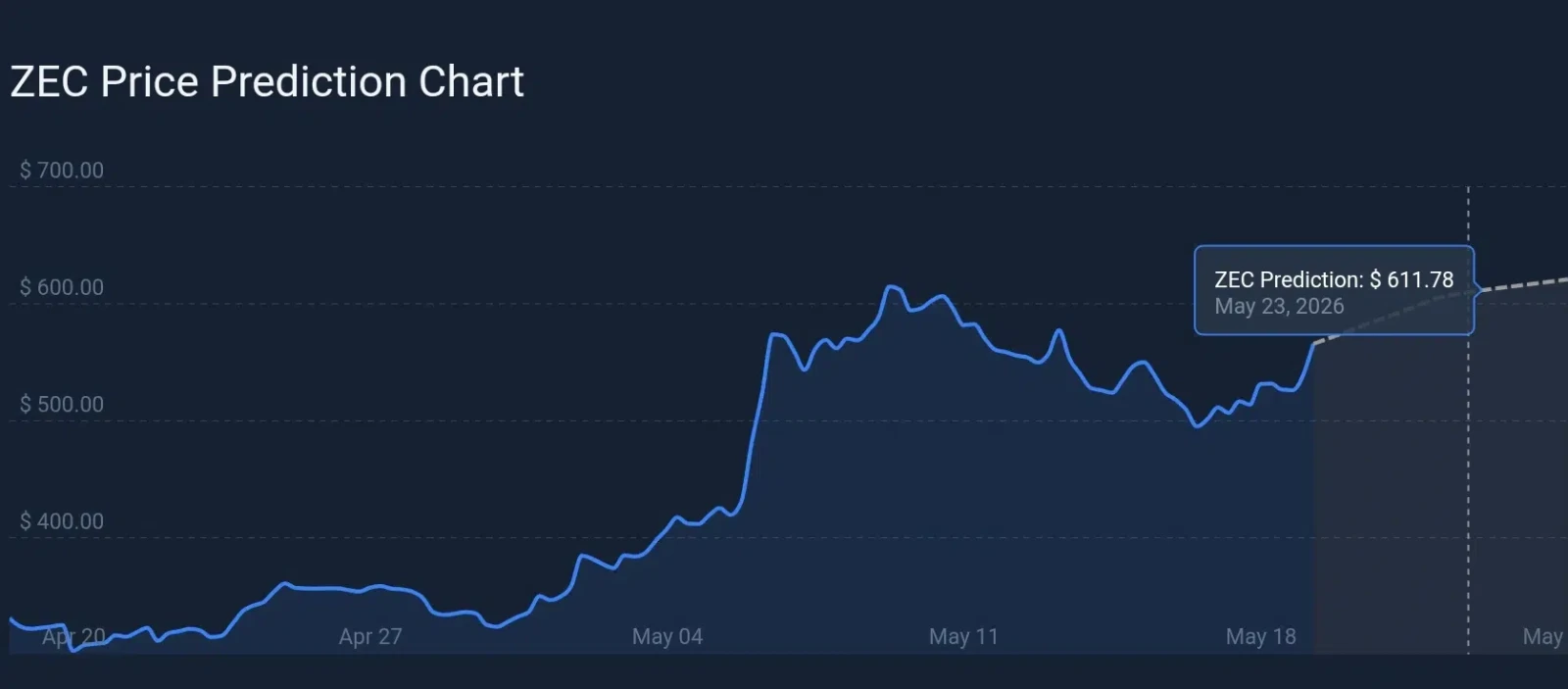
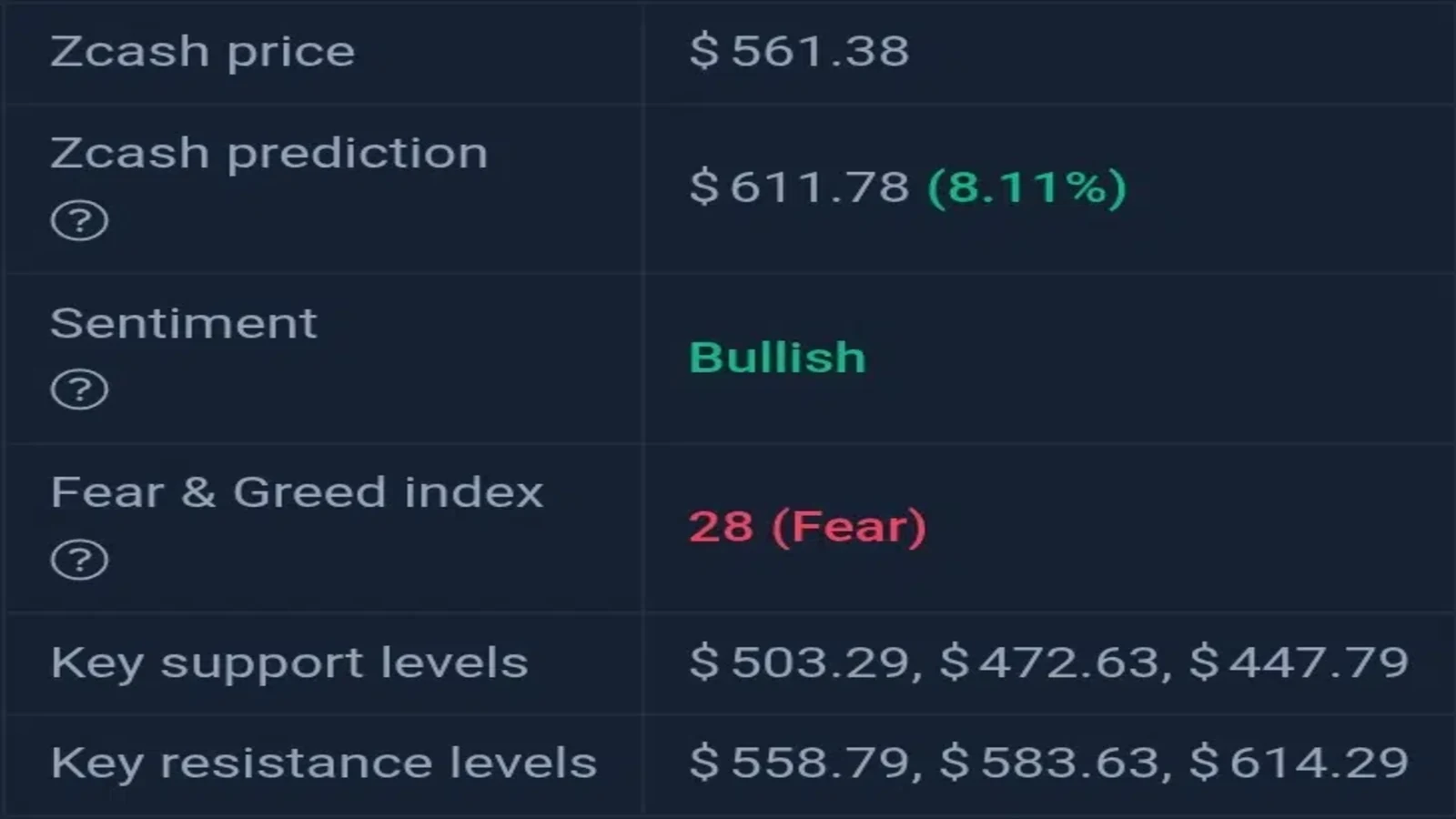
The latest Zcash price rally is turning heads again. The privacy-focused cryptocurrency has surged hard over the past month, and traders are watching closely to see if the momentum can continue. ZEC is currently trading at $561.38 after climbing 5.72% in the last 24 hours. That move pushed it ahead of the broader crypto market, which gained 5.11% during the same period.

ZEC also beat Bitcoin on the day, posting a 6.16% gain against the world’s largest cryptocurrency. Analysts now expect the token to rise another 8.11% over the next five days. If that target is reached, the Zcash price could touch $611.78 by May 23, 2026.

Source: CoinCodex

Also Read: Zcash Price Analysis Shows 70% Rally Strength and Next Move Levels

Zcash Price Shows Strong Monthly Momentum

The recent trend has been hard to ignore. Over the last 30 days, ZEC has surged 74.13%. The gains become even larger on a wider timeframe. In the last three months, the coin has climbed 95.07%. Over the past year, Zcash has exploded by 1,248.25%.

Source: CoinCodex

One year ago, ZEC traded at just $41.64. That sharp rise shows how quickly sentiment around the token has changed.

Even so, Zcash still remains far below its all-time high of $5,941.80 reached in October 2016. The current market cycle high stands at $736.68, while the cycle low sits at $16.04.

Volatility remains elevated. Zcash recorded a monthly volatility reading of 23.68, while posting 18 green days in the last 30 sessions.

Zcash Price Faces Key Resistance Levels

Technical indicators currently support the bullish outlook. Thirty indicators are signaling bullish momentum, while only one points toward bearish conditions. That leaves overall sentiment strongly positive.

Key resistance levels now sit at $558.79, $583.63, and $614.29. On the downside, support levels are positioned at $503.29, $472.63, and $447.79.

Source: CoinCodex

The Relative Strength Index currently stands at 60.24, suggesting ZEC is neither overbought nor oversold. However, the coin still trades below both its 50-day and 200-day simple moving averages, which remains a warning sign for traders.

Source: CoinCodex

The broader crypto market is also showing caution. The Fear & Greed Index currently reads 28, signaling fear among investors. Still, analysts believe that if momentum holds, the Zcash price may continue climbing in the days ahead.

Also Read: Zcash Price Breaks Above $513 as Bullish Structure Signals Continued Upside

Filed Under: Cryptocurrency News, Altcoin News, World

USDT Gains $5B While Strong Rivals Lose $4.2B

By Aishwarya shashikumar | Edited By Sahana Kiran,May 20, 2026, 2:00 PM

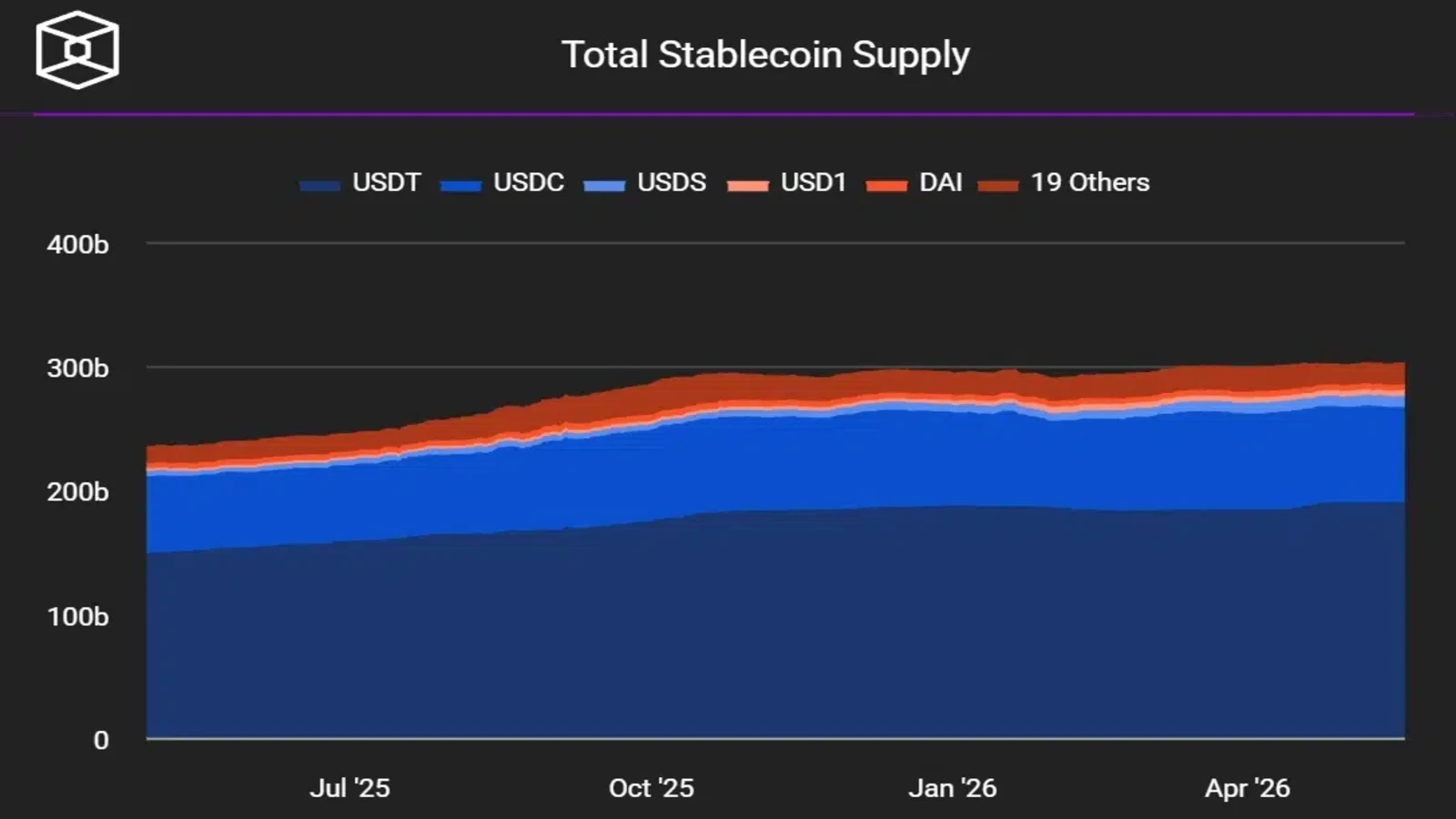
The stablecoin market just crossed a major line. Total supply moved above $300 billion. On paper, that looks strong. But USDT gains tell a different story beneath the surface.

The growth came almost entirely from Tether’s USDT. Over the last month, Tether added more than $5 billion in supply. At the same time, USDC, USDe, and PYUSD together lost roughly $4.2 billion. That left the broader stablecoin market with net growth of just $900 million, or 0.3%.

Every new dollar entering the market appears to be flowing into USDT while competing stablecoins shrink. The market is not growing evenly. It is consolidating around one dominant player.

Also Read: Tether Freeze Hits $514M USDT Across Tron and Ethereum in 30 Days

USDT Gains Show Market Consolidation

The latest numbers make one thing clear. USDT gains are coming at the expense of rivals. USDe has been one of the biggest losers. Ethena’s synthetic dollar dropped 28% over the last month and nearly 34% since the start of the year. The decline has been steady since October 2025.

The reason is structural. USDe depends on positive perpetual futures funding to support its yield. That model weakened after the Oct. 10 deleveraging event compressed crypto perpetual funding rates. Without strong yields, users moved elsewhere.

Source: X

Sky’s USDS has benefited from that shift. Its supply has climbed nearly 49% this year. World Liberty Financial’s USD1 also posted strong growth, rising more than 33%.

PYUSD struggled as well. Its supply fell 13% over the last month. The project’s institutional distribution strategy has not translated into meaningful demand growth.

USDT Gains Leave Rivals Searching for Answers

The rise of Tether also highlights the weakness of newer entrants. Bank-issued and GENIUS Act-compliant stablecoins were expected to compete aggressively with USDT. So far, that has not happened.

The challenge is simple. Any stablecoin trying to take market share from Tether must offer something better. That could mean higher yields, wider distribution, or regulatory advantages. Right now, none of the second-tier stablecoins have shown they can do that.

For now, USDT remains the center of the stablecoin economy. And as long as rivals fail to offer a stronger alternative, USDT gains may continue to define the market.

Also Read: Tether Takes Strong Action, Freezes $344 Million USDT With U.S. Authorities

Filed Under: Cryptocurrency News, Altcoin News, World

XRP Ledger Advances Quantum Security with Ripple & Project Eleven Partnership

By Yahya Raza Sherazi | Edited By Messam Raza,May 20, 2026, 1:30 PM

The XRP Ledger Foundation says the XRP Ledger is structurally prepared for the Quantum Era. It cited built-in key rotation and an account-based design as core features that could support a future move toward quantum-resistant signatures for users and businesses.

In a post on X, the foundation said users may keep the same XRP wallet addresses during that shift. These addresses, known as r-addresses, are already familiar to customers, exchanges, custodians, and payment firms.

Also Read: Ripple Prime Secures $200 Million From Neuberger to Expand Margin Trading

Ripple, Project Eleven Target Post-Quantum Security

The update came after a new partnership between Ripple and Project Eleven. The collaboration is to enhance the post-quantum readiness of the XRP Ledger ecosystem via audits, testing, and engineering.

Project Eleven said that the initiative is to bring blockchain quantum security out of theory. It stated that the work was a practical move towards real deployment for post-quantum protection.

The firm cautioned that advanced quantum computers could soon pose a risk to cryptography relied on by major blockchains. It included Bitcoin, Ethereum, XRP, and Solana in the list of networks that may require additional measures in the future.

Source: Project Eleven

Global timelines have placed pressure on the discussion. Project Eleven stated the U.S. government has pledged to move away from the weak encryption standards by 2035.

A number of large tech companies have also begun their transitions. The company says that Google and Cloudflare aim to make the transition to quantum-safe systems by 2029.

The majority of blockchain discussion about quantum risk is still academic, said Project Eleven CEO Alex Pruden. The issue is just a problem that Ripple is approaching as an engineering one, which requires working systems, he said.

XRP Ledger Builds Path to Quantum-Safe Systems

RippleX Head of Engineering J. Ayo Akinyele said the XRP Ledger is not starting from zero. He pointed to key rotation and coordinated validator upgrades as important foundations.

Validators, custody systems, wallets, and network infrastructure will be audited as per the plan. Project Eleven will evaluate these and provide an identification of potential quantum vulnerabilities throughout the ecosystem.

Hybrid signature development will also be a part of the collaboration. These systems would integrate existing cryptographic techniques with quantum-resistant ones for a more secure transition.

The prototype for a custody wallet that is secure for quantum computers is also included. The work will involve code, performance testing, and a roadmap for production deployment, Project Eleven said.

Project Eleven was established in 2024 and has been working on post-quantum cryptography. In January 2026, Castle Island Ventures led the company’s $20 million round.

It also maintains the Bitcoin Risq List, which lists potentially quantum-vulnerable Bitcoin holdings, and created Quantum Vault, a tool for post-quantum wallet security.

Project Eleven also created Quantum Vault as a model to secure wallets with post-quantum technology. According to the company, the Ripple partnership is the largest blockchain security deal.

Also Read: Zerohash Fund Seeks New Valuation Above $1.5 Billion After Mastercard Exit

Filed Under: Cryptocurrency News

Trump-linked Truth Social Pulls Spot Bitcoin ETF Filing From SEC Review

By Bena Ilyas | Edited By Sahana Kiran,May 20, 2026, 1:00 PM

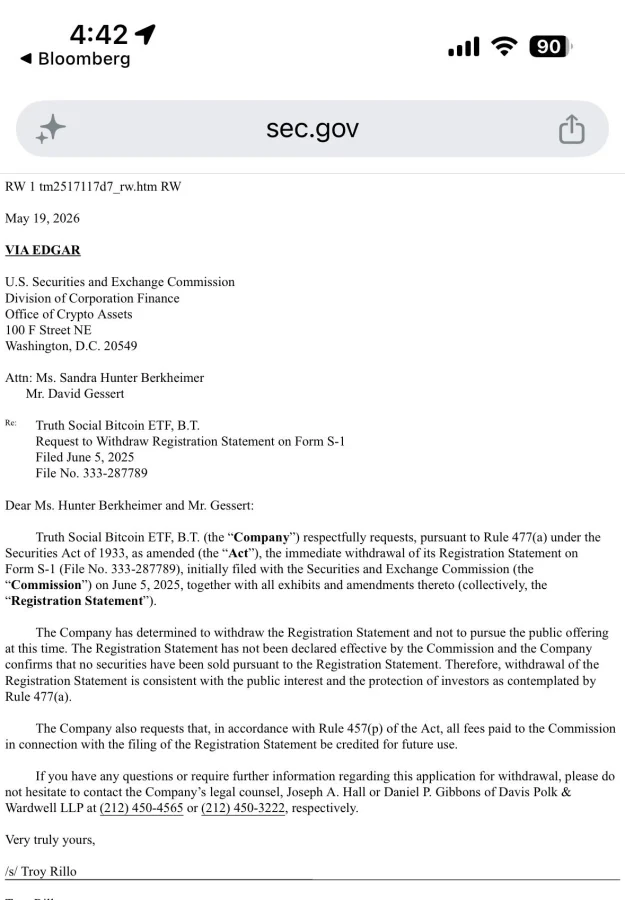
Truth Social has withdrawn its proposed spot Bitcoin ETF filing, signaling a shift in strategy as competition intensifies across the United States crypto ETF market. Increasing pressure from lower-cost institutional products entering the rapidly evolving Bitcoin investment sector.

The withdrawal follows the launch of Morgan Stanley’s MSBT product, which introduced a management fee of 0.14%. Bloomberg ETF analyst James Seyffart reported the withdrawal, and issuers are using aggressive pricing strategies to compete and win over the Bitcoin ETF market share. Pricing is becoming more and more relevant due to waning demand from investors for crypto-related investment products in 2026.

Bitcoin ETF filing
Source: James Seyffart’s X Post 


Also Read | NVIDIA Price Signals Potential Rebound After TD Sequential Buy Trigger Near $230 Zone

Yorkville America Revises Crypto Investment Structure

Yorkville America also withdrew filings relating to the Truth Social Bitcoin & Ethereum ETF and the Truth Social Crypto Blue Chip ETF. The company stated that it prefers the Investment Company Act of 1940 framework, describing it as better suited for developing diversified and rules-based digital asset investment strategies aimed at long-term institutional participation.

The Yorkville America-managed investment products are associated with Trump Media & Technology Group, which is the parent company of Truth Social. While the firm did not confirm future crypto ETF plans under the ’40 Act structure, analysts believe the change reflects broader efforts to adapt products to evolving regulatory and competitive market conditions in the United States investment industry.

The ETF filing withdrawals are taking place in the context of increased political pressure on President Donald Trump regarding his connections with cryptocurrency-related business ventures. Members of the Democratic Party have raised concerns about the possibility of conflicts of interest arising from Trump’s financial investments in digital assets, especially World Liberty Financial, as president since January 2025.

Bitcoin ETF Demand Weakens Across Market

Crypto ETF demand has significantly slowed during 2026 as institutional investors reduce exposure amid broader digital asset market volatility. The US spot Bitcoin ETFs have experienced net inflows of approximately $790 million in the year, sharply down from $25 billion in 2025, with most of the inflows coming from the BlackRock IBIT product.

The waning sentiment was further demonstrated through recent data showing net outflows. U.S.-listed Bitcoin ETFs experienced a total net outflow of $648.6 million on May 18. BlackRock’s IBIT was leading in net outflows with $448.4 million, followed by other competing funds such as Fidelity FBTC, ARKB, and Bitwise BITB.

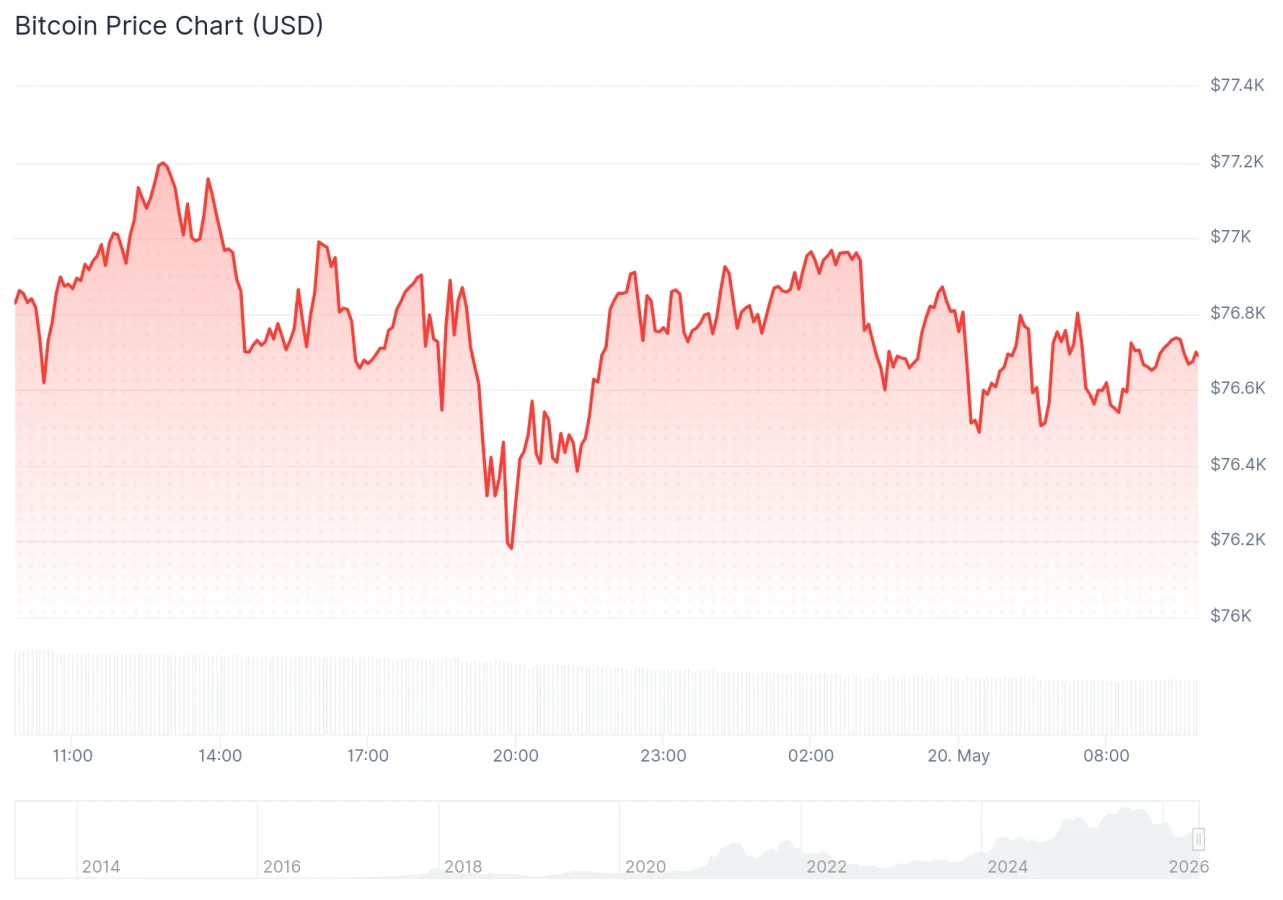
Meanwhile, Bitcoin is trading at $76,813, with a 24-hour volume of $27.64 billion and a market capitalization of $1.54 trillion, holding 60.44% market dominance. The price has recorded a decline over the past 24 hours.

Bitcoin price chart
Source: CoinGecko

Also Read | TIA Price Prediction: Can Bulls Push the Rally to $3.90 After Recovery Signs?

Filed Under: Cryptocurrency News, Bitcoin (BTC)

SpaceX IPO 2026: Massive Capital Shift Ignites Web3 Growth

By Ananthyka J | Edited By Sahana Kiran,May 20, 2026, 12:00 PM

Rumors that Goldman Sachs is going to be the main underwriter of a possible SpaceX IPO have caught the eyes not only of traditional finance but also digital asset markets. According to Reuters, the company could release its prospectus as early as Wednesday, which would be a big step for the aerospace company and a sign for investors watching how the institutionals are moving into tech and blockchain-adjacent sectors.

Institutional Signalling and Market Sentiment

Goldman Sachs’ possible role as lead underwriter shows that even investment banks that have been around for a long time are still the ones that help tech listings get the most attention in the market. Though for the crypto market, such SpaceX IPOs are key events that can shape the overall market mood and liquidity.

SpaceX IPO
Source: Analytics Insight

Market participants keep a close eye on equity market events to see if there are any correlations with Bitcoin, Ethereum, and other Web3 tokens, given that the flow of institutional capital can indirectly drive the valuations of digital assets.

Also Read: SpaceX Unveils Bold $7.5 Trillion Valuation Target in Ambitious Musk Compensation Plan

Potential Blockchain and Tokenization Implications

Although SpaceX is not directly involved in the crypto industry, the scale of the SpaceX IPO indicates that new technological innovation requiring large-scale capital continues to be in demand. Experts in the field have even remarked that the SpaceX IPO has driven an increase in conversations about the tokenization of real-world assets, decentralized infrastructures, and using blockchains for cap tables.

Goldman Sachs is expected to secure the much-coveted lead left position in Elon Musk's rocket and satellite maker SpaceX's initial public offering, a source familiar with the matter told Reuters on Tuesday. https://t.co/PO5x6aXMly

— Reuters Legal (@ReutersLegal) May 19, 2026

While the company does not have any direct crypto connections, going public successfully may be a major way that institutional investors open their doors to technological innovations in distributed ledger ecosystems.

Also Read: Solana(SOL) Surges on SpaceX Buzz: Bullish Breakout Targets $95 and Beyond

Regulatory Context and Infrastructure Risks

Public offerings not only bring about the need for increased disclosure, governance, and compliance but also the same levels of regulatory scrutiny that correct public equities are currently being subjected to are those that digital assets, stablecoins, and DeFi protocols will increasingly face. For the creators and investors of blockchain technology, the SpaceX IPO case works as a double-edged sword. On one hand, it is an example of the advantages of transparent markets, and, on the other hand, it demonstrates the substantial capital-raising operations.

Also Read: Robinhood Stock Falls as SpaceX IPO Role Faces Uncertainty

Filed Under: Industry, Cryptocurrency News

Massive GitHub Breach 2026: Web3 Security Alert

By Ananthyka J | Edited By Sahana Kiran,May 20, 2026, 11:00 AM

An alleged GitHub breach of their internal systems has prompted new security concerns. Blockchain and Web3 developers use the platform to store smart contract code and decentralized application repositories. Hackers TeamPC claims to have stolen data from 4,000 private repositories. The data allegedly includes proprietary source code and internal files, referencing a similar GitHub breach. They are offering the dataset on cybercrime forums for over $50,000. The company has confirmed it is looking into the matter of unauthorized access.

Possible Extent of the GitHub Repository Leak

TeamPCPs’ accusation focuses on private repositories that might have platform core codes and organizational documents. Although this has not been verified, the GitHub breach incident exposes crypto projects to supply chain risks both for open-source and closed-source projects on GitHub.

GitHub Breach
Source: Cyber Security News

Developers working in DeFi, NFT, and Layer-1 ecosystems regularly store their API keys, deployment scripts, and other sensitive information in version control, So making repository hygiene a crucial factor for security.

Also Read: Chainlink (LINK) and Ethereum (ETH) Rank High in GitHub Activity Over Past 30 Days

Implications for Blockchain and Web3 Developers

The security breach reveals continuous weaknesses in the infrastructure that supports the developers. If private codes are compromised, it can mean the leaking of zero-day vulnerabilities in smart contracts, wallet integrations or node software that can be exploited by attackers even before patches are rolled out.

We are investigating unauthorized access to GitHub’s internal repositories. While we currently have no evidence of impact to customer information stored outside of GitHub’s internal repositories (such as our customers’ enterprises, organizations, and repositories), we are closely…

— GitHub (@github) May 19, 2026

Phishing and social engineering campaigns against core contributors of decentralized protocols may also be facilitated by leaked internal tools. The incident is a perfect example of how security on-chain is largely reliant on good off-chain development practices.

Also Read: Revolut Launches Dogecoin Debit Card: Strong Target of 100K Daily Crypto Payments

Recommended Security Steps and Industry Response

Developers should check their GitHub repositories for any exposed API keys and change credentials immediately, as the GitHub breach underscores critical risks, GitHub advises. Security professionals recommend the use of two-factor authentication, secret scanning tools, and hardware wallets for signing commits. There is a lot at stake for the larger crypto community: while improving DevSecOps will increase trust, centralized development platforms will always be an Achilles heel in the whole of decentralized networks, especially after a GitHub breach.

Also Read: Minnesota Approves Crypto Custody for Banks and Credit Unions

Filed Under: Cyber Security, Cryptocurrency News, Industry

CFTC Minnesota Lawsuit Could Redefine Rules for Prediction Markets in the US

By Bena Ilyas | Edited By Messam Raza,May 20, 2026, 10:00 AM

The CFTC Minnesota lawsuit is a legal suit brought against the state of Minnesota by the United States Commodity Futures Trading Commission to settle a serious legal conflict involving prediction markets. It has been launched against state officials following the enactment by Minnesota of legislation prohibiting the use of prediction markets.

The U.S. Commodity Futures Trading Commission (CFTC), headed by Chairman Michael Selig, has filed a case in the U.S. District Court for the District of Minnesota against the newly enacted state statute prohibiting prediction markets. According to the commission, such action by Minnesota State is a violation of federal jurisdiction.

CFTC Minnesota lawsuit Challenges State Ban on Prediction Markets

The CFTC Minnesota lawsuit is based on Senate File 4760, which became law under the signing of Governor Tim Walz. The legislation criminalizes advertising, operating, and promoting prediction market exchanges within Minnesota. Additionally, it considers event contracts related to sports, weather, international affairs, and other matters offered through exchanges like Kalshi and Polymarket to be gambling bets.

CFTC Minnesota lawsuit filing
Source: CFTC

The CFTC asserts that only the CFTC has jurisdiction in such matters according to the Commodity Exchange Act. The CFTC is now seeking an injunction in the CFTC v. State of Minnesota case, seeking to halt the law both temporarily and permanently because the state cannot interfere with federal regulation of swaps.

The officials mentioned in the lawsuit include the governor, Tim Walz; the attorney general, Keith Ellison; and the public safety director, Jon Anglin. According to the CFTC, the state legislation would require the approved exchanges to cease their activities, which would create conflicts with the existing federal approvals.

According to the CFTC Minnesota lawsuit, moving ahead with the state ban will affect the power of the federal government and cause problems for the markets that have been regulated by the CFTC. The CFTC claims that it has already accepted self-certified contracts on these exchanges.

Kalshi has also been pushing back, stating that the law is unenforceable and incompatible with federal law. Kalshi asserts that prediction markets are subject to national regulation, not state prohibition.

Also Read | Ethereum’s ETH Whale Activity Analysis Points to Growing Accumulation Near $2,100 Support Zone

Legal Pressure Builds Around Prediction Markets

The CFTC Minnesota lawsuit arises amid efforts by some American states to regulate prediction markets as an equivalent of unlawful sports wagering. Nonetheless, this initiative marks the first time such a comprehensive legal prohibition is being made.

The case is being spearheaded by Michael Selig, who is now the only commissioner on the CFTC. Members of Congress in Washington have been advised to appoint commissioners for the vacant positions, but none have been appointed yet.

Governor Walz and Minnesota are putting special interests first and American farmers and innovators last.

Minnesota’s new law would make it a felony to trade event contracts in the state, hurting Minnesota farmers who have relied on weather and crop-related event contracts for…

— Mike Selig (@ChairmanSelig) May 19, 2026

Apart from this disagreement, Minnesota has enacted some other crypto regulations. The state has recently permitted banks and credit unions to provide crypto custody services while also enacting a crypto ATM ban to prevent any scams.

Also Read | NVIDIA Price Signals Potential Rebound After TD Sequential Buy Trigger Near $230 Zone

Filed Under: Cryptocurrency News

  • « Go to Previous Page
  • Page 1
  • Interim pages omitted …
  • Page 55
  • Page 56
  • Page 57
  • Page 58
  • Page 59
  • Interim pages omitted …
  • Page 3666
  • Go to Next Page »

Primary Sidebar

Recent Posts

  • ALGO Price Forecast: Can it Break Above $0.1319 Resistance? June 6, 2026
  • XRP Price Struggles at $1 Support While Bullish Cycle Targets Stay Locked at $5, $10 June 6, 2026
  • Galaxy Research Warns CLARITY Act Could Face Major Delays in 2026 June 6, 2026
  • Binance Coin Price Holds $570 as Resistance Triggers Market Uncertainty June 6, 2026
  • Professional Bitcoin Holdings Fall 17% as Hedge Funds Exit Positions June 6, 2026

Footer

News

  • Latest News
  • Altcoin News
  • Bitcoin (BTC)
  • Blockchain
  • Tron (TRX)
  • World

Digest

  • Meet the Founder
  • Price Winning Article
  • DeFi
  • Cyber Security
  • Crypto Scam

Industry

  • Project Review
  • Technology
  • Fintech
  • Tron Exchange
  • New in Town

Tron Universe

  • Event and Tron Parties
  • New in Town
  • Tron Tokens

FOLLOW US

  • Facebook
  • Telegram
  • Twitter
  • Linkedin

Subscribe US

Editorial Policy | Privacy Policy | Disclaimer | Terms and Conditions | Masthead

Copyright © 2026 · Tron Weekly. All Rights Reserved. NOTE: Tron Weekly is an independent crypto news site that adheres to the strict journalism policy anchored on transparency, trust, and objectivity, we have no affiliation with the TRON Foundation, its founder Justin Sun or any other cryptocurrency firm.