
• Skip to primary navigation
  • Skip to main content
  • Skip to primary sidebar
  • Skip to footer
  • About TronWeekly
  • Write for us
  • Terms and Conditions
  • Privacy Policy
  • Disclaimer
  • Contact
  • All Posts
  • Advertise

TronWeekly

Crypto World News

  • Home
  • Latest News
  • Opinion
    • Education
    • Best TRON Wallets
    • Beginner’s guide to TRON
    • Tron Tokens
    • Market Analysis
  • Industry
    • Tron Exchange
    • Project Review
  • Press Release
  • Bitcoin (BTC)
  • Ripple (XRP)
  • Advertise
  • About TronWeekly
    • The Team
    • Editorial Policy
    • Write for us
    • Privacy Policy
    • Disclaimer
    • Terms and Conditions
    • Contact
You are here: Home / Cryptocurrency News / Bitcoin (BTC) / Bitcoin’s Shocking Resilience in 2026: Subsea Cable Strength Meets Vulnerable Hosting Dependency

Bitcoin’s Shocking Resilience in 2026: Subsea Cable Strength Meets Vulnerable Hosting Dependency

What to know:

  • Bitcoin's network is resilient to random subsea cable failures, with 72-92% of cables needing to fail before significant disruption occurs.
  • Targeted attacks on key subsea cable chokepoints or hosting providers like Hetzner, OVH, and Amazon could severely disrupt Bitcoin's network.
  • Tor adoption has enhanced Bitcoin's resilience, with 64% of nodes using Tor, making the network more resistant to disruptions.

By Ananthyka J | Edited By Sahana Kiran,March 16, 2026, 6:30 PM

Bitcoin

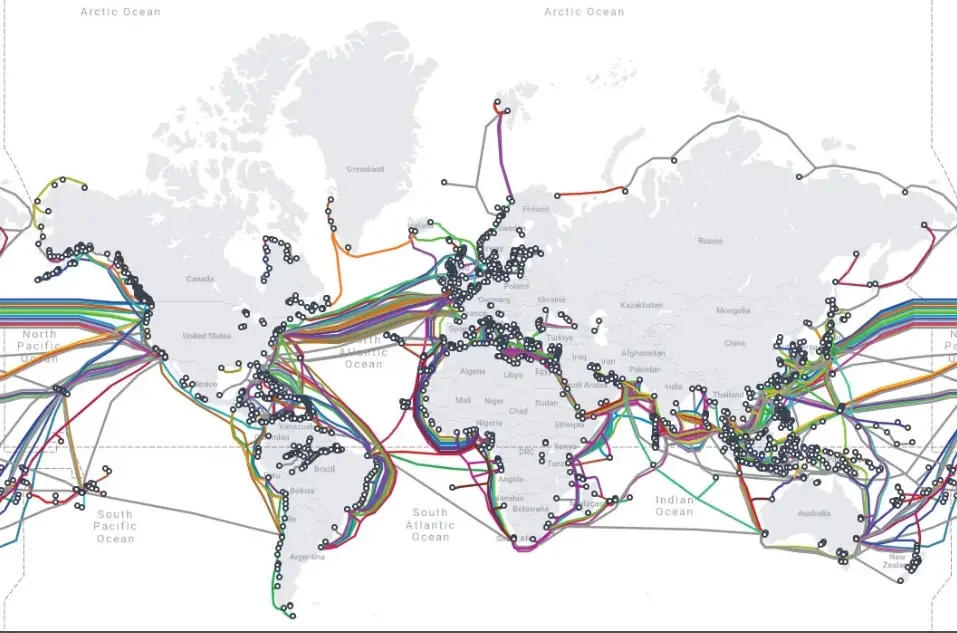
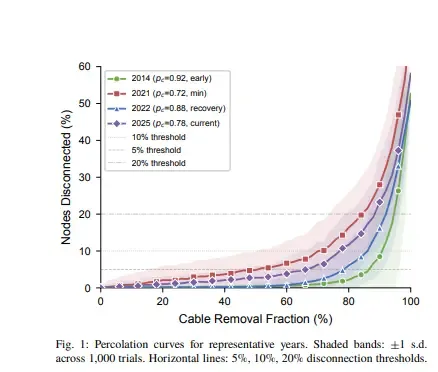
A fresh look at data from the Cambridge Centre for Alternative Finance shows Bitcoin’s network keeps running even if many undersea internet lines go down. Most connections would have to break – between 72% and 92% – before any real trouble starts. While luck-based outages hardly faze the system, focused sabotage could still cause harm. Strength against chaos does not mean safety from smart strikes. The strength is when cables break at random. Eleven years of peer-to-peer network records, along with 68 confirmed cable outages, were examined – revealing how Bitcoin adjusts its flow without disruption.

Most Disruptions

Eighty-seven percent barely touched the network, affecting fewer than one in twenty nodes. Price changes during these times showed almost no link to the glitches below ground or under sea. Built-in backups across global connections help explain why things hold together so well. Spreading nodes far and wide turns out to be a quiet strength when cables fail.
Undersea cable map
Source: SubmarineCableMap 

Also Read: BTC Proves Critics Wrong as $100 ‘Death’ Buys Worth $74.8M

Vulnerabilities to Targeted Attacks

Nevertheless, the research has found that pinpointing attacks on important subsea cable chokepoints or large hosting service providers could almost thoroughly paralyze the BTC network. The very critical fault level reduces to 20% for targeted attacks on the key cables and 5% for attacks on the largest hosting providers like Hetzner, OVH, and Amazon. This is possible because of the concentration of nodes and mining hash rate in a few centralised data centers.

You could cut almost every submarine cable on the planet and Bitcoin would still work.

An 11-year study just analyzed Bitcoin's resilience to submarine cable failures using 68 verified cable fault events from 2014 to 2025. Random cable failures would require roughly 72% to 92%… pic.twitter.com/7goQS7nAjU

— TFTC (@TFTC21) March 14, 2026

Also Read: Strategy Bitcoin Buying Surge Could Overtake Satoshi Nakamoto’s BTC by 2027

The Role of Tor in Enhancing Resilience

In fact, the researchers noted that Tor (The Onion Router) implementation has physically strengthened BTC. With 64% of nodes running on Tor, the network largely relies on the geographically concentrated relay infrastructure of very well-connected European countries, thereby making a disruption much more difficult. This serves as a reminder of the vital role that decentralised and censorship-resistant infrastructure plays in ensuring the security of Bitcoin.
Tor and Partial Observability Bitcoin
Source: Wenbin Wu and Alexander Neumueller

Also Read: Boris Johnson Calls BTC a ‘Ponzi Scheme,’ Sparks Debate

Filed Under: Bitcoin (BTC), Cryptocurrency News

About Ananthyka J

Ananthyka J is a market reporter at Tronweekly, reporting on cryptocurrency news. She covers cryptocurrency markets, blockchain technology, and digital asset regulation, focusing on Bitcoin, Ethereum, DeFi, altcoins, and crypto policy. Her reporting emphasizes clear and accurate market coverage, including crypto market movements, regulatory developments, and blockchain adoption. She holds a BA in Journalism and Mass Communication and an MA in Communication and Media Studies. She has also completed multiple media internships, follows strict editorial and fact-checking standards, and discloses potential conflicts of interest when reporting.

Primary Sidebar

Recent Posts

  • Bitcoin Sentiment Turns Bullish as Social Targets $90,000 Amid Weakening Trend April 30, 2026
  • Dogecoin (DOGE) Whale Down $13.7M Doubles Down with 10x Leveraged Bet April 30, 2026
  • Chainlink Surge Alert: LINK Targets $13–$18 Breakout as CCIP Boom Intensifies April 30, 2026
  • Canada Moves to Ban Crypto ATMs Due to Rising Scam Threat April 30, 2026
  • XRP Whale Outflows Hit 60% as Price Stays Weak April 30, 2026

Footer

News

  • Latest News
  • Altcoin News
  • Bitcoin (BTC)
  • Blockchain
  • Tron (TRX)
  • World

Digest

  • Meet the Founder
  • Price Winning Article
  • DeFi
  • Cyber Security
  • Crypto Scam

Industry

  • Project Review
  • Technology
  • Fintech
  • Tron Exchange
  • New in Town

Tron Universe

  • Event and Tron Parties
  • New in Town
  • Tron Tokens

FOLLOW US

  • Facebook
  • Telegram
  • Twitter
  • Linkedin

Subscribe US

Editorial Policy | Privacy Policy | Disclaimer | Terms and Conditions | Masthead

Copyright © 2026 · Tron Weekly. All Rights Reserved. NOTE: Tron Weekly is an independent crypto news site that adheres to the strict journalism policy anchored on transparency, trust, and objectivity, we have no affiliation with the TRON Foundation, its founder Justin Sun or any other cryptocurrency firm.