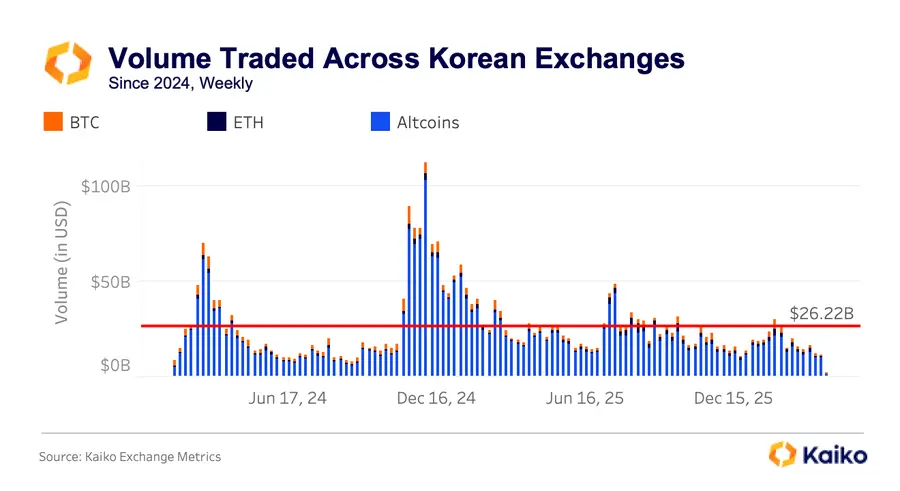
South Korea remains a major player in the international crypto trading arena, with statistics indicating that altcoins constitute an incredible 85% of South Korea’s weekly trading volumes, which are approximately $26 billion. The numbers indicate how retail-led demand influences asset choices and makes up a unique feature of the Korean market environment.
South Korea’s Growing Influence in Global Crypto Markets
South Korea represents roughly 30% of global cryptocurrency trading activity, making it one of the most influential regional markets. Local exchanges consistently record high volumes, often driven by strong retail participation and rapid trend adoption.
This outsized presence means that shifts in Korean market sentiment can have broader implications for global crypto price movements, particularly in altcoin markets.
Also Read: Altcoin Market Signals Trend Reversal as Resistance Weakens Against Bitcoin
Altcoin Dominance Signals Retail-Driven Activity
Altcoins account for approximately 85% of total trading volume across Korean exchanges, far outweighing major assets. This trend suggests a strong preference for higher-risk, higher-reward assets among local traders.
Unlike institutional-heavy markets that tend to favor Bitcoin and Ethereum, Korea’s trading environment is largely retail-driven. Traders frequently rotate capital into emerging tokens, contributing to elevated volatility and short-term price swings.
Bitcoin and Ethereum Take a Back Seat
Despite their global dominance, Bitcoin and Ethereum represent a relatively small share of trading activity in South Korea. Bitcoin accounts for around 9% of volume, while Ethereum holds approximately 6%. This distribution underscores a divergence between Korea and other major markets, where Bitcoin and Ethereum typically command a much larger share of trading activity.
Liquidity and Market Structure Differences
Korean exchanges often operate within a unique liquidity environment, influenced by local regulations, fiat on-ramps, and capital controls. These factors can create pricing inefficiencies and localized premiums, sometimes referred to as the “Kimchi premium.”
Additionally, the concentration of trading in altcoins can lead to thinner liquidity in major assets, further amplifying volatility in smaller-cap tokens.
Comparison With Other Asian Markets
Compared to South Korea, other Asian markets such as Japan exhibit more balanced trading activity. Japanese crypto volumes are generally lower and more evenly distributed, with deeper liquidity in major assets like Bitcoin. This contrast highlights how regulatory frameworks and investor demographics shape market behavior across regions.
Also Read: Altcoins Fade as 2026 Massive Capital Shifts to Real Assets