
Bitcoin is approaching a key technical level that has historically marked the end of major bear markets, while on-chain data shows long-term investors continue to hold a growing share of the cryptocurrency’s supply. Together, these signals are drawing attention as the market searches for clues about Bitcoin’s next long-term direction.
Also Read: Revolut to Delist Tether USDT in Europe by August 31 Under MiCA Rules
Bitcoin’s Historical Pattern Remains in Focus
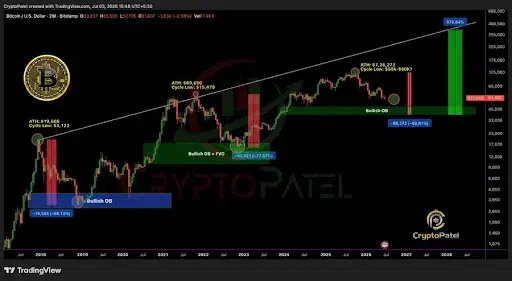
In his recent market analysis, Crypto Patel notes that there is a bullish order block on a weekly basis between the price ranges of $40,000 and $50,000. He believes that the crypto had taken a similar route in previous cycles when it reached its all-time highs.
This is a comparison of the current drop with the ones seen in 2018 and 2022. Following the peak at the end of 2017 that was near $19,666, the cryptocurrency lost more than 84% of its value and bottomed out at the level of $3,122.
Source: X
The level became a starting point for a rally, which eventually drove the cryptocurrency price near $69,000. In a way, the same scenario took place in the aftermath of the bull market in 2021, when the cryptocurrency lost 78% and bottomed out at the level of $15,479.
According to Crypto Patel, Bitcoin is currently undergoing another major correction period after touching its all-time high at around $126,272.
If the price falls towards the expected level of support, the correction may resemble some other market cycles that eventually hit all-time high prices. On the chart, there is also a long-term target range from $500,000 to $600,000, but it is not guaranteed.
Long-Term Holders Tighten Available Supply
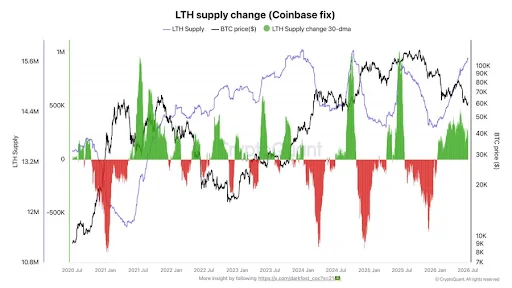
On-chain data shared by Darkfost adds another layer to the market outlook. Approximately 15.6 million Bitcoin, which represents about 78% of total existing Bitcoin, is currently held by long-term holders. The coins held have not been moved within the last six months.
Analyst Darkfost commented on the metric, stating that it does not represent new buying. The metric focuses on the period the coins have been held, thus showing that Bitcoin purchased six months back ($90,000) is now a long-term holder coin.
Source: X
Why It Matters and What Comes Next
The strong history of backing and lack of selling by the long-term investors may determine the next major move for the cryptocurrency. Historical cycles indicate that the large price falls have created opportunities for the long-term investors to act.
People are observing whether Bitcoin will be able to hit the $40,000-$50,000 range and whether it will receive the same kind of protection as previously seen by the buyers. Furthermore, people will be looking at the August figures as the BTC purchased during the sharp fall from above $60,000 will become long-term holders.
This article contains market analysis and price predictions. These are not guarantees. Crypto markets are volatile. Always DYOR. Not financial advice.
Also Read: Bitcoin Price Could Reach $65,400 as Three Bullish Indicators Flash Buy Signal