
• Skip to primary navigation
  • Skip to main content
  • Skip to primary sidebar
  • Skip to footer
  • About TronWeekly
  • Write for us
  • Terms and Conditions
  • Privacy Policy
  • Disclaimer
  • Contact
  • All Posts
  • Advertise

TronWeekly

Crypto World News

  • Home
  • Latest News
  • Opinion
    • Education
    • Best TRON Wallets
    • Beginner’s guide to TRON
    • Tron Tokens
    • Market Analysis
  • Industry
    • Tron Exchange
    • Project Review
  • Press Release
  • Bitcoin (BTC)
  • Ripple (XRP)
  • Advertise
  • About TronWeekly
    • The Team
    • Editorial Policy
    • Write for us
    • Privacy Policy
    • Disclaimer
    • Terms and Conditions
    • Contact
You are here: Home / Cryptocurrency News / Bitcoin Policy Institute (BPI) Challenges Fed Basel Rules Over 1,250% Bitcoin Risk Weight

Bitcoin Policy Institute (BPI) Challenges Fed Basel Rules Over 1,250% Bitcoin Risk Weight

What to know:

  • Bitcoin Policy Institute challenges Federal Reserve proposal over strict 1,250% risk weight on Bitcoin holdings.
  • BPI argues that Basel rules unfairly treat Bitcoin as extremely risky compared with traditional assets.
  • Banks must hold equal capital for every Bitcoin dollar due to the 1,250% risk-weight requirement.

By Bena Ilyas | Edited By Sahana Kiran,March 13, 2026, 5:00 PM

Bitcoin

The Bitcoin Policy Institute (BPI) intends to challenge Bitcoin’s status under international banking regulations as the US Federal Reserve issues new guidance on how banks should handle asset risk weighting. The BPI contends that international regulations place undue stress on financial institutions that handle or hold BTC.

On March 13, 2026, BPI managing director Conner Brown stated that the group will review the upcoming proposal from the Federal Reserve and will make comments to ensure that BTC is treated properly. In a post on X, Brown said that the institute wants the US regulators to properly evaluate the classification of BTC in the banking system.
Source: X

Bitcoin Faces Harsh Basel Banking Rules

The move is in line with a Federal Reserve plan to issue a proposal outlining how U.S. banks should apply Basel Committee risk-weighting rules. The rules evaluate asset risk on a bank’s balance sheet and determine how much capital is needed to fund those assets.

According to Brown, Basel rules classify BTC very harshly, assigning it a risk weight of 1,250%. This is very high when compared to other traditional assets. Brown says that this is very strict, almost treating BTC as if it were a toxic asset in banking.

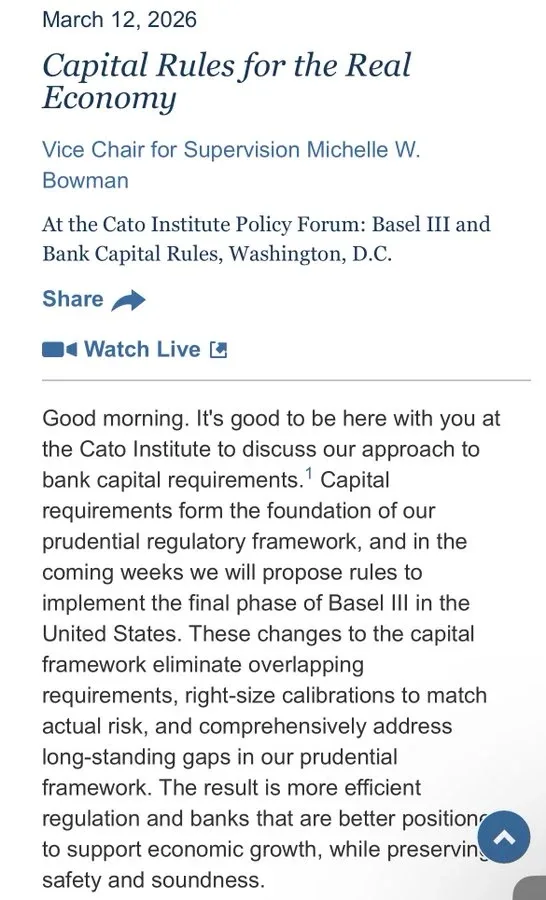
Meanwhile, Michelle Bowman stated that the Fed plans to introduce regulations in the coming weeks to implement the last Basel phase in the US. The goal is to have an efficient regulation system while making banks strong to support growth.

The current system dictates that a 1,250% risk weight means banks must back all their Bitcoins with approved capital. In essence, for every dollar of Bitcoins that banks have on their balance sheets, they must have an equivalent amount of capital. This means that Bitcoins are extremely costly for banks to hold.

In contrast, cash, government bonds, and physical gold have a 0% risk weight, which means that no additional capital is required by the bank.

Also Read | Bitcoin Stabilizes at $67,556 Support, Eyes $169,000 Potential Rally

BPI Criticizes Basel Bitcoin Classification

Brown has previously expressed disapproval of this method in a blog post. He described BTC’s classification by Basel as the “most punitive” classification and said that the rule misunderstands the way that the asset works and is being evaluated in the financial system.

The debate on the classification of BTC started in 2021 when the Basel Committee on Banking Supervision proposed that cryptocurrencies be included in the high-risk group 2. This means that the value of the cryptocurrencies held by a bank will not be more than 1% of the value of the assets held in group 1.

According to Brown, these restrictions prevent banks from serving BTC users and crypto businesses. The Fed is currently crafting a proposal on the matter. The Bitcoin Policy Institute hopes that the comments it submits will help create a framework that allows banks to work with BTC with fewer regulatory barriers.

Also Read | Virtual Asset Companies Face Risks of Exploiting Regulatory Gaps, FATF Warns

Filed Under: Cryptocurrency News, Bitcoin (BTC)

About Bena Ilyas

Bena Ilyas is a Global News Correspondent and Market Analyst at Tronweekly with over four years of experience covering global cryptocurrency, blockchain, and Web3 developments. She has written 1,000+ articles for leading crypto news platforms, reporting on Bitcoin, Ethereum, altcoins, DeFi, and global crypto regulation, alongside Web3 trends, Layer 2 ecosystems, and AI-driven crypto use cases. Her work is based on verified sources and fact-based reporting for global market participants.

Primary Sidebar

Recent Posts

  • HYPE Whale Sells $22M Tokens, Adds $32M Leveraged Short April 30, 2026
  • xStocks Debuts 50+ Tokenized Stocks and ETFs on BNB Chain April 30, 2026
  • COTI Bearish Market Structure Shift Signals Further Downside Pressure April 30, 2026
  • Fetch.ai (FET) Demand Zone Retest Signals Bullish Reversal Toward $0.31 April 30, 2026
  • Avalanche (AVAX) Shows Signs of Accumulation: Is a Bullish Shift to $200 Next? April 30, 2026

Footer

News

  • Latest News
  • Altcoin News
  • Bitcoin (BTC)
  • Blockchain
  • Tron (TRX)
  • World

Digest

  • Meet the Founder
  • Price Winning Article
  • DeFi
  • Cyber Security
  • Crypto Scam

Industry

  • Project Review
  • Technology
  • Fintech
  • Tron Exchange
  • New in Town

Tron Universe

  • Event and Tron Parties
  • New in Town
  • Tron Tokens

FOLLOW US

  • Facebook
  • Telegram
  • Twitter
  • Linkedin

Subscribe US

Editorial Policy | Privacy Policy | Disclaimer | Terms and Conditions | Masthead

Copyright © 2026 · Tron Weekly. All Rights Reserved. NOTE: Tron Weekly is an independent crypto news site that adheres to the strict journalism policy anchored on transparency, trust, and objectivity, we have no affiliation with the TRON Foundation, its founder Justin Sun or any other cryptocurrency firm.