
The Swiss Bitcoin reserve referendum, which was trying to force the establishment of a Bitcoin reserve at the country’s central bank, has come to an end due to a lack of support from the people of the country, according to a Reuters report.
The organizers aimed to amend the constitution by making it mandatory for the Swiss National Bank to hold a Bitcoin reserve, along with its reserves of gold and foreign currencies. However, the campaign fell short of reaching the target of 100,000 signatures, with only about 50,000 being gathered.
The central bank has repeatedly turned down the notion of a Bitcoin reserve because digital currencies fail to satisfy their safety and liquidity criteria. According to Reuters, the authorities still exercise caution regarding the inclusion of any digital currency reserves amid price fluctuations and inadequate market depths.
Founder of the campaign, Yves Bennaim, stated that although the initiative may have been a risky venture, it certainly gained more traction for the concept of a Bitcoin reserve and its significance within contemporary finance.
According to supporters, a Bitcoin reserve would lessen the dependence of Switzerland on dollar- and euro-denominated financial instruments, which make up a majority of the Swiss National Bank’s foreign portfolio.
Also Read | Solana Price Holds Key Support as Market Shows Mixed Signals
Global Debate Over Bitcoin Reserve Strategies Grows
The interest in the Bitcoin reserves concept has increased around the world, but government acceptance is still limited and inconsistent.
El Salvador was the first nation to establish its sovereignty by purchasing Bitcoins during the tenure of President Nayib Bukele in 2021. The data provided by BitcoinTreasuries.com indicates that the nation is still holding its 7,645 BTC, essentially establishing what can be termed its “national Bitcoin reserve.”
Bhutan has also accumulated substantial Bitcoin reserves due to government-supported mining operations that use hydropower. Such measures were meant to generate a sustainable source of digital income as well as a Bitcoin reserve.
But according to Arkham Intelligence analysis, their holdings have fallen drastically recently, declining from around 13,000 BTC in 2024 to just 3,654 BTC in April 2026.
Unlike those countries, the biggest Bitcoin owners in government hands, such as the USA, China, and the UK, have received their funds by seizures and confiscations, without having developed a plan to create a Bitcoin reserve.
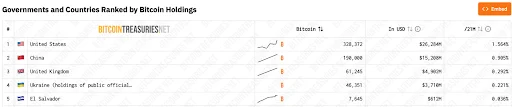
Source: BitcoinTreasuries.net
The big policy change happened in March 2025 when President Donald Trump issued an executive order for a Strategic Bitcoin Reserve to be established in the U.S.
The strategic reserve will be backed by Bitcoin owned by the government, but will not be for sale. There were also discussions about exploring further expansion of the Bitcoin reserve using neutral budgeting means.
For now, the Swiss proposal illustrates an important point: although there is increased interest in a Bitcoin reserve, the vast majority of central banks do not feel ready to take action in that direction.
Also Read | Bitcoin Price Holds $80,000 Support as Bulls Eye $100,000 Breakout Target
