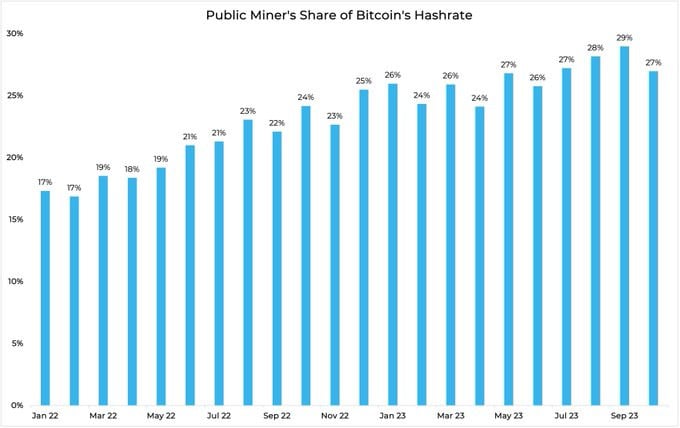
Bitcoin’s hashrate distribution has seen significant shifts over the past year, with public miners now accounting for 27% of the Bitcoin network’s hashrate. It marks a substantial increase from January 2022, when public miners held only 17% of the network’s mining power. HashRate Index, a prominent authority on cryptocurrency mining data, suggests that this trend is set to continue as well-capitalized public miners acquire the assets of distressed private miners post-halving.
HashRate Index recently released its Q3-2023 Bitcoin Mining Report, highlighting significant industry changes and trends. The report acknowledges the positive impact of Bitcoin’s 2023 price rally, as BTC reached a yearly high of just over $30,000 during Q3. Notably, the average price throughout this quarter was $28,100, providing support to the USD-denominated hashprice despite an increase in Bitcoin’s mining difficulty.
The hashprice experience declined in August, dropping below $70/PH/day. Currently, it is hovering close to its all-time low of $55/PH/day and stands just below $60/PH/day. As a result, September’s average USD hashprice is recorded at $61.71/PH/day. This figure reminds us of the averages from December and November 2022 when BTC’s price fluctuated between $16,000 and $17,000
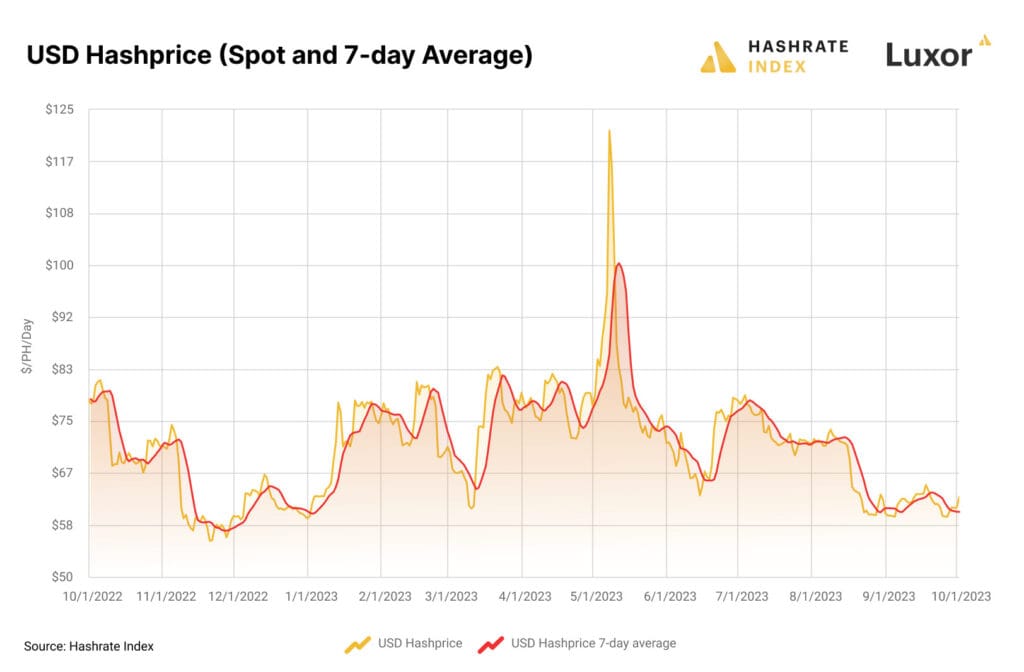
In 2023, the stability of hashprice has shown improvement compared to previous years. During the first three quarters, there was a 63% recovery rate, effectively countering BTC’s 7-day average hashrate growth of 59% in that same period. This stability has been influenced by transaction fees, which witnessed a notable increase to 4.38% of block rewards in Q3-2023. This rise can be attributed to the emergence of a new standard for non-fungible tokens (NFTs) on Bitcoin.
Seasonal Patterns In Bitcoin’s Hashrate
The report highlights a seasonal pattern in Bitcoin’s hashrate. It indicates growth from October to May and a slowdown during summer. This trend aligns with U.S.-based miners reducing operations, particularly in Texas. This year, the 7-day average hashrate increased by 56% in the first five months but declined by 1.3% in June, July, and August. A sudden 12% rise in September pushed the hashrate to an all-time high in mid-October, attributed to this seasonal pattern.

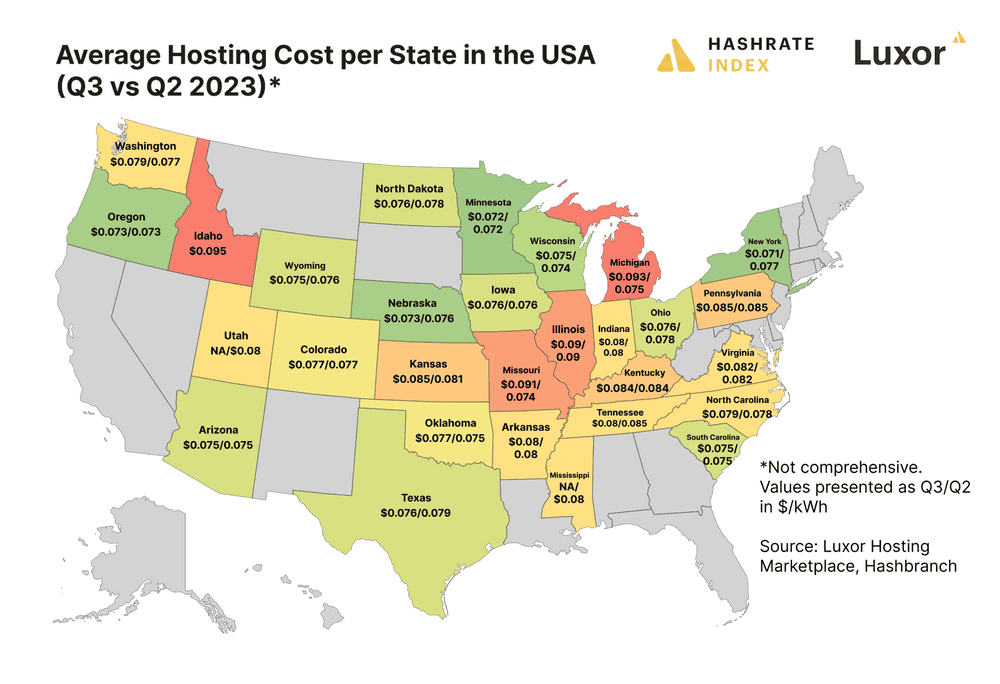
The analysis indicates a connection between the reduction in U.S. miners and the higher power prices observed during summer hours. In Q3-2023, both the United States and Canada experienced minimal changes in their national average hosting rates. For instance, the U.S. average hosting rate was $0.0790/kWh in Q3-2023, slightly higher compared to $0.0787/kWh in Q2-2023.
The report also discusses the performance of Bitcoin mining stocks during Q3-2023. At the beginning of the quarter, these stocks showed a strong start in line with Bitcoin’s price surge to $30,000. However, they exhibited significant volatility throughout the entire quarter, highlighting their correlation with Bitcoin’s price movements.
Related Reading | Blockstream Exposes Phishing Scam: Urges Caution Amid Rising Threats