- ESMA proposes new guidelines under MiCA to ensure competence in crypto service providers.
- These standards focus on investor protection and market transparency.
- Final guidelines, shaped by stakeholder feedback, are expected in Q3 2025.
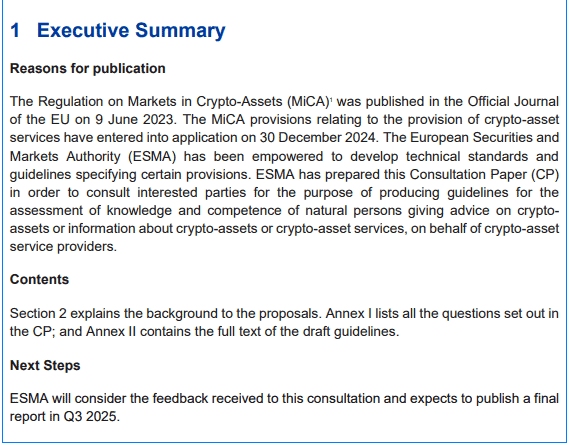
The European Securities and Markets Authority (ESMA) has published a consultation paper laying down extensive guidelines for crypto-asset service providers’ personnel for the purpose of acquiring minimum levels of knowledge and competence.
The proposal, under the Markets in Crypto-Assets Regulation (MiCA) regime, has been made with the objective of strengthening investor protection and trust in the quickly emerging digital-asset space.
Scheduled to be implemented on December 30, 2024, MiCA delegates the task of developing such regulations to ESMA. The regulator’s strategy targets crypto-specific issues such as asset volatility, cybersecurity, and low levels of knowledge of digital currencies.
Crypto Guidelines for Information Providers and Advisors
ESMA’s proposed regime puts proportionality first, with requirements proportionate to the size and complexity of the service provider. The guidelines also distinguish between two main roles: information providers and advisors.
Information providers must be knowledgeable of the inherent natures of digital-assets, such as their fees and their volatility, and their related risks. They must also comply with minimum professional requirements and engage in continuing professional development (CPD).
Advisors face more stringent requirements. In addition to meeting the same minimum as information providers, they must also be experienced and knowledgeable in portfolio management and requirements of suitability. Benchmarks of experience and training have been created to ensure that advisors can best inform clients on crypto investments.
Organizational Responsibilities for Compliance
The guidelines also extend into organizational responsibility. Crypto-asset service providers must implement systems for their employees’ levels of knowledge, and these must be monitored and measured. The processes must be written down for purposes of facilitating observation by the regulator and maintaining conformity.
By mandating such requirements, ESMA intends to foster the contribution of the service providers towards reducing misinformation and reinforcing trust among investors. The requirements for such organizations also comply with the overall goal of creating a safe and knowledgeable environment for trading crypto-assets.
Stakeholder Feedback Shapes the Future
The consultation period, closing on 22 April 2025, asks industry participants for feedback on the draft standards. The anticipated deadline for finalized guidelines and publication of its report is Q3 2025.
These efforts represent a significant step towards crypto industry regulation, with the purpose of equipping investors with accurate advice and quality data. Imposing higher levels of knowledge and competence, ESMA hopes to lower the related trading risks of crypto assets and foster higher trust in this up and coming industry.
The feedback process will be critical in shaping these standards for purposes of addressing the varying needs of the crypto space and maintaining the stability of the financial environment.