- Crypto stands to gain as the Federal Reserve eases banking rules, allowing banks to serve digital asset companies.
- The removal of reputational risk gives banks a clearer path to offering legal, crypto-related services without penalties.
- Following the regulatory shift, Bitcoin, Ethereum, and other major cryptocurrencies have seen notable price increases.
Crypto could be the primary winner of a strategic shift in banking regulations, revealed on Tuesday by Federal Reserve Chair Jerome Powell. Banks will now be free to choose their customers, including customers in the cryptocurrency sector. The ruling permits additional crypto-related services and paves the way to new investment products built around digital assets.
Powell declared a hearing before the House Financial Services Committee. He stated that now banks are liberated to provide tailored services to cryptocurrency companies. Such a change recognizes increasing crypto influence in the financial system. It further shows that conventional banking is becoming increasingly closer to adopting digital assets completely.
Also Read: XRP Eyes $2.50 Rebound: Analyst Predicts Big Move Ahead of ETF Buzz
Crypto Policy Shift
Powell emphasized that crypto-related banking operations should be focused on safety and soundness. The Federal Reserve is interested in protecting investors as digital asset services expand. Powell also focused on the necessity of appropriate regulation to ensure financial soundness and to include innovation in the sphere of crypto.
The new policy will be adopted soon after the Federal Reserve eliminated reputational risk as an element of its bank examination requirements on Monday. The shift is consistent with the initiatives by other U.S. financial regulators, the Office of the Comptroller of the Currency (OCC) and the Federal Deposit Insurance Corporation (FDIC). A removal of reputational risk removes the fears that banks may face penalties where the digital currency services being provided are legal yet viewed negatively by the regulators.
The reputational-risk standard was developed a doubtful scenario to banks in the past. Banking firms were even fearful of the risk that penalties would be imposed on banks that offer digital currency services lawfully. The elimination of this requirement has made the Federal Reserve provide a more predictable condition for banks showing interest in the digital currency market. This will likely urge other financial institutions to investigate the potential of digital assets.
Inflation and Tariff Impact
Powell discussed more significant economic matters in addition to other digital assets-related policy developments. He pointed out that inflation is higher than the Federal Reserve target of 2%. Powell expressed acknowledgment of the uncertainty in the economic impacts of the tariffs imposed by President Donald Trump. He indicated that the effects of tariffs are yet uncertain and that the effects of inflation were more likely to be temporary, instead of being sustained.
In response to this development, the digital assets market has experienced notable price movements. Bitcoin (BTC) has seen a significant surge. As of now, BTC is trading at $106,052, up by 0.90% over the past day.
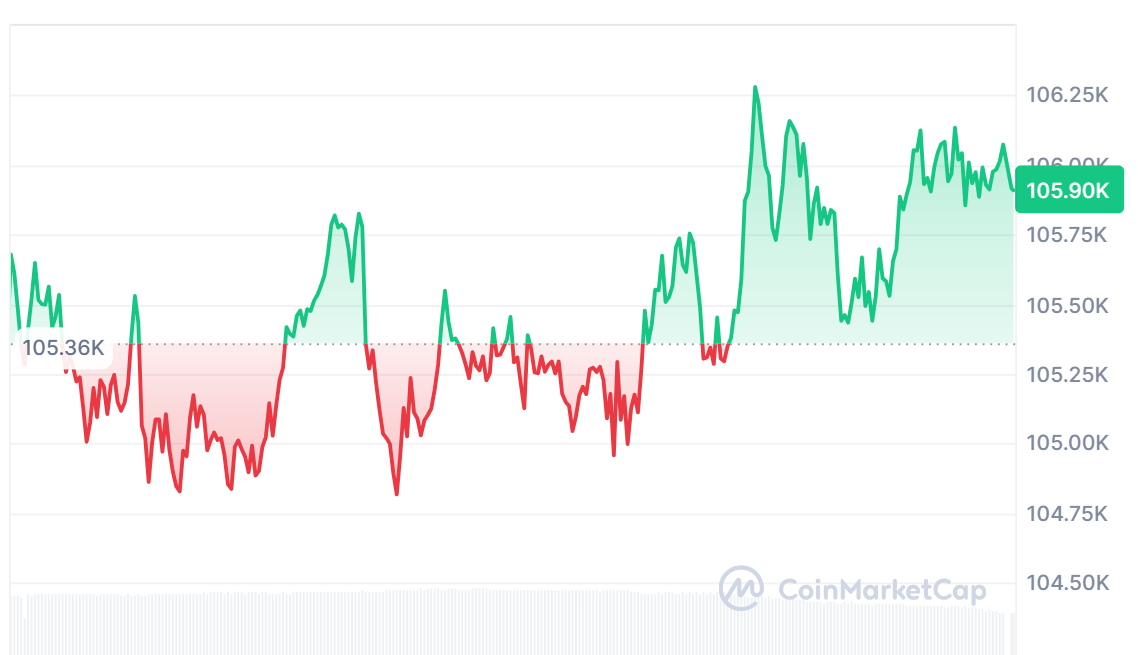
Source: TradingView
Other major cryptocurrencies have also experienced gains. Ethereum (ETH) is up 1.18%, BNB (BNB) has increased by 0.34%, Cardano (ADA) is up 0.88%, and XRP has risen by 1.86%.
A new approach to digital assets by the Federal Reserve is a significant change in the way that banks are going to treat digital currency. The shift would ease the ability of banks to innovate and provide crypto-related services. It also creates a path to a broader use of digital assets in the traditional financial sector.
Also Read: Hedera (HBAR) Price Near $0.15 Signals Possible Trend Reversal Amidst Downtrend