- Ethereum’s fee growth has failed to match rising stablecoin and RWA activity.
- Comparisons of ETH to commodities like oil overlook the limits of such narratives.
- Institutional adoption remains limited, with no evidence of large-scale ETH purchases.
Andrew Kang recently sparked debate by criticizing Tom Lee’s bullish thesis on Ethereum, describing it as a mix of financially unsound arguments.
Lee’s view was built around five main points: growing stablecoin and RWA adoption, comparing ETH to digital oil, institutional staking demand, ETH’s value rivaling global financial firms, and supportive technical charts. Kang’s breakdown, however, challenges each assumption with data and logic.
On the matter of stablecoins and tokenized assets, Lee argued that rising adoption should fuel Ethereum’s fees. Kang countered that despite a 100 to 1000-fold increase in transaction volumes since 2020, ETH’s daily transaction fees remain near the same levels. This is due to network upgrades lowering costs, activity shifting to other chains, and tokenized assets often sitting idle.
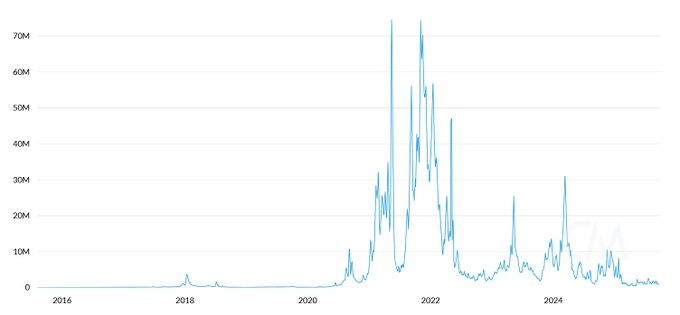
Kang emphasized that a trillion dollars in tokenized bonds means little if transactions are rare, adding that other networks like Solana, Arbitrum, and Tempo are capturing more of this growth. Even Tether is launching its own Plasma and Stable chains to keep USDT traffic within its ecosystem.
Ethereum as “Digital Oil” Comparison Questioned
Lee’s comparison of Ethereum with digital oil was also challenged. Kang supported that, despite oil itself being a commodity, inflation-adjusted real prices have ranged in a relatively constant band across more than a century, with only temporary spikes.
If ETH is managed in the same way, it does not form a bullish case. Instead, it draws attention to long-term stagnation with Ethereum trading in big ranges, such as crude oil.
Lee’s claim that institutions will hoard and stake ETH as operating capital was similarly questioned. Kang posited that not one large bank or financial institution has gone public about buying ETH for its balance sheet. He drew comparisons to banks stockpiling gasoline or purchasing custodian shares, something that isn’t actually done in standard finance.
Technical Picture Suggests Weakness
Chart analysis saw Kang arguing that Ethereum remains trapped in a multi-year trading range, with resistance recently holding firm. ETH has ranged between $1,000 and $4,800, which is comparable to long-term lateral movement by crude oil.
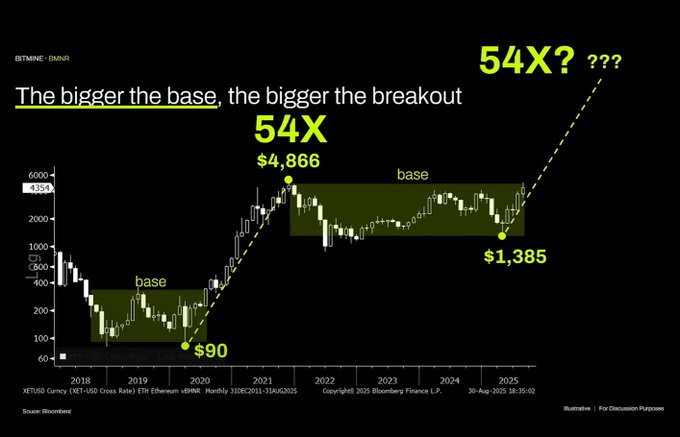
He warned that fundamentals do not support further valuation expansion, with ETH’s storyline already over-saturated. The ETH/BTC cross, he noticed, presents a downtrend through short-term rallies consistent with slower growth than Bitcoin.

As Per Kang, Ethereum’s high valuations are premised on unrealistic optimism. ETH may face years of underperformance if big structural changes do not occur.
Related Reading: Ethereum Struggles Below $4,045 Support Zone as Bears Gain Control