
• Skip to primary navigation
  • Skip to main content
  • Skip to primary sidebar
  • Skip to footer
  • About TronWeekly
  • Write for us
  • Terms and Conditions
  • Privacy Policy
  • Disclaimer
  • Contact
  • All Posts
  • Advertise

TronWeekly

Crypto World News

  • Home
  • Latest News
  • Opinion
    • Education
    • Best TRON Wallets
    • Beginner’s guide to TRON
    • Tron Tokens
    • Market Analysis
  • Industry
    • Tron Exchange
    • Project Review
  • Press Release
  • Bitcoin (BTC)
  • Ripple (XRP)
  • Advertise
  • About TronWeekly
    • The Team
    • Editorial Policy
    • Write for us
    • Privacy Policy
    • Disclaimer
    • Terms and Conditions
    • Contact
You are here: Home / Industry / Kenya Takes Bold Step Towards Crypto Regulation with Draft VASP Rules in 2026

Kenya Takes Bold Step Towards Crypto Regulation with Draft VASP Rules in 2026

What to know:

  • Kenya's National Treasury has published draft Virtual Asset Service Providers (VASP) regulations, outlining licensing, reserve, and disclosure requirements for crypto firms.
  • The regulations propose a 0.05% transaction fee for token issuance platforms and a 0.5% levy on initial virtual asset offerings.
  • The draft rules are open for public comment until April 10, with critics arguing that compliance requirements may hinder innovation.

By Ananthyka J | Edited By Ammar Raza,March 18, 2026, 10:57 PM

Kenya Takes Bold Step Towards Crypto Regulation with Draft VASP Rules in 2026

Kenya’s National Treasury may suggest that the draft Virtual Asset Service Providers regulations could establish significant licensing, reserve, and disclosure requirements for crypto firms.

Moreover, the proposed rules appear to demonstrate that the country’s anti-money laundering and counter-terrorism financing framework could indicate important deficiencies to address.

Key Proposals in Kenya’s Draft

The draft regulations may suggest that licensing eligibility could expand to include limited liability partnerships, and the findings indicate that the definition of virtual assets might cover digital representations of real-world assets on blockchain.

Given that the evidence demonstrates stablecoin issuers must maintain 30% of funds in segregated accounts at Kenyan commercial banks, the results could suggest that remaining reserves appear to require investment in secure, low-risk assets.

Key Proposals in Kenya's Draft
Source: CIO Africa

Also Read: Bitcoin (BTC) Sparks Urgent Review of Kenya’s Crypto Law as New ATMs Hit Shopping Malls

Fee Structures and Tax Implications

The regulations indicate that fees will be imposed on platforms. Also, the draft regulations could imply that transaction-type fees may encompass a 0.05% charge per transaction for token issuance platforms, while the proof suggests that a 0.5% tax on initial virtual asset offerings is the one that gets applied.
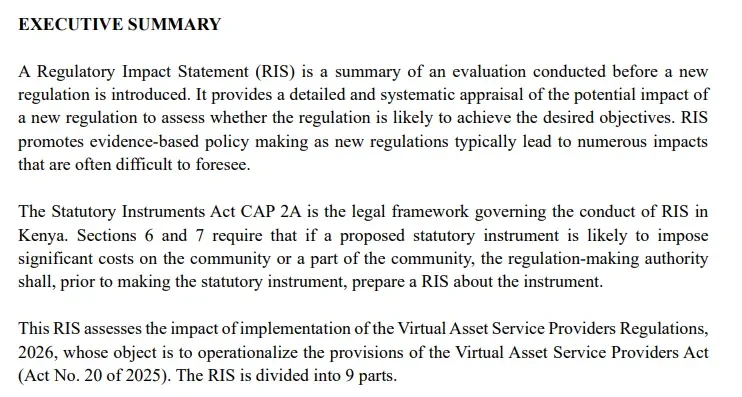
Fee Structures and Tax Implications
Source: treasury.co.go

Also Read: SEC Declares SOL a Digital Commodity in 2026, Redrawing Crypto Rules

In Conclusion

However, critics may argue that the results point towards compliance requirements being a major hurdle to innovation. Moreover, the National Treasury can hint that the major public participation forums might reflect stakeholder engagement in 11 venues across Kenya, with the findings showing that the feedback period seems to be open until April 10.

The National Treasury has released draft Virtual Asset Service Providers (VASP) Regulations 2026, introducing strict rules to govern Kenya’s fast-growing cryptocurrency sector. The regulations set licensing requirements for local and foreign crypto firms, mandate physical… pic.twitter.com/yj2YqCbnBI

— Nyakundi Report (@NyakundiReport) March 17, 2026

Hence, Kenya’s draft VASP rules could mean that the evidence points to a major step in the regulation of the country’s crypto space, whereas the results seem to show that the major challenges ahead might be balanced by the key opportunities for growth and clarity.

Also Read: U.S. Crypto Market Surges Ahead as Institutional and ETFs Drive Unstoppable Growth

Filed Under: Industry, Cryptocurrency News

About Ananthyka J

Ananthyka J is a market reporter at Tronweekly, reporting on cryptocurrency news. She covers cryptocurrency markets, blockchain technology, and digital asset regulation, focusing on Bitcoin, Ethereum, DeFi, altcoins, and crypto policy. Her reporting emphasizes clear and accurate market coverage, including crypto market movements, regulatory developments, and blockchain adoption. She holds a BA in Journalism and Mass Communication and an MA in Communication and Media Studies. She has also completed multiple media internships, follows strict editorial and fact-checking standards, and discloses potential conflicts of interest when reporting.

Primary Sidebar

Recent Posts

  • Ethereum Security Targets $1.5 Billion Hack Risk May 13, 2026
  • Kelp DAO Revives After $292M DeFi Exploit May 13, 2026
  • Vietnam Crypto Moves Toward Official Regulated Crypto Asset Market Launch Q3 May 13, 2026
  • JPMorgan Files for JLTXX Tokenized Money Market Fund on Ethereum May 13, 2026
  • AVAX Price Prediction: Drastic 1.56% Rally Ahead May 13, 2026

Footer

News

  • Latest News
  • Altcoin News
  • Bitcoin (BTC)
  • Blockchain
  • Tron (TRX)
  • World

Digest

  • Meet the Founder
  • Price Winning Article
  • DeFi
  • Cyber Security
  • Crypto Scam

Industry

  • Project Review
  • Technology
  • Fintech
  • Tron Exchange
  • New in Town

Tron Universe

  • Event and Tron Parties
  • New in Town
  • Tron Tokens

FOLLOW US

  • Facebook
  • Telegram
  • Twitter
  • Linkedin

Subscribe US

Editorial Policy | Privacy Policy | Disclaimer | Terms and Conditions | Masthead

Copyright © 2026 · Tron Weekly. All Rights Reserved. NOTE: Tron Weekly is an independent crypto news site that adheres to the strict journalism policy anchored on transparency, trust, and objectivity, we have no affiliation with the TRON Foundation, its founder Justin Sun or any other cryptocurrency firm.