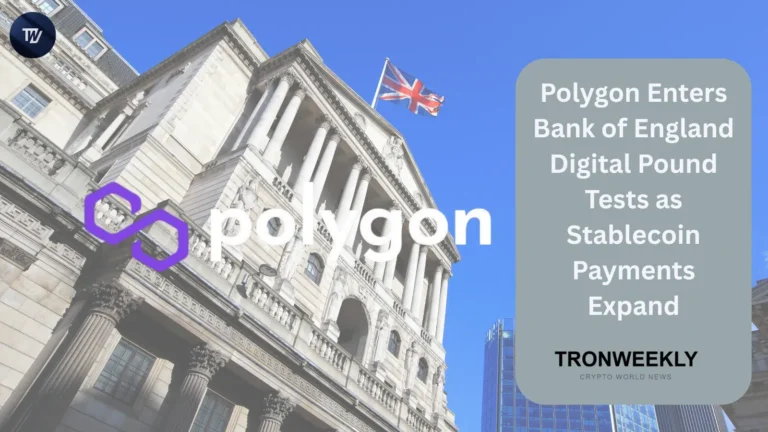
Polygon Labs has joined Phase 2 of the Bank of England’s Digital Pound Lab alongside NOBO Finance and Dun & Bradstreet, testing whether stablecoins and a potential digital pound can work together in cross-border trade finance.
The initiative examines how different forms of digital money could settle within one transaction flow without forcing businesses onto disconnected payment rails.

Source: Polygon
Polygon Tests Stablecoin and Digital Pound Settlement
The Digital Pound Lab is a simulated environment with no real customers, real money, or formal regulatory approval attached to its experiments.
Participation also does not mean the Bank of England endorses Polygon or has selected its technology for a future digital pound. Instead, the program allows companies to test potential use cases before any real-world deployment.
Polygon will participate in cross-border settlement innovation trials wherein the exporter can settle through stablecoins, and the importer can settle via the digital pound.
The stablecoin leg of the settlement process will be provided by the Polygon Open Money Stack, while the digital pound leg will run through the bank’s simulated rails.
This experiment is focused on fragmentation between bank money, stablecoins, tokenized deposits, and possible CBDCs. In the case where different types of money cannot settle each other effectively, firms can get into a liquidity trap, extra costs, and increase risks of the settlement process.
Also Read: Nvidia Credit Risk Climbs as $500 Billion AI Financing Plan Draws Scrutiny
SME Credit Profiles Add Trade-Finance Use Case
Another development taking place in the consortium is the SME Bankable Profile, which is headed by NOBO Finance. This profile will use consented wallet activities, open-finance data, and the commercial data provided by Dun & Bradstreet in order to come up with a bankable financial identity for small and medium enterprises.
This would be helpful for small enterprises engaged in foreign business, where cumbersome verification processes and late payments may impede their ability to obtain working capital. Settlements done quicker together with credit records that are easily transportable would enable lenders to evaluate small enterprises.
Polygon Expands Onchain FX Infrastructure
Polygon’s involvement is taking place in the process of expanding its overall payment ecosystem. Mento Protocol has gone live on Polygon with a USDm/EURm liquidity pool with the backing of Capa and Schuman Financial’s EURØP. This project is focusing on the non-dollar stablecoin market.
The Mento protocol relies on a fixed-price market maker mechanism, referencing foreign exchange rates using price oracles in order to get deterministic execution rather than uncertain execution of a volatile automated market maker.
The innovation helps Polygon build an additional layer in their ecosystem linking stablecoins, local currencies, and financial institutions.
Interoperability between public and private digital currencies is key to making blockchain payments systems work in facilitating international commerce, said Marc Boiron, CEO of Polygon. The Bank of England pilot tests will soon put that theory into practice.
What Happens Next?
The next significant step will be the outcomes of Phase 2. Positive results would make Polygon a better infrastructure for connecting stablecoins, tokenized assets, and even potential CBDCs in the future. However, the experiments still should not be taken as proof of the development of a digital pound or Polygon settlement infrastructure soon.
Also Read: Wintermute Plans $1 Billion Investment to Expand Beyond Crypto