
Polygon (POL) is moving in a consolidation phase following the changing conditions in the crypto market. Furthermore, the derivative data also points to decreasing potential for the Polygon price, with the stable open interest and declining volume. According to CoinMarketCap, as of Friday, May 8, POL is currently trading at $0.09923, with signs of stability over the last 24 hours.

Source: CoinMarketCap
POL Derivative Data Points to Cautious Outlook
According to Coinglass, the POL open interest remained stable at $68.63 million, indicating steady trader positioning and balanced derivatives exposure. Trading volume fell 3.56% to $56.55M, reflecting slightly reduced market participation and softer activity.

Source: Coinglass
Trading volume decline signals mild cooling in short-term activity, though liquidity remains present in the market. This drop suggests reduced execution flow while overall engagement stays sufficient to support ongoing price discovery and orderly trading conditions.
Also Read: Polygon Price Prediction: Can POL make a Rebound Toward $0.141?
Polygon Price Setup Shows a Recovery Attempt
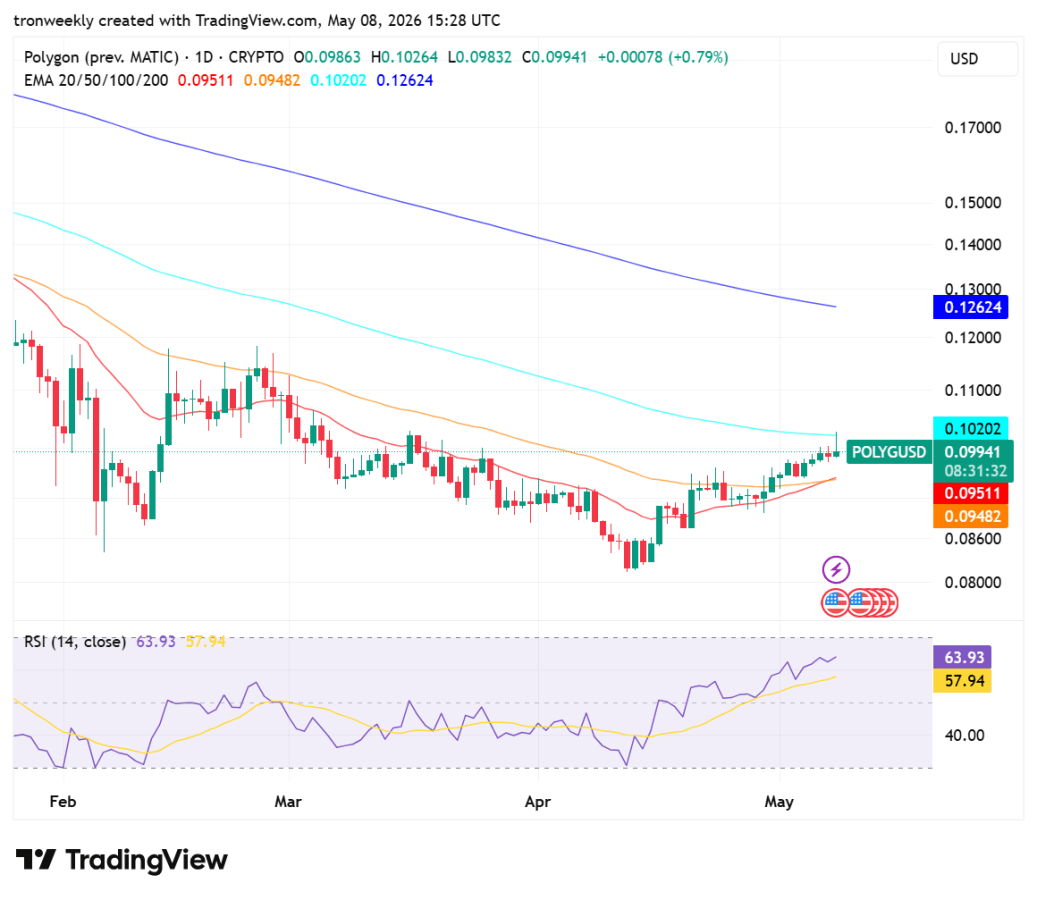
According to TradingView, the Polygon price on the daily chart reveals a transition from a bearish trend toward a recovery phase. After bottoming near $0.08200 in April, the Polygon (POL) price crossed the 20-day and 50-day EMAs.
This rounded bottom structure indicates growing short-term momentum as the moving averages begin to curl upward, providing a new layer of support for the digital asset.
Source: TradingView
Currently, the Polygon (POL) price at $0.09941 is moving closer to the psychological level of $0.1000 and touching the resistance level of the 100-day EMA.
RSI is currently at 63.93, indicating that there is still potential for an upward move without entering the overbought zone. However, the Polygon (POL) price remains below the 200-day EMA at $0.12624.
Polygon Surges to 3,200 TPS After Major Upgrade
Apart from the price movements, Polygon has achieved another benchmark in terms of speed, processing more than 3,200 transactions per second.
It is currently operating on a block time of 1.75 seconds and less than five seconds for finality due to a recent update that took place in 250 ms. This makes it clear why Polygon is among the fastest blockchain networks available today.

Source: Polygon’s X Post
The update offers around a 14% increase in throughput for payments per second, leading to improved efficiency throughout the network. In an industry that runs on milliseconds, such an increase improves usability in practical applications.
Polygon continues its trajectory toward becoming a payments-oriented blockchain, aiming to match the performance of legacy finance systems.
This article contains market analysis and price predictions. These are not guarantees. Crypto markets are volatile. Always DYOR. Not financial advice.
Also Read: Polygon Unlocks Private Stablecoin Payments to Drive Institutional Adoption
