• Skip to primary navigation
  • Skip to main content
  • Skip to primary sidebar
  • Skip to footer
  • About TronWeekly
  • Write for us
  • Terms and Conditions
  • Privacy Policy
  • Disclaimer
  • Contact
  • All Posts
  • Advertise

TronWeekly

Crypto World News

  • Home
  • Latest News
  • Opinion
    • Education
    • Best TRON Wallets
    • Beginner’s guide to TRON
    • Tron Tokens
    • Market Analysis
  • Industry
    • Tron Exchange
    • Project Review
  • Press Release
  • Bitcoin (BTC)
  • Ripple (XRP)
  • Advertise
  • About TronWeekly
    • The Team
    • Editorial Policy
    • Write for us
    • Privacy Policy
    • Disclaimer
    • Terms and Conditions
    • Contact
You are here: Home / Cryptocurrency News / Solana Prepares to Outpace Sui with New Alpenglow Consensus Protocol

Solana Prepares to Outpace Sui with New Alpenglow Consensus Protocol

By Usman Zafar | Edited By Sahana Kiran,September 2, 2025, 3:30 PM

solana
  • Solana’s Alpenglow upgrade aims to cut block finality to just 150 milliseconds.
  • More than 99% of votes cast support the proposal, and the quorum has been met.
  • The upgrade could make Solana the fastest layer-1 blockchain, rivaling Web2 speeds.

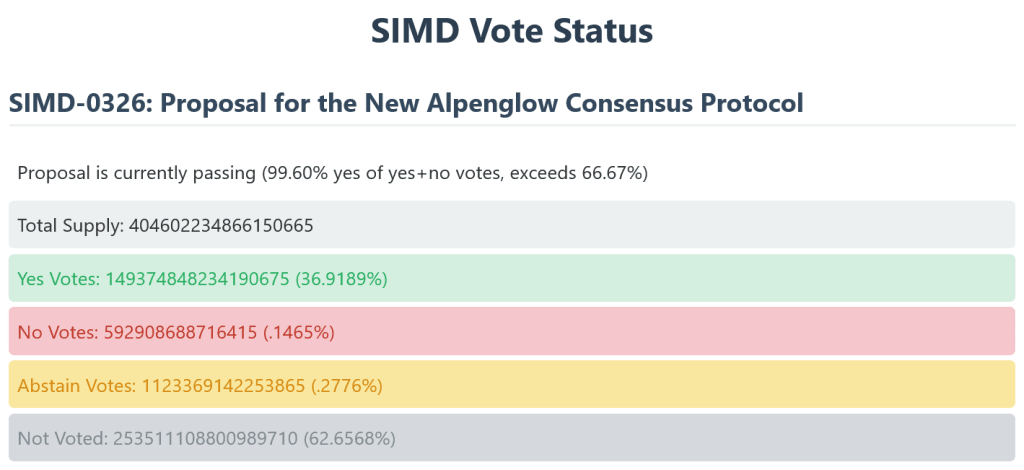
Solana’s Alpenglow proposal under the designation SIMD-0326 is entering the final stretch of its voting phase. It is being voted on between Epochs 840 and 842 and is likely to culminate on Sept. 2 at 1:40 PM UTC. Even though votes yet to be cast are more than 60% of the votes cast, the community is solidly supporting it, and the proposal is very likely to pass. It was initiated on the governance track on Aug. 21 and has witnessed votes of over 99.6% affirming it. It has already crossed the 33% quorum threshold, and therefore, the final outcome is almost a certainty.
If implemented, Alpenglow will mark one of the biggest upgrades in the network’s history. The goal is to cut block finality from 12.8 seconds to just 150 milliseconds. This nearly 100-fold improvement could put Solana on par with standard internet speeds, boosting its performance for applications that rely on fast transactions.

How Alpenglow Works

Alpenglow introduces two main components: Votor and Rotor. Votor manages voting and block finalization. It can finalize blocks in a single round if 80% of the stake participates, or in two rounds if only 60% respond. This replaces the older TowerBFT system. Rotor is a new data protocol that replaces Solana’s proof-of-history timestamping. It helps all nodes agree on the network state faster, further cutting delays.

1/ Rotor is Solana’s new block propagation protocol introduced in the Alpenglow upgrade. It’s a single layer of relayers that replaces Turbine’s multi-hop, delivering blocks faster and more uniformly across the network 🧵 pic.twitter.com/0KhpLuLe8u

— Anza (@anza_xyz) August 13, 2025

The upgrade was developed by Anza, a Solana spin-off, with researchers Quentin Kniep, Kobi Sliwinski, and Roger Wattenhofer. They noted that a median latency of 150 milliseconds does more than improve speed. It allows SOL to compete with traditional internet infrastructure and opens the door for real-time blockchain applications, from gaming to financial services, that weren’t practical before.

Also Read: Solana Targets 150ms Finality with Alpenglow Consensus Upgrade Vote

What’s Next for Solana

Even with Alpenglow, SOL will not be immune forever to outages. Currently, the network only relies on one production-grade client, Agave, and this can lead to vulnerabilities. It is said that a new autonomous validator client named Firedancer will come later this year. This will offer added resilience and client diversity.

If Alpenglow goes live, the network can possibly catch up with Sui, which confirms transactions within about 400 milliseconds, and perhaps keep up with the speed of Google searches that have results within roughly 200 milliseconds. The new update solidifies Solana as one of the best fast layer-1 blockchains and expands its potential for real-time use cases requiring instant responsiveness.

Also Read: Solana Price Prediction: Will $205 Hold or Spark a Major Breakdown?

Filed Under: Cryptocurrency News

About Usman Zafar

Usman Zafar is a News Desk writer at Tronweekly with over five years of experience in cryptocurrency and blockchain journalism. He covers Bitcoin, Ethereum, DeFi, crypto laws and regulation, market activity, Layer 2 scaling solutions, and blockchain-based innovations, focusing on fast-moving developments and official industry updates. Usman previously wrote for BTCread and follows strict verification and editing practices to ensure accurate, timely, and responsible crypto news for a global audience.

Primary Sidebar

Recent Posts

  • Chinese Developer Killed in Cambodia After $2M Crypto Ransom Demand June 1, 2026
  • SUI Analyst Reviews $0.60–$0.90 Zone After 1,300% Rally June 1, 2026
  • XRP Falls 66% From Peak as Analyst Identifies Buy Zones June 1, 2026
  • Stellar Price Surges 26% as Developer Activity Tops Web3 Rankings June 1, 2026
  • Strive Bitcoin Treasury Strategy Expands With $4.2B Funding Push June 1, 2026

Footer

News

  • Latest News
  • Altcoin News
  • Bitcoin (BTC)
  • Blockchain
  • Tron (TRX)
  • World

Digest

  • Meet the Founder
  • Price Winning Article
  • DeFi
  • Cyber Security
  • Crypto Scam

Industry

  • Project Review
  • Technology
  • Fintech
  • Tron Exchange
  • New in Town

Tron Universe

  • Event and Tron Parties
  • New in Town
  • Tron Tokens

FOLLOW US

  • Facebook
  • Telegram
  • Twitter
  • Linkedin

Editorial Policy | Privacy Policy | Disclaimer | Terms and Conditions | Masthead

Copyright © 2026 · Tron Weekly. All Rights Reserved. NOTE: Tron Weekly is an independent crypto news site that adheres to the strict journalism policy anchored on transparency, trust, and objectivity, we have no affiliation with the TRON Foundation, its founder Justin Sun or any other cryptocurrency firm.