
South Africa has shared a new plan that seeks to reshape how money flows in and out of its economy.
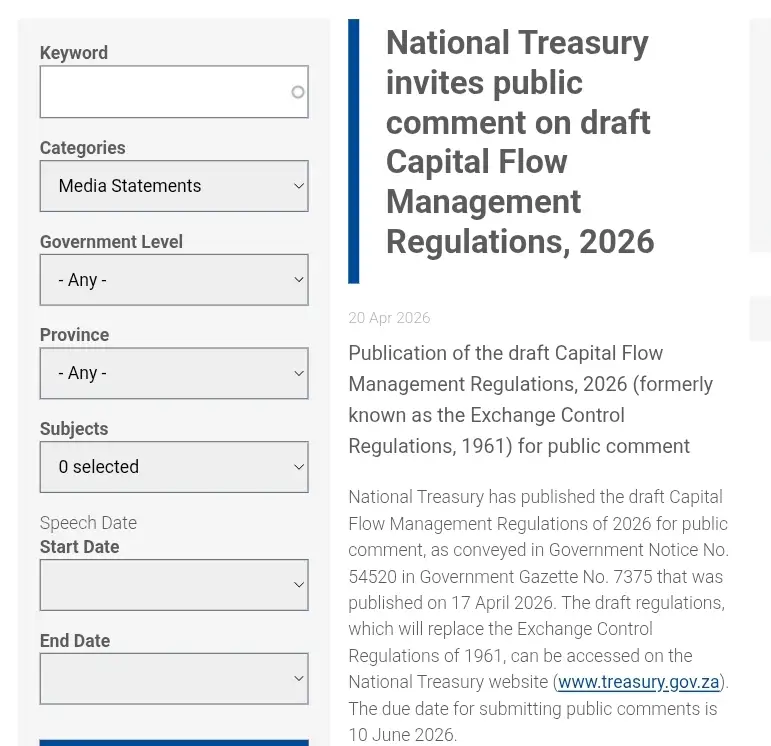
The National Treasury released a draft for the Capital Flow Management Regulations for the public to comment. These new rules recently shared are going to replace the outdated Exchange Control Regulations of 1961 and modernize South Africa’s financial system.
The proposed regulations were published in April 2026 and are open for public feedback until June 10. This step shows a major shift in how South Africa manages cross-border financial activity. For decades, South Africa has managed to successfully adjust its exchange control system, especially after scrapping the financial rand in 1991.
Source: gov.za
Authorities have tried to balance attracting global investment with protecting the economy from sudden capital outflows and currency volatility.
Now, policymakers want a more flexible and modern system. Instead of strict approvals for every transaction, the focus will move toward monitoring, reporting, and targeting high-risk financial movements. This approach aligns with global standards and aims to make the country more competitive while still managing risks.
South Africa’s Move Toward Smarter Financial Oversight
One of the biggest changes is the introduction of a “positive bias” system. This means fewer barriers for legitimate cross-border transactions, while regulators focus more on suspicious or high-impact activities.
The new framework also addresses gaps in fast-growing areas like crypto. It introduces clearer rules for cross-border crypto asset transactions, working alongside regulators like the Financial Sector Conduct Authority and the Financial Intelligence Centre.
Also Read: Global Crypto Adoption Plunges in Q1 2026 as Economic Pressure Reshapes Market
Other updates include stricter penalties, clearer definitions, and better rules for declaring foreign assets. The reforms also remove certain restrictions, such as dealing with securities owned by non-residents, and clarify how foreign-controlled local businesses should operate.
At the same time, authorities will still keep some protective measures in place. These are meant to shield the economy from shocks and ensure stability during the transition.
Once finalized, the new regulations will fully replace the old system and introduce updated manuals and exemptions to help businesses adjust.
Also Read: Ripple USD (RLUSD) Expands to Chains in 2026 Bold Move