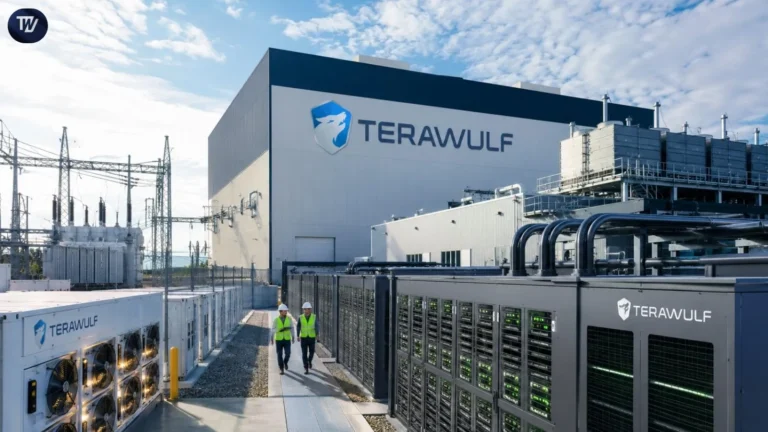
TeraWulf reported a wider first-quarter loss as weaker Bitcoin mining revenue weighed on results. The company also expanded its artificial intelligence infrastructure business. Its latest figures show a major shift in revenue toward high-performance computing services during the quarter.
According to a report, the Bitcoin miner posted a net loss of $427 million for the first quarter of 2026. That compared with a $61.4 million loss in the same period last year. The increase came as mining revenue declined and sector economics remained under pressure.
Also Read: Pakistan IMF funding boost: IMF releases $1.32 billion under EFF climate programs
TeraWulf AI Leasing Revenue Outpaces Bitcoin Mining
Quarterly revenue reached $34 million. AI and computing leasing generated $21 million of that amount. Bitcoin mining revenue fell by 50% to about $13 million.
TeraWulf said demand for AI computing infrastructure continued to support its business transition. The company is moving further into long-term leasing tied to high-performance computing. This strategy aims to reduce exposure to sharp changes in mining income.
The Chief Executive Officer (CEO), Paul Prager, said that as the year 2026 started, contracts, infrastructure, and financing were in place. He said management is now concentrating on leveraging them to generate recurring revenues.
The quarterly reports indicated that AI leasing made up a significant percentage of the company’s income.
TeraWulf brought online 60 megawatts (MW) of key IT capacity for Core42 at the Lake Mariner facility. The firm also expanded the facility further alongside its partners Fluidstack and Google. Other facilities such as CB-3, CB-4, and CB-5 will soon begin operations this year.

TeraWulf Expands Power Capacity for AI Infrastructure
According to CFO Patrick Fleury, long-term leases have helped achieve revenue stability. Recurring artificial intelligence infrastructure revenue may reduce the volatility of earnings connected to Bitcoin mining operations. At the end of the quarter, TeraWulf had about $3.1 billion in cash and restricted cash.
The company is also developing its overall infrastructure capabilities. It operates facilities in Hawesville, New York, and Maryland. The Hawesville facility has access to up to 480 megawatts of power.
According to TeraWulf, it will increase its contracted capacity by 250 to 500 megawatts yearly. This strategy will aid the firm in establishing itself in the computing infrastructure industry. This is also indicative of how the business utilizes its power resources for artificial intelligence workloads.
Other miners have adopted a similar approach. Riot Platforms generated $33.2 million in additional data center revenues for the quarter under review. The company’s growth was mainly attributed to its AMD-associated computing infrastructure expansion.
It represents a broader shift in the mining industry. The businesses are looking for sources of income outside of their block rewards and transaction fees. The company’s performance reflects the growing importance of AI infrastructure in this shift.
Also Read: BlackRock’s 2026 Ethereum Launch Boosts On-Chain Finance