• Skip to primary navigation
  • Skip to main content
  • Skip to primary sidebar
  • Skip to footer
  • About TronWeekly
  • Write for us
  • Terms and Conditions
  • Privacy Policy
  • Disclaimer
  • Contact
  • All Posts
  • Advertise

TronWeekly

Crypto World News

  • Home
  • Latest News
  • Opinion
    • Education
    • Best TRON Wallets
    • Beginner’s guide to TRON
    • Tron Tokens
    • Market Analysis
  • Industry
    • Tron Exchange
    • Project Review
  • Press Release
  • Bitcoin (BTC)
  • Ripple (XRP)
  • Advertise
  • About TronWeekly
    • The Team
    • Editorial Policy
    • Write for us
    • Privacy Policy
    • Disclaimer
    • Terms and Conditions
    • Contact
You are here: Home / Cryptocurrency News / Tether Launches QVAC SDK to Enable Universal AI Across Devices and Platforms

Tether Launches QVAC SDK to Enable Universal AI Across Devices and Platforms

What to know:

  • Tether launches QVAC SDK, enabling open-source local AI development.
  • Local-first framework ensures privacy without reliance on cloud infrastructure.
  • Decentralized features enhance resilience with peer-to-peer AI capabilities.

By Tina Fatima | Edited By Ammar Raza,April 9, 2026, 10:30 PM

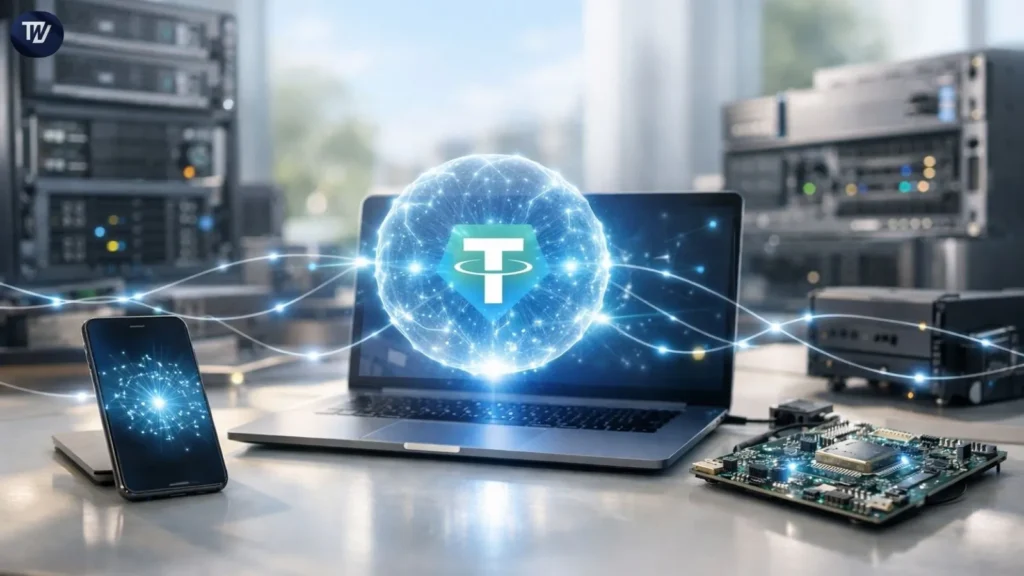
Tether’s QVAC team introduced the QVAC SDK on April 9, 2026, marking a step toward redefining how artificial intelligence operates across devices through a more open-source and distributed approach. The launch signals a move toward what the company describes as a new phase of computing, where billions of humans interact with autonomous machines and vast networks of AI agents. The SDK positions itself as a universal building block for AI systems. It focuses on modular design and high efficiency. Source: Tether Developers can deploy intelligence across a wide range of hardware, from industrial servers to compact embedded chips. The framework is designed to evolve alongside advances in silicon, ensuring long-term adaptability. This approach reflects a broader shift in thinking. AI is no longer treated as a remote service but as a core component embedded directly into devices. The goal is to create a scalable and standardized intelligence layer that supports future technological growth. Also Read: Tether Moves to Secure Funding at $500 Billion Valuation Tether Pushes Local-First AI Infrastructure QVAC SDK introduces a local-first architecture that allows AI models to run directly on user devices. This design removes the need for constant communication with centralized servers. Applications built with the SDK can function across iOS, Android, Windows, macOS, and Linux without requiring code modifications. In the case of users, it results in better performance and improved security of their data. Activities that are usually done by AI, like writing, translating, transcribing, and generating images, can be performed locally without having to send any private data out of the system. The developers benefit from simplicity in their workflows. Instead of maintaining builds separately for each operating system, one can send just one piece of code to all available platforms. This way, everything becomes simpler and easier to manage. Decentralized Infrastructure Expands Capabilities Thereby, the SDK binds various local inference engines into a single interface. These include processes such as generating text, processing speech, translating content, and multimodal applications, and they are all controlled using the same entry point in the SDK. The peer-to-peer architecture is the core of this system. The SDK is built using decentralized technology, which makes it possible to share models and perform inference without relying on a central network. In the future, upgrades will make it possible for decentralized learning and fine-tuning through distributed networks. Also Read: Tether Selects KPMG for First USDT Audit as Transparency Push Grows

Tether’s QVAC team introduced the QVAC SDK on April 9, 2026, marking a step toward redefining how artificial intelligence operates across devices through a more open-source and distributed approach.

The launch signals a move toward what the company describes as a new phase of computing, where billions of humans interact with autonomous machines and vast networks of AI agents.

The SDK positions itself as a universal building block for AI systems. It focuses on modular design and high efficiency.

Tether launches QVAC SDK
Source: Tether

Developers can deploy intelligence across a wide range of hardware, from industrial servers to compact embedded chips. The framework is designed to evolve alongside advances in silicon, ensuring long-term adaptability.

This approach reflects a broader shift in thinking. AI is no longer treated as a remote service but as a core component embedded directly into devices. The goal is to create a scalable and standardized intelligence layer that supports future technological growth.

Also Read: Tether Moves to Secure Funding at $500 Billion Valuation

Tether Pushes Local-First AI Infrastructure

QVAC SDK introduces a local-first architecture that allows AI models to run directly on user devices. This design removes the need for constant communication with centralized servers. Applications built with the SDK can function across iOS, Android, Windows, macOS, and Linux without requiring code modifications.

In the case of users, it results in better performance and improved security of their data. Activities that are usually done by AI, like writing, translating, transcribing, and generating images, can be performed locally without having to send any private data out of the system.

The developers benefit from simplicity in their workflows. Instead of maintaining builds separately for each operating system, one can send just one piece of code to all available platforms. This way, everything becomes simpler and easier to manage.

Decentralized Infrastructure Expands Capabilities

Thereby, the SDK binds various local inference engines into a single interface. These include processes such as generating text, processing speech, translating content, and multimodal applications, and they are all controlled using the same entry point in the SDK.

The peer-to-peer architecture is the core of this system. The SDK is built using decentralized technology, which makes it possible to share models and perform inference without relying on a central network. In the future, upgrades will make it possible for decentralized learning and fine-tuning through distributed networks.

Also Read: Tether Selects KPMG for First USDT Audit as Transparency Push Grows

Filed Under: Cryptocurrency News

About Tina Fatima

Tina Fatima is a Web3 & DeFi Correspondent at Tron Weekly, covering digital assets and blockchain-based financial ecosystems. Her reporting focuses on decentralized finance (DeFi), Web3 developments, Bitcoin, altcoins, and crypto regulation, with attention to major events shaping the broader cryptocurrency market.
She tracks crypto markets on a daily basis and writes news and analysis grounded in real-time market activity, official announcements, and verified market data. Tina’s work is aimed at explaining crypto developments clearly and accurately for both beginners and experienced market participants, without speculation or investment guidance.

Primary Sidebar

Recent Posts

  • TRX Price Prediction: Could TRX Move Upward After Institutional Accumulation? May 24, 2026
  • BNB Price Forecast: Accumulation Phase Points Toward $5,000 Cycle Peak May 24, 2026
  • France Dominates 70% Global Crypto Wrench Attacks Raising Investor Fears May 24, 2026
  • LINK Price Holds $9.30 Support as Bulls Eye $10.50-$12 Breakout Zone May 24, 2026
  • NEAR Protocol (NEAR) Price Breakout Signals Trend Reversal Toward $3.42 Zone May 24, 2026

Footer

News

  • Latest News
  • Altcoin News
  • Bitcoin (BTC)
  • Blockchain
  • Tron (TRX)
  • World

Digest

  • Meet the Founder
  • Price Winning Article
  • DeFi
  • Cyber Security
  • Crypto Scam

Industry

  • Project Review
  • Technology
  • Fintech
  • Tron Exchange
  • New in Town

Tron Universe

  • Event and Tron Parties
  • New in Town
  • Tron Tokens

FOLLOW US

  • Facebook
  • Telegram
  • Twitter
  • Linkedin

Editorial Policy | Privacy Policy | Disclaimer | Terms and Conditions | Masthead

Copyright © 2026 · Tron Weekly. All Rights Reserved. NOTE: Tron Weekly is an independent crypto news site that adheres to the strict journalism policy anchored on transparency, trust, and objectivity, we have no affiliation with the TRON Foundation, its founder Justin Sun or any other cryptocurrency firm.