
• Skip to primary navigation
  • Skip to main content
  • Skip to primary sidebar
  • Skip to footer
  • About TronWeekly
  • Write for us
  • Terms and Conditions
  • Privacy Policy
  • Disclaimer
  • Contact
  • All Posts
  • Advertise

TronWeekly

Crypto World News

  • Home
  • Latest News
  • Opinion
    • Education
    • Best TRON Wallets
    • Beginner’s guide to TRON
    • Tron Tokens
    • Market Analysis
  • Industry
    • Tron Exchange
    • Project Review
  • Press Release
  • Bitcoin (BTC)
  • Ripple (XRP)
  • Advertise
  • About TronWeekly
    • The Team
    • Editorial Policy
    • Write for us
    • Privacy Policy
    • Disclaimer
    • Terms and Conditions
    • Contact
You are here: Home / Cryptocurrency News / Top Crypto Exchanges Step Up With Proof-of-Reserves Amidst FTX Fiasco

Top Crypto Exchanges Step Up With Proof-of-Reserves Amidst FTX Fiasco

By Mishal Ali | Edited By Sahana Kiran,November 15, 2022, 4:00 AM

Crypto

The failure of FTX proved the importance of proof-of-reserves for centralized crypto exchanges. The growing commitment to transparency among crypto firms is encouraging for every other exchange.

Multiple crypto exchanges have expressed interest in publishing Proofs of Reserves, including popular ones, Bitget, Huobi, OKX, Deribit, Binance, Gate.io, KuCoin, Poloniex, Binance, Gate.io, and Bybi.
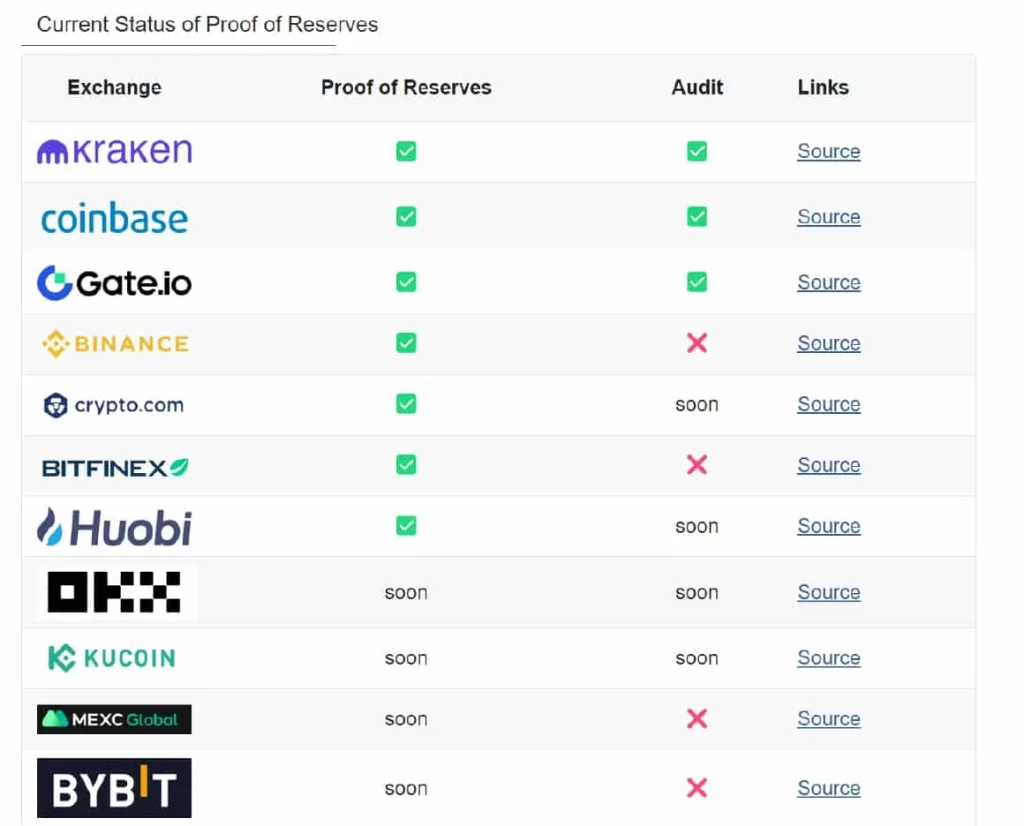
Source: Blockchaincenter.net

On Tuesday, Sam Bankman-Fried of FTX received a lethal blow from Binance founder and CEO Changpeng Zhao. He made the odd statement on Twitter that Binance will start issuing “proof of reserves.”

All crypto exchanges should do merkle-tree proof-of-reserves.

Banks run on fractional reserves.
Crypto exchanges should not.@Binance will start to do proof-of-reserves soon. Full transparency.

— CZ 🔶 BNB (@cz_binance) November 8, 2022

However, an independent audit known as a Proof of Reserves (POR) is carried out by a third party to ensure that a custodian has the assets it says it has on behalf of its clients. This auditor creates a Merkle tree, a privacy-friendly data structure that contains all client balances, using an anonymized snapshot of all retained balances.

The prominent crypto exchanges Gate.io, Coinbase, and Kraken, were the first exchanges to submit proofs of reserves that included liabilities. But despite this, Binance, the leading crypto exchange, started the trend; it hasn’t included its liabilities in its proof of reserves. 

Others, including Crypto.com, Bitfinix, and Houbi, produced proof of reserves but did not reveal their liabilities. However, community experts believe that it is a good start but isn’t sufficient.

Vinny Lingham, a trader and investor said on Saturday that displaying reserves was a diversion. He suggested that an accounting of how much a platform owes or evidence of liabilities was truly what was required.

Exchanges publishing Proof-of-Reserves is just a distraction. We also need Proof-of-Liabilities to go with it.

E.g. I could have proof that I have $1bn in deposits but if I owe depositors $2bn, then that’s meaningless.

Let’s not make the same mistake again.

— Vinny Lingham (@VinnyLingham) November 12, 2022

Crypto Exchange Gate.io Completes Proof-Of-Reserves

A third-party approved and user-verifiable Proof of Reserves audit was first made available by Gate.io in 2020, making it the first cryptocurrency exchange to do so. Additionally, the exchange just finished a new audit, which revealed that it has over 100% of its users’ BTC and ETH in reserve.

The Founder and CEO of Gate.io, Dr. Lin Han, said:

Enabling trust and transparency with users is of the utmost importance for market stability and the future of cryptocurrency. Providing 100% Proof of Reserves is a part of Gate.io’s commitment to user asset security and the long-term health of the crypto industry.

The exchange has released the source code for its “Merkle Tree Proof of Reserves” system, shared by the CEO of Gate.io on Twitter. The exchange encourages other exchanges to get consulting and advisory help and expects other platforms to embrace its open-source solution to improve transparency and industry health.

Related Reading | Shiba Inu Burn Rate Soars by 1064% as Market Slumps

Filed Under: Cryptocurrency News

About Mishal Ali

Mishal Ali is a Policy and Regulations Reporter at Tron Weekly with over four years of experience covering the global crypto and blockchain space. Her reporting focuses on crypto regulations and policy, alongside Bitcoin, Ethereum, altcoins, DeFi, NFTs, Web3, Layer 2 solutions, and AI-driven crypto use cases. She also tracks Ripple-related developments, enforcement actions, licensing updates, and crypto scams and fraud trends, helping readers understand regulatory and compliance risks.

🔗 Connect on LinkedIn

Twitter LinkedIn

Primary Sidebar

Recent Posts

  • Cardano Price Faces Downside Risk Toward $0.145 Support Zone May 14, 2026
  • Bitcoin Price Outlook: $76,527 Becomes Crucial Level for Next Market Move May 14, 2026
  • ADA Price Analysis: Cardano Eyes $0.33 as $0.25 Support Holds May 14, 2026
  • Clarity Act Faces Partisan Hurdle as Senate Talks Stall in 2026 May 14, 2026
  • Binance Coin Price Prediction: BNB Eyes Explosive 61% Surge in 2026 May 14, 2026

Footer

News

  • Latest News
  • Altcoin News
  • Bitcoin (BTC)
  • Blockchain
  • Tron (TRX)
  • World

Digest

  • Meet the Founder
  • Price Winning Article
  • DeFi
  • Cyber Security
  • Crypto Scam

Industry

  • Project Review
  • Technology
  • Fintech
  • Tron Exchange
  • New in Town

Tron Universe

  • Event and Tron Parties
  • New in Town
  • Tron Tokens

FOLLOW US

  • Facebook
  • Telegram
  • Twitter
  • Linkedin

Subscribe US

Editorial Policy | Privacy Policy | Disclaimer | Terms and Conditions | Masthead

Copyright © 2026 · Tron Weekly. All Rights Reserved. NOTE: Tron Weekly is an independent crypto news site that adheres to the strict journalism policy anchored on transparency, trust, and objectivity, we have no affiliation with the TRON Foundation, its founder Justin Sun or any other cryptocurrency firm.