South Korean cryptocurrency exchange Upbit has designated Zilliqa (ZIL) as a trading caution asset after a critical security vulnerability in Zilliqa’s application for Ledger hardware wallet users created a potential risk of private key compromise.
The decision follows Zilliqa’s suspension of all native blockchain transactions after confirming the flaw had been actively exploited, prompting multiple exchanges to take precautionary measures.
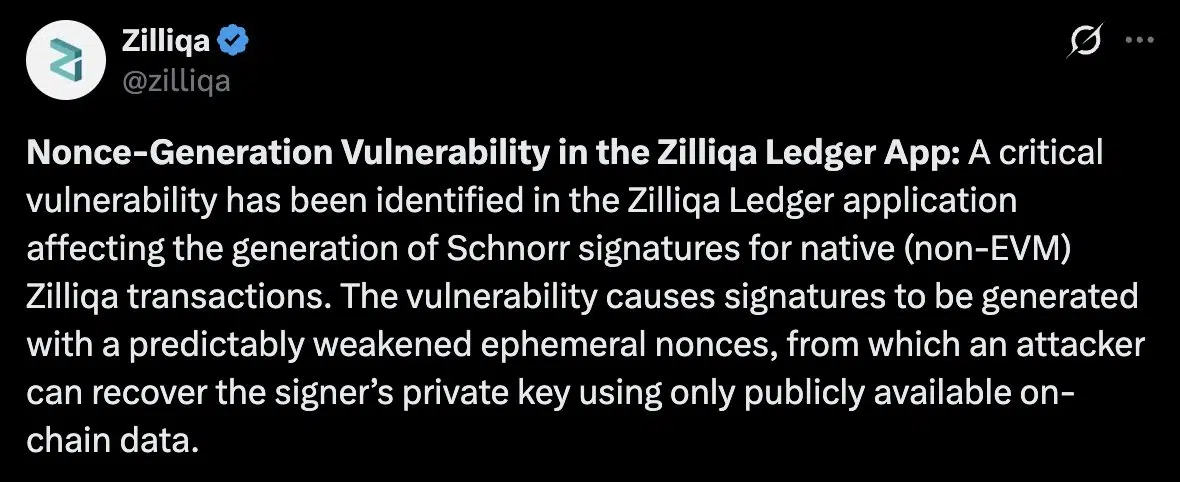
Source: Wu Blockchain’s X Post
Upbit Places Zilliqa (ZIL) Under Trading Caution
Upbit announced that ZIL/KRW and ZIL/BTC have been designated as trading caution markets after determining that the unresolved security incident could pose risks to users under South Korea’s Virtual Asset User Protection Act.
The exchange confirmed that ZIL deposits had already been suspended on July 20, while withdrawals will only resume once it determines the network is secure.
Upbit will review the project through the third week of August 2026, after which it may remove the caution designation, extend the review period, or terminate trading support if security concerns remain unresolved.
Also Read: Pi Network Launches Mainnet Protocol Version 25 While PI Targets $0.10
Zilliqa Application Vulnerability Forces Native Transaction Halt
The exchange’s action follows Zilliqa’s disclosure of a critical vulnerability affecting every version of its application designed for Ledger hardware wallet users released between 2019 and 2026.
The development team says that the bug caused an error while generating the nonce for the transaction, thus making the cryptographic signatures predictable.
Since the signatures on the blockchain are permanently stored in the blockchain, hackers would be able to reverse-engineer the private key of the user from just a few transaction signatures.
According to Zilliqa, the vulnerability had been exploited since July 19th, which made it necessary for there to be an immediate stoppage of all native transactions until engineers can find a solution to the problem. The team stressed that the EVM transactions are not affected.
Exchanges Respond as Security Concerns Grow
According to the guidelines provided by Zilliqa, both Binance and KuCoin stopped the deposits and withdrawal of ZIL to protect the funds of their customers. Zilliqa also advised users of its application for Ledger hardware wallets to create new wallet addresses, as compromised private keys cannot be secured again.
The security incident weighed on market sentiment, with ZIL falling roughly 10% as investors reacted to uncertainty surrounding network recovery and exchange support.
While many crypto vulnerabilities have historically targeted smart contracts, this incident affected the signature generation process, one of the most critical components of blockchain security. It is believed that this vulnerability had existed undetected for about seven years.
What Happens Next?
The solution that Zilliqa aims at now is long-lasting until native transaction capability is restored and activities become normal.
The investors will have their eyes fixed on the security changes to see how the exchanges are going to resume deposits and withdrawals and wait for the Upbit review due in August 2026 that can determine if the ZIL token will remain on the list of one of the largest South Korean cryptocurrency exchanges.
Also Read: Hester Peirce Warns Crypto Vaults Could Fall Under US Securities Laws