
US debt is at an all-time high of $40 trillion. The achievement of this milestone means that the spending power of the government is surpassing its income levels, thereby creating more debt for the US economy.
As per the latest information provided by the Treasury, the current level of US debt stands at $40.05 trillion, out of which $32.27 trillion is debt held by the public while the remaining $7.78 trillion is intragovernmental debt.
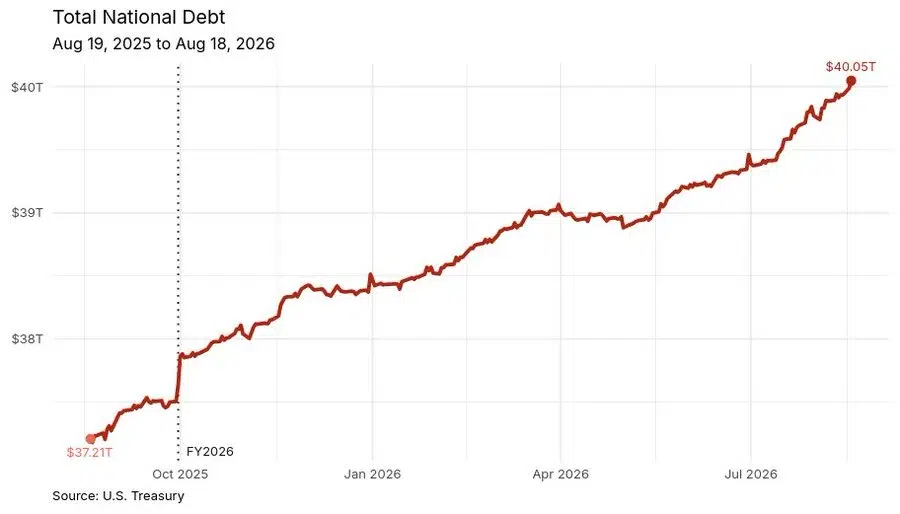
US debt has more than doubled within nine years’ time and has again grown by $1 trillion in a few months’ time.
Also Read | Chainlink Price Eyes $14.40 as Whale Accumulation Fuels Bullish Breakout
US Debt Grows as Federal Deficit Widens
The federal government has continued spending more than it receives from its revenues. The deficit for the month of July was reported to be $432 billion, the highest monthly deficit level since March 2021.
This makes the deficit for the ongoing fiscal year reach $1.799 trillion, surpassing the total fiscal year deficit of $ 1.775 trillion that occurred in the year 2025.
With such high deficits, more borrowing will have to take place, causing the US debt to rise further.
Interest Costs Add More Pressure
The increasing debt is increasingly costly to service. Rising Treasury interest rates require the federal government to refinance its maturing debts at increased costs, leading to higher interest costs for the government.
Net interest costs will exceed $1 trillion by fiscal year 2026 and would amount to 3.3% of GDP. Under existing policies, net interest costs will be $2.1 trillion in fiscal 2036.
This is one vicious circle because large deficits mean higher borrowing, and high interest costs will raise future spending by the government.
Furthermore, long-term bond yields for Treasuries have risen on fears of inflation, government borrowing, and the fiscal situation. Recently, the yield on the 30-year bond rose to 5.34%, its highest point since 2007.
Treasury Expands US Debt Buybacks
The Treasury has responded to market pressure by boosting some of its repurchase activities in 10 to 30-year bonds. This increase in repurchases has doubled their scale from $2 billion to at least $4 billion per activity.
This step has brought down long-term interest rates, but repurchases continue to be small relative to the Treasury market scale.
However, businesses also continue to borrow substantial sums of money to finance their AI infrastructure projects.
Publicly held debt will be 101% of America’s GDP in 2026 and will hit the figure of 120% in 2036, according to the Congressional Budget Office.
The US debt threshold poses a bigger question concerning the cost of borrowing in the future and whether the increased interest payments will further add to the burden of the federal budget.
Also Read | CFTC Ends Ellison, Wang Cases With Multi-Year Trading Bans
This article contains market analysis and price predictions. These are not guarantees. Crypto markets are volatile. Always DYOR. Not financial advice.