• Skip to primary navigation
  • Skip to main content
  • Skip to primary sidebar
  • Skip to footer
  • About TronWeekly
  • Write for us
  • Terms and Conditions
  • Privacy Policy
  • Disclaimer
  • Contact
  • All Posts
  • Advertise

TronWeekly

Crypto World News

  • Home
  • Latest News
  • Opinion
    • Education
    • Best TRON Wallets
    • Beginner’s guide to TRON
    • Tron Tokens
    • Market Analysis
  • Industry
    • Tron Exchange
    • Project Review
  • Press Release
  • Bitcoin (BTC)
  • Ripple (XRP)
  • Advertise
  • About TronWeekly
    • The Team
    • Editorial Policy
    • Write for us
    • Privacy Policy
    • Disclaimer
    • Terms and Conditions
    • Contact
You are here: Home / Cryptocurrency News / Why Are Banks Embracing Crypto Assets Now? The $23 Trillion Opportunity

Why Are Banks Embracing Crypto Assets Now? The $23 Trillion Opportunity

What to know:

  • More than half of the top U.S. banks are testing digital asset services.
  • Crypto adoption has reached hundreds of millions of global users.
  • Banks see stablecoins and tokenization as new revenue engines.

By Mishal Ali | Edited By Messam Raza,February 28, 2026, 3:00 PM

crypto

The world of banking is slowly entering the blockchain era. A report shared by BitGo on February 27 shows that more than half of the twenty-five largest U.S. banks are already testing digital asset services.

These trials focus on custody, tokenization, and stablecoin use. Financial institutions are trying to stay relevant as customer behavior changes.

The market for digital assets is expanding rapidly. Globally, 716 million people own crypto, and the number of monthly active users is estimated to be 40 to 70 million.

Source: BitGo

In the past year, 10 million new users entered the market. Young investors are leading the revolution, with individuals under 43 years of age allocating 14% of their investments to crypto assets.

Source: BitGo

Large investment products are also expanding. Crypto exchange-traded funds have more than $225 billion in assets under management.

Investment products linked to BlackRock have been successful, and its Bitcoin ETF was the fastest-growing exchange-traded product in the history of Wall Street.

Regulation Brings Confidence to Institutional Adoption

Slowly, governments are starting to formulate regulations for the digital market. In the United States, the GENIUS Act was passed in 2025, allowing banks and non-bank issuers to issue regulated stablecoins.

There is also another proposal called the CLARITY Act, which is being processed by lawmakers to define digital commodities and securities.

It is evident that there is progress in regulation globally. The European Union is implementing the Markets in Crypto-Assets regulatory framework to ensure that there is a uniform regulatory framework for all member states.

Singapore and Hong Kong are increasing the bar for the licensing of crypto exchanges and custody businesses.

The United Kingdom is extending crypto regulation to its core financial regulations. The volume of stablecoin transactions is now above one trillion dollars monthly.

Such high volumes are similar to those of traditional payment systems, and this indicates that digital currencies have outgrown the speculation stage of trading.

Also Read: Crypto Crime Report 2026 Reveals 8% Drop in Ransomware Revenue

Banks Explore Crypto Assets for New Revenue Streams

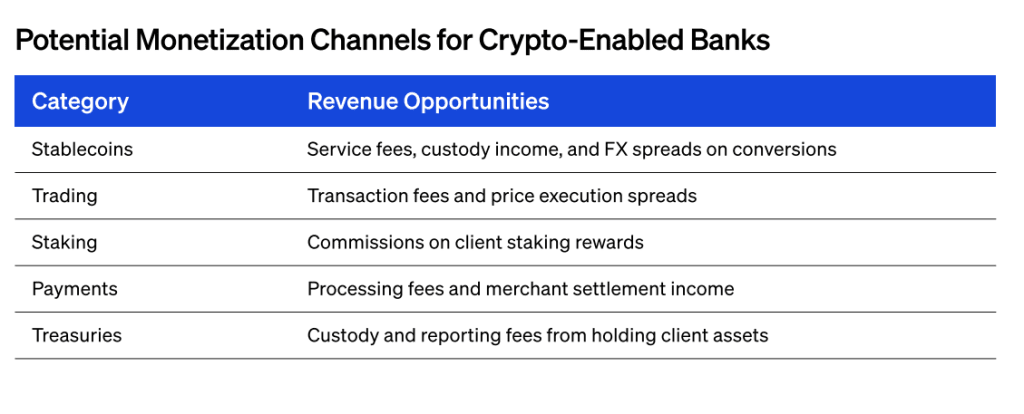
Banks are exploring ways in which digital assets can generate revenue. Stablecoins assist in maintaining deposits and enable instant payments. The trading function within banking apps can generate revenue through spreads and fees.

Staking is another revenue-generating function where customers can lock their digital assets on proof-of-stake blockchains and earn rewards, with a nominal service fee charged by banks. Cross-border payments become cheaper using blockchain rails.
Source: BitGo

Tokenization is expected to be a large financial trend. Forecasts indicate that the market for tokenized assets could reach $23 trillion by 2033. Wealth platforms are likely to combine traditional investment portfolios with blockchain-based assets.

Also Read: Judge Blocks Binance’s Arbitration Push, Keeping Pre‑2019 Crypto Claims in U.S. Court

Filed Under: Cryptocurrency News

About Mishal Ali

Mishal Ali is a Policy and Regulations Reporter at Tron Weekly with over four years of experience covering the global crypto and blockchain space. Her reporting focuses on crypto regulations and policy, alongside Bitcoin, Ethereum, altcoins, DeFi, NFTs, Web3, Layer 2 solutions, and AI-driven crypto use cases. She also tracks Ripple-related developments, enforcement actions, licensing updates, and crypto scams and fraud trends, helping readers understand regulatory and compliance risks.

🔗 Connect on LinkedIn

Twitter LinkedIn

Primary Sidebar

Recent Posts

  • XRP Price Builds Long-Term Setup as Fibonacci Extensions Target $8 May 16, 2026
  • Dogecoin Price Could Rebound Toward $0.15 if Buyers Regain Momentum May 16, 2026
  • Ethereum Price Weakens Short-Term but Long-Term Target Remains $5,000 May 16, 2026
  • Cardano Price Holds $0.25 Support as Wealth Tech Forum Sparks Optimism May 16, 2026
  • Hyperliquid (HYPE) Price Eyes $100 Target Amid Strong Bullish Momentum May 16, 2026

Footer

News

  • Latest News
  • Altcoin News
  • Bitcoin (BTC)
  • Blockchain
  • Tron (TRX)
  • World

Digest

  • Meet the Founder
  • Price Winning Article
  • DeFi
  • Cyber Security
  • Crypto Scam

Industry

  • Project Review
  • Technology
  • Fintech
  • Tron Exchange
  • New in Town

Tron Universe

  • Event and Tron Parties
  • New in Town
  • Tron Tokens

FOLLOW US

  • Facebook
  • Telegram
  • Twitter
  • Linkedin

Editorial Policy | Privacy Policy | Disclaimer | Terms and Conditions | Masthead

Copyright © 2026 · Tron Weekly. All Rights Reserved. NOTE: Tron Weekly is an independent crypto news site that adheres to the strict journalism policy anchored on transparency, trust, and objectivity, we have no affiliation with the TRON Foundation, its founder Justin Sun or any other cryptocurrency firm.