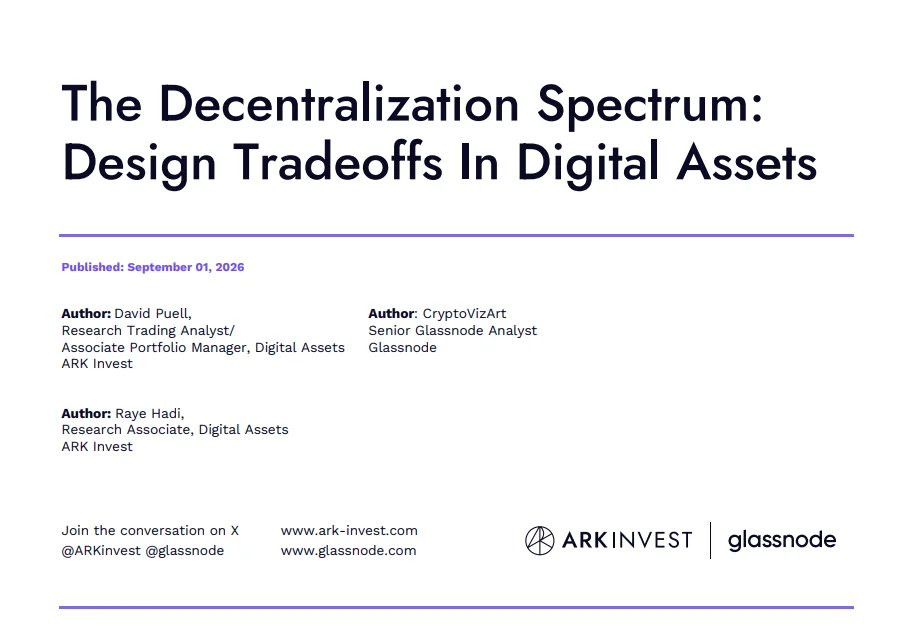
The ARK Glassnode report highlights the differences between BTC, ETH, and SOL, taking into account their different ways to achieve decentralization. Released on September 1, 2026, this study conducted by ARK Invest and Glassnode covers auditability, security, governance, and ownership.
The title of the report is “The Decentralization Spectrum: Design Tradeoffs in Digital Assets.” According to the report, the concept of decentralization should not be considered either centralized or decentralized but is associated with different design choices of blockchain systems.
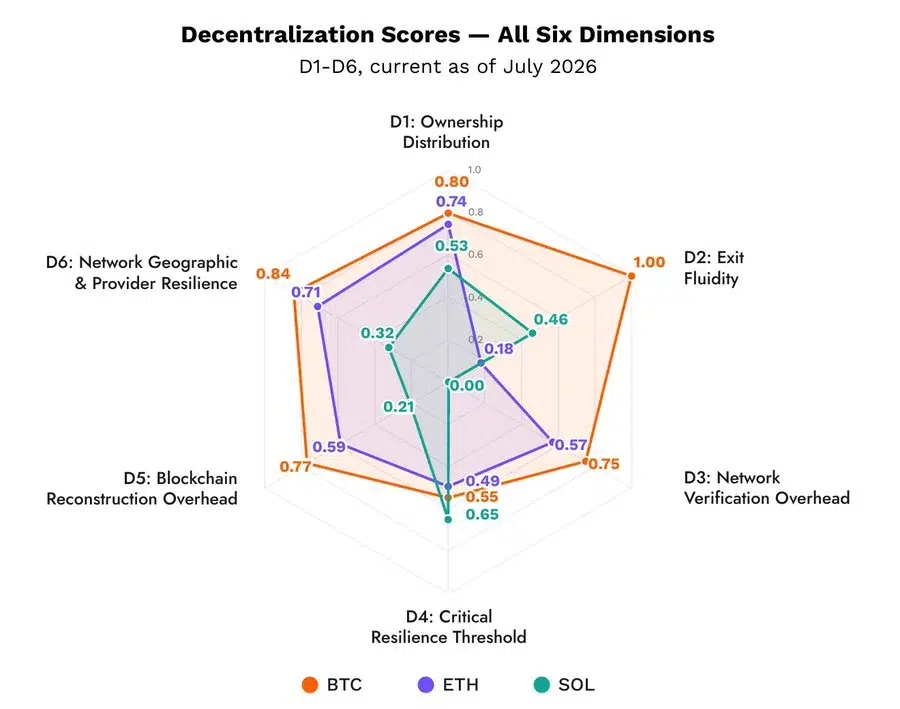
The ARK Glassnode report analyzes the distinctions between major blockchains in terms of six measurable parameters, offering investors and developers a data-driven basis for their comparison.
Also Read | Bitcoin Faces September Risk After 2 Green Months in 2026
ARK Glassnode Report Shows Different Blockchain Designs
Bitcoin, Ethereum, and Solana use distinct methods of designing their networks.
While Bitcoin focuses more on the elements of auditability, the distribution of ownership, and monetary legitimacy, Ethereum uses an approach that tries to balance decentralization and programmability using proof-of-stake. Solana, on the other hand, concentrates much on speed and efficiency.
The main insights obtained from the ARK Glassnode report include control thresholds. It is a measurement of how many entities would need to collaborate to gain critical control of block creation.
Bitcoin and Ethereum have a control threshold of three, whereas Solana has one of 19. These numbers do not imply that the entities already control their corresponding networks. They are rather indicative of potential concentration levels.
Security and Infrastructure Differ Across Networks
In addition, the report emphasizes the different procedures for entering and exiting the networks for participants.
While Bitcoin uses the proof-of-work system, where a miner would be able to easily quit, a miner owning 1% of network power would be able to quit within about 30 seconds by simply shutting off its equipment.
The proof-of-stake system used by Ethereum works differently. For instance, unstaking an equal amount of money may take several weeks, depending on the demand.
Solana depends a lot on data center infrastructure for its high performance levels. The data center infrastructure helps it achieve fast transaction processing while at the same time raising the issue of infrastructure centralization.
Another distinction between the blockchains is their geographical dispersion and service providers. Bitcoin is geographically widely distributed, where more than 63% of the nodes use the Tor service. Ethereum is geographically dispersed by cloud providers, where 20% of the nodes are hosted by AWS.
ARK Glassnode Report Highlights Six Measures
The ARK Glassnode report grades the networks on criteria like distribution of ownership, exitability, verification costs, robustness, cost of reconstituting the blockchain, and geographic and provider robustness.
Bitcoin excels in terms of distribution of ownership and geographic robustness. Ethereum finds a balance between decentralization and programmability, whereas Solana is focused more on speed and scalability.
On the whole, the ARK Glassnode report concludes that there is no single blockchain that outperforms others in all measures of decentralization.
Also Read | ZEC Signals Bullish Reversal as $900 Breakout Emerges as Key Target