
Artificial Intelligence (AI) is revolutionizing the way people work, with new data indicating a significant increase in its usage throughout the country, particularly among high-earning workers. Meanwhile, a major court ruling in China has established boundaries for the utilization of AI in hiring decisions.
Artificial Intelligence Adoption Surges Among High Earners
A Market Intelligence firm, The Kobeissi Letter, noted that AI tools have become a norm within the contemporary workspace.
As per a recently conducted survey by the Federal Reserve Bank, 66.3% of the United States’ employees who earn more than $200,000 have reported using AI tools at their workplaces in the last year. It is evident from these statistics that as the income level decreases, the usage of AI tools reduces as well.
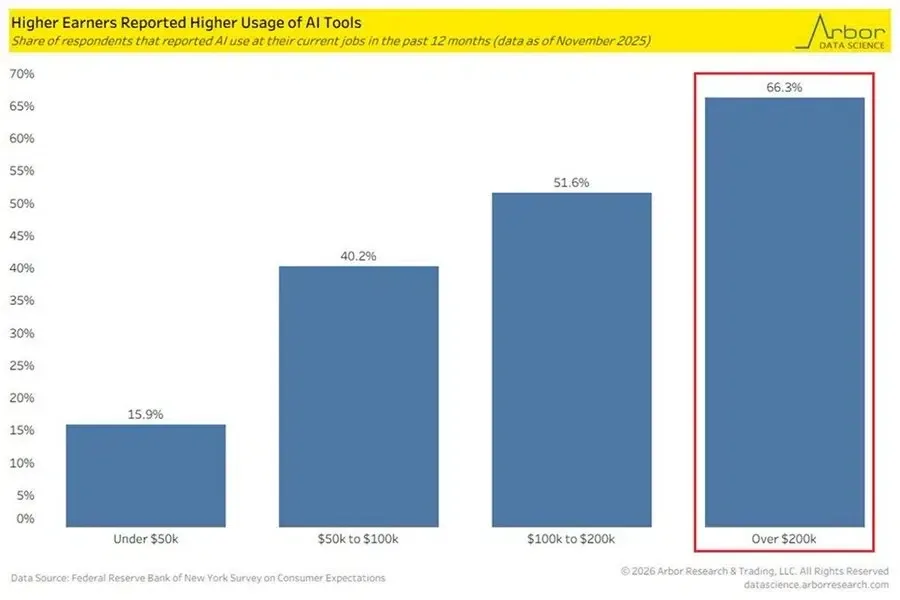
This difference becomes clearer when looking at lower-income households. Workers earning less than $50,000 only accounted for 15.9% of individuals who used AI software. Education is another significant factor; college-educated employees make up 58.7% of people using AI software in their work, while non-college-educated employees represent only 22.9%.
Patterns related to work also reveal a similar divide. There is a higher use of Artificial Intelligence among full-time workers, as opposed to part-time workers, at 42.7% versus 24.7%, respectively. For the users, 68% believe that AI simplifies their job, while 56.7% are able to be more productive.
Also Read | Ripple Strengthens Global Payouts as MassPay Links to VISA Direct Rails in 2026
China Court Limits AI Workplace Layoffs
Although AI is aiding organizations to be more efficient, it is simultaneously generating worries among employees about their job security. For instance, there is an interesting case related to the use of AI technology by corporations in China.
The ruling from the Hangzhou Intermediate People’s Court in the case brought by an experienced IT worker named Zhou stated that the adoption of AI technologies does not amount to a substantial alteration in employment terms as per China’s labor laws. Consequently, enterprises cannot dismiss or reclassify workers on the grounds of such a technological innovation.

The decision serves as a clear message to technology companies that have invested heavily in automation. Although AI can lower expenses and boost production, it does not grant businesses unlimited discretion to alter their staffing without legal constraints.
These trends reflect an international trend where AI improves efficiency in America, especially for professional employees, whereas Chinese policymakers strive to ensure that workers’ rights remain intact amidst the rise of Artificial Intelligence (AI).
With the increasing application of artificial intelligence, the challenge of maintaining a delicate balance between innovation and job security will continue to be a significant challenge for everyone.
Also Read | ZEC Breaks Out of Consolidation: Is a Massive Bull Run Toward $600 Coming?
