Binance is expanding its derivatives operations from crypto-assets with the introduction of its very first foreign-exchange perpetual futures contract that enables investors to trade the U.S. dollar relative to the Brazilian real via a USDT-denominated instrument.
Table of Contents
Based on an official press release by Binance dated September 18, the USDBRLUSDT perpetual contract will be available at Binance Futures from September 21 at 14:00 UTC. This is the very first perpetual futures contract offered by Binance that is related to a traditional foreign-exchange currency pair of the U.S. dollar versus the Brazilian real.
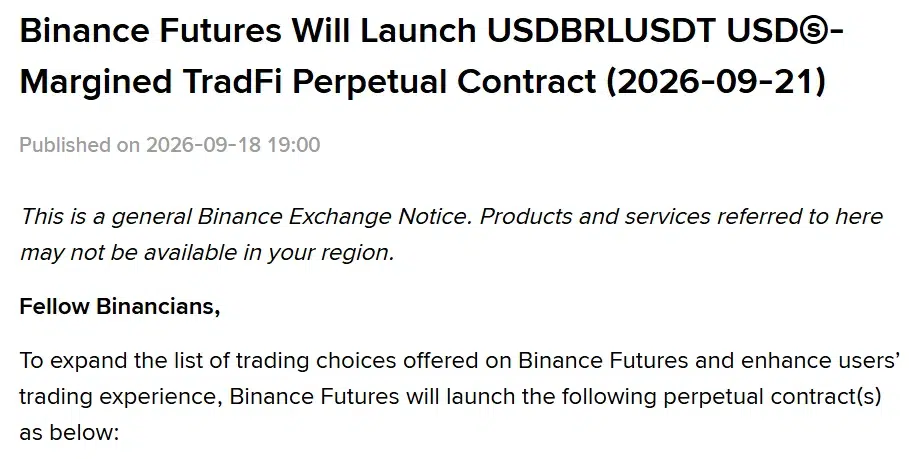
Binance USDBRL Contract Details
The USDBRLUSDT contract will be USDⓈ-margined and quoted in USDT, with the leverage reaching up to 100x. As per the Exchange, the tick size and minimum notional value of this contract have been set at 0.0001 and 5 USDT. Funding will be paid out every eight hours, and the funding rate will be restricted within -0.375% to +0.375%, while the interest rate will stay at zero percent.
Furthermore, the contract will also support Binance’s Multi-Assets Mode, wherein qualified users may utilize a variety of supported assets for collateral.
Also Read | GenLayer CEO Says CLARITY Act Stall May Bring Back Crypto Middlemen
Binance Brings 24/7 Trading to FX
Another characteristic of the USDBRL contract is that trading occurs on a 24×7 basis. The typical forex trading market operates during specified market hours and shuts down during weekends and holidays. The perpetual nature of the contract ensures that it can continue to trade even when the spot FX market is closed.
The pricing mechanism will differ based on whether the forex market is open or not. The index will be calculated using the price data from the data vendors every second between 17:00 ET on Sundays and 17:00 ET on Fridays. In case of weekend and holiday periods, the order book will be used for the calculation of the EWMA.
The pricing mechanism ensures that the perpetual contract continues running even when normal foreign exchange prices are not available through the feed. This also brings out one of the contrasts between an FX derivative based on a crypto exchange and regular currency trading, which relies a great deal on market sessions.
The Exchange Expands Its TradFi Derivatives Push
The launch of USDBRL is a continuation of Binance’s overall strategy to expand to the traditional financial world. In addition to launching perpetuals for non-crypto assets, the Exchange has also been working on other TradFi products.
The launch of a foreign currency perpetual will add yet another important asset class from the TradFi world to Binance’s derivatives product suite. The launch will also lay down a foundation for more currency pairs in case Binance chooses to do so.
Why the Binance FX Launch Matters
The USDBRLUSDT contract offers the user exposure to changes in the relationship between U.S. dollars and Brazilian reals, without owning any of the two currencies. The USDT settlement method enables the use of the same wallet structure that the Exchange uses for its other derivatives products.
On the downside, the high leverage limit of 100x on the contract can amplify both profits and losses. In addition, the funding costs and the difference between the perpetual contract and the underlying FX market can have an impact on one’s position, especially on weekends and holidays.
The launch is thus important not only due to the new currency pair but also due to the crypto-based perpetual trading model of the Exchange being used in a regular financial market.
WSJ Reports Lagarde Intervention Over Binance License
The introduction of Binance FX is at a time when Binance continues to be the subject of regulatory scrutiny in Europe. As per reports in The Wall Street Journal, the European Central Bank’s president Christine Lagarde blocked Binance’s efforts for a MiCA license via Greece.
As per the report, the European authorities had worries about Binance’s compliance history and the threat of the expansion of dollar stablecoins in Europe. It was also feared that the use of more dollar stablecoins could have an effect on the European financial system and the digital euro of the European Union.
The Exchange had reportedly been gearing up to declare that its Greek application had been approved prior to the disruption of the process. The Exchange later reportedly withdrew its application, citing the Wall Street Journal.
It must be noted that the ECB itself is not responsible for issuing the MiCA license. It is the responsibility of national authorities within the EU jurisdiction to decide on licensing issues.
The Exchange Moves Closer to Traditional Finance
The Exchange USDBRLUSDT perpetual contract is yet another move towards expansion in foreign currency trading markets by the Exchange. With its introduction of a 24/7 USDT-settled derivative product, Binance is including conventional forex trading into its existing system of perpetual futures contracts.
The September 21st launch will mark the first time the Exchange will have an FX perpetual contract. Although it is unknown what currency pairs will be included in the future after the listing of USDBRL on the exchange, the USDBRL contract lays a framework for it.
Also Read | Hyperliquid TVL Hits Stunning $6.76B as L1 Dominates