
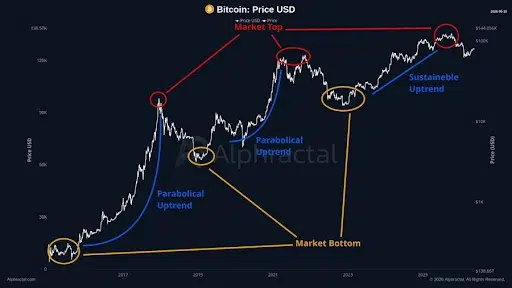
Crypto analytics platform Alphractal shared a detailed thread explaining how the Bitcoin Cycle has evolved over the past decade. The report highlighted that Bitcoin formed three major macro tops during this period, but each followed a different structural pattern.
It can be seen that the market experienced a rapid parabolic increase to a peak, followed by a steep decline in 2017.
The same trend was visible during 2020 and 2021, where there was a rapid rise in Bitcoin and a subsequent steep fall. However, during 2023 and 2024, the Bitcoin Cycle is quite unlike what has been witnessed before.
Source: X
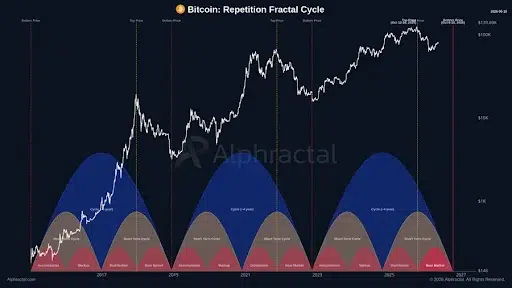
According to Alphractal, the market cycles follow four stages, namely, accumulation, markup, distribution, and markdown. It is also important to note that the Bitcoin market follows four-year cycles because of halving, which impacts mining returns.
Also Read: Ethereum Price Prediction: Will ETH Break $2,200 or Drop to $1,800?
Bitcoin Cycle Indicators Reveal Market Position
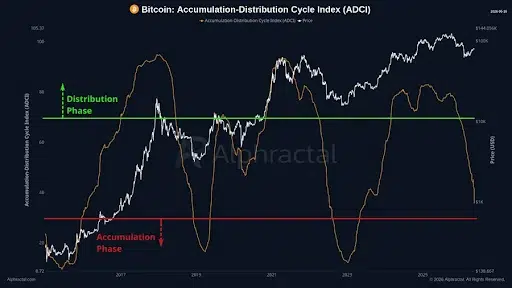
Among such indicators, the Accumulation/Distribution Cycle Index, or ADCI is one that has been talked about. It is a proprietary index that gauges the stage in the Bitcoin Cycle based on blockchain transactions. Above 70 implies a distribution condition, while values under 30 indicate accumulation.
Source: X
According to Alphractal, sustainable bull trends tend to drift horizontally for a relatively extended period of time before topping out, whereas unsustainable rallies tend to crumble after sharp upward price moves.
According to the firm’s Repetition Fractal Cycle theory, Bitcoin usually exhibits behavior in a cycle of about four years, which includes a period of a year of accumulation followed by a period of higher gains.
Source: X
Historical data indicate that Bitcoin usually achieves record highs after about three years following a significant low point.
Cost Basis Metrics Track Bitcoin Market Transitions
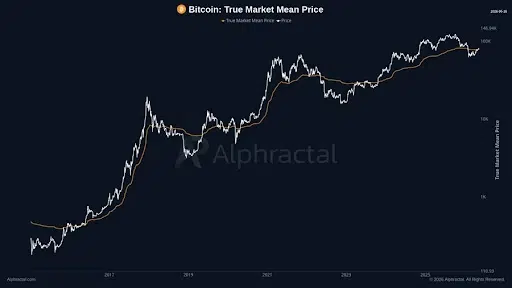
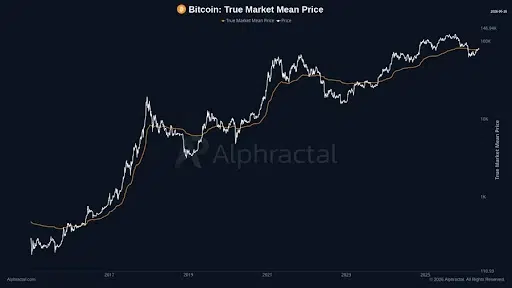
In order to identify trend strength and reversals in the Bitcoin Cycle, Alphractal evaluated a number of cost-related metrics. TMMP (True Market Mean Price) reflects the average cost of buying an active Bitcoin, not including the dormant stock owned by miners.
A Bitcoin price that stays above TMMP indicates a bull run, whereas when the price falls below TMMP, it means bearish conditions prevail.
Source: X
A Bitcoin price rising above Short-Term Holder Realized Price indicates a high level of demand for the cryptocurrency, whereas when it falls, it implies weak momentum and increased selling pressure. STH-LTH provides insights into the different Bitcoin cycle phases.
Source: X
This article contains market analysis and price predictions. These are not guarantees. Crypto markets are volatile. Always DYOR. Not financial advice.
Also Read: Solana Overtakes Ethereum With $1.23B in RWA Lending