Bitcoin has continued to underperform the U.S. stock market, prompting renewed debate over whether the cryptocurrency has reached its cycle low.
Crypto analyst Niels argues that BTC may experience one final capitulation if equities weaken before eventually outperforming traditional markets. While the view remains speculative, it reflects a broader discussion about BTC’s evolving relationship with risk assets.
Bitcoin Trades Below Stocks Across 2 Major Market Cycles
According to Niels (@Web3Niels), Bitcoin is still lagging U.S. equities based on the BTC/SPX ratio, a metric comparing BTC’s performance against the S&P 500 Index. In an X post, the analyst wrote, “The final capitulation in Bitcoin will happen once the stock market crashes. After that, Bitcoin will start to outperform the stock market.”
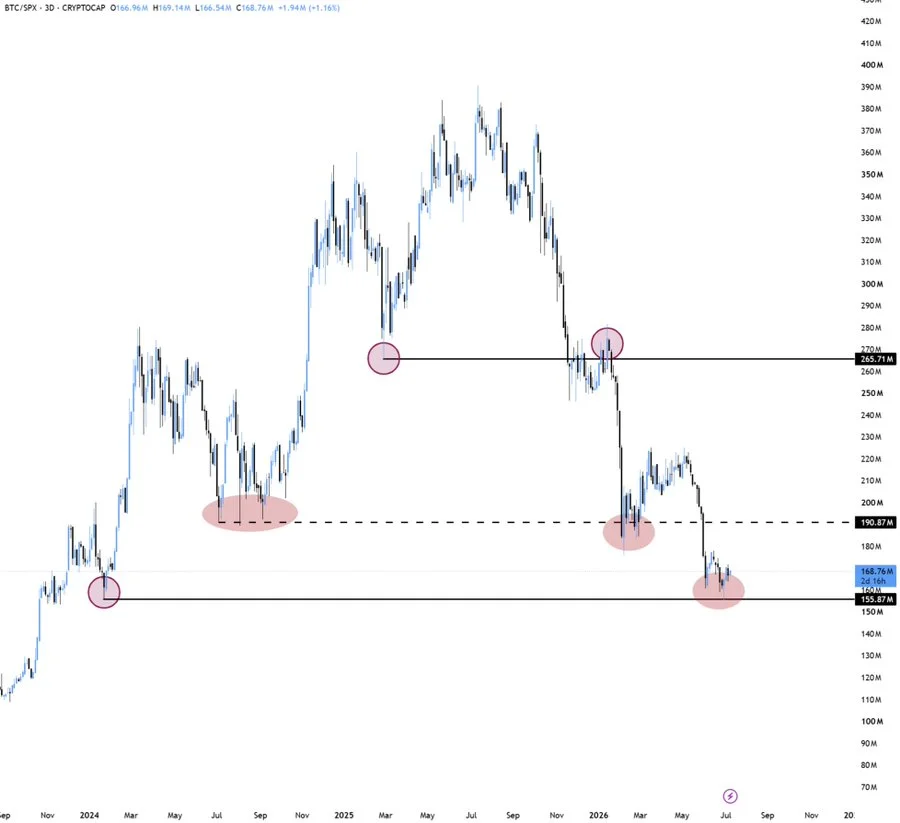
The accompanying chart highlights historical support and resistance zones in the BTC/SPX ratio. It suggests BTC has yet to establish sustained relative strength against equities.
Although the chart is not a prediction of price, it reflects the analyst’s view that macro conditions remain the primary driver of BTC’s performance.
Also Read: BlackRock Resumes Bitcoin Buying After 2 Week Pause
Macroeconomic Trends Continue to Shape BTC Performance
Bitcoin has increasingly traded alongside technology stocks during periods of tighter monetary policy and changing investor risk appetite. Higher interest rates and economic uncertainty have reduced demand for speculative assets, often causing BTC and equities to move in the same direction.
However, previous market cycles have shown that BTC can eventually decouple from traditional assets. During periods of renewed liquidity and improving investor sentiment, the cryptocurrency has historically outperformed many equity benchmarks. Whether that pattern repeats will largely depend on macroeconomic conditions and institutional capital flows.
Institutional Demand Adds New Layer to BTC Market
Unlike previous cycles, BTC now benefits from growing institutional participation following the launch of spot BTC exchange-traded funds (ETFs) in the United States. According to BlackRock, its iShares BTC Trust (IBIT) has become one of the fastest-growing spot BTC ETFs, reflecting sustained institutional interest despite periods of market volatility.
ETF inflows have introduced a new source of demand that did not exist in earlier cycles. While institutional buying may help absorb selling pressure, broader market weakness could still influence short-term price movements as investors reduce exposure to risk assets across multiple markets.
BTC Outlook Depends on Stocks and Investor Confidence
The next phase for BTC may depend on whether U.S. equity markets maintain their current momentum or enter a deeper correction. If equities weaken significantly, BTC could initially face additional selling pressure before establishing stronger relative performance, as suggested by Niels’ analysis.
Investors should recognize that this outlook represents one analyst’s interpretation rather than a confirmed market forecast. Monitoring macroeconomic data, Federal Reserve policy, ETF flows, and on-chain indicators will likely provide a more comprehensive picture of BTC’s direction over the coming months.
Also Read: Trump Says Iran MoU Is Over as Bitcoin Drops, Oil Rallies