Argentina’s growing stablecoin market is attracting deeper institutional interest as Circle expands its Latin American footprint through a regulated partnership with financial group BIND.
Circle, the issuer of the USDC stablecoin, has partnered with Argentine financial group BIND to provide institutional access to USDC through BIND’s digital asset platform, BEN, in a move aimed at integrating regulated stablecoin infrastructure into the country’s financial system.
Announced during Circle CEO Jeremy Allaire’s visit to Buenos Aires, the partnership will allow eligible businesses and financial intermediaries to use USDC for treasury operations, payments, and digital asset transactions.
BEN will operate through Grupo BIND’s registered Virtual Asset Service Provider (VAS/PSAV), offering institutions a regulated gateway to dollar-backed stablecoins.
“Through BEN, we aim to provide companies with transparent, secure, and efficient access to digital dollar infrastructure within a framework designed to support regulatory compliance and operational integrity,” said Andrés Meta, shareholder of Grupo BIND.
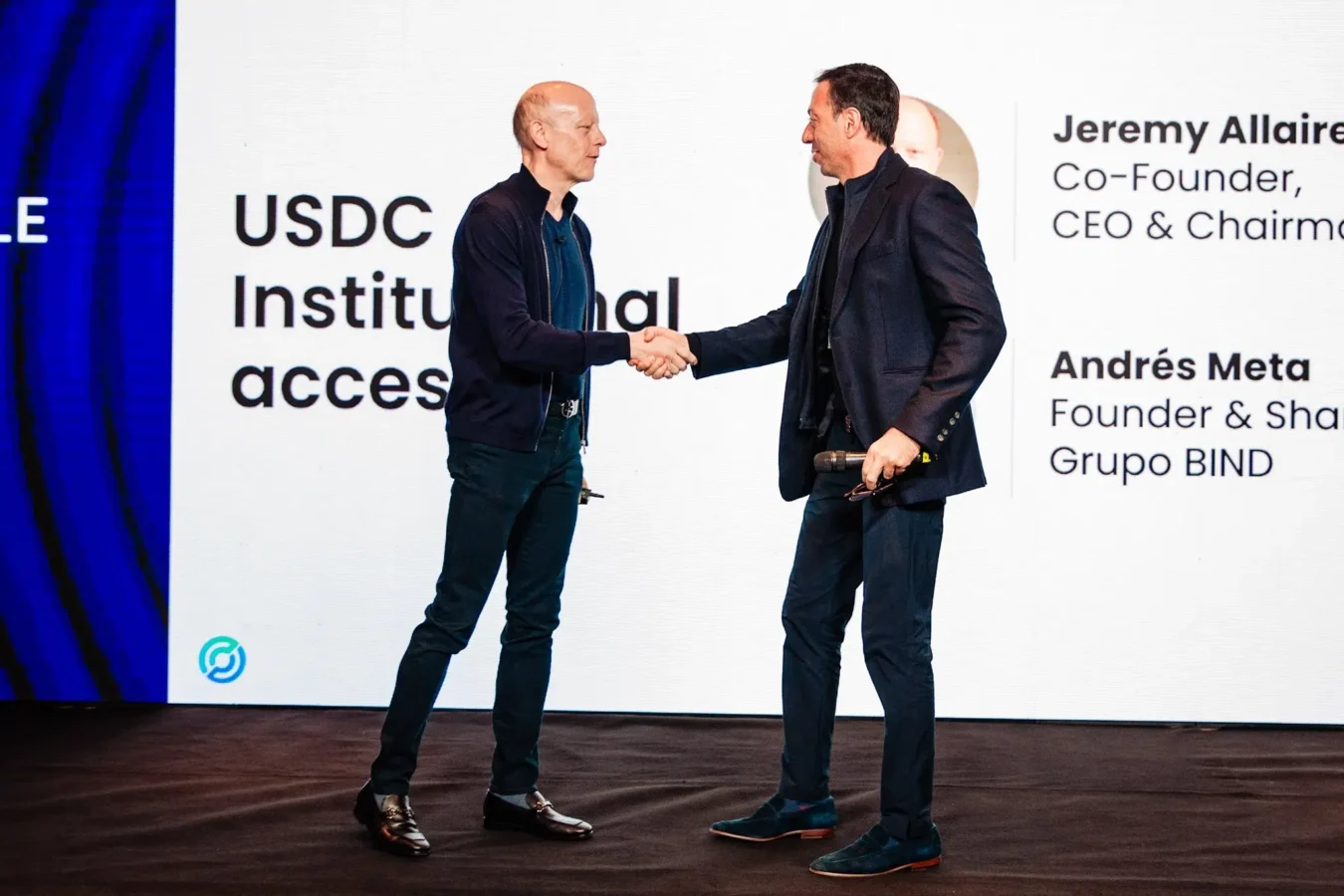
Source: Jeremy Allaire’s X Post
Also Read: Circle Secures Key JCB Deal to Test USDC Payments 2026
Circle Brings Institutional USDC to Argentina
The alliance arises when Argentina maintains its position among the world’s largest markets for stablecoins, owing to years of high inflation rates, repeated currency devaluation, and limited access to US dollars.
Stablecoins have already become a popular instrument for protecting the purchasing power of consumers, while the alliance between the companies shifts the focus towards institutional usage.
By allowing corporations to access their digital currencies through a licensed financial institution rather than simply cryptocurrency exchanges, the collaboration may enable large-scale corporate treasury management, easy cross-border transactions, and strong blockchain-enabled payment systems.
Circle Advances Regional Stablecoin Strategy
The move by Circle to expand in Latin America is not just a mere idea; rather, it is a fundamental aspect of its Latin American expansion strategy. The firm is putting together a local team in Argentina and looking for partnerships with banks, fintech companies, exchanges, and payments solutions providers. Circle currently operates in Brazil and plans to move into Mexico and Colombia.
During his visit, Allaire said stablecoins are evolving beyond crypto trading into core financial infrastructure.
“People have discovered that, by using stablecoins, they can transact instantly and at no cost with anyone, anywhere in the world,” he said, adding that blockchain technology could eventually make the concept of “cross-border payments” obsolete.
Circle is currently collaborating with Argentina’s Central Bank, the National Securities Commission (CNV), and the Ministry of Economy in the process of formulating new regulations for digital assets.
What could be next?
The cooperation emphasizes Circle’s strategy to attract regulatory institutional customers rather than focusing on only the retail customers, an area where the competing stablecoin USDT has been dominating in most parts of Latin America.
Argentina would be able to benefit from the creation of such institutions that would make international payments more efficient for businesses operating in such an unstable economy.
However, the success of the program will depend on the consistency of regulations in a country known for its inconsistent policy-making process. If such regulations emerge, then the cooperation between Circle and BIND might become a turning point.
Also Read: Tether Ban Debate Intensifies After Circle Blocked Heka Over USDC Arbitrage