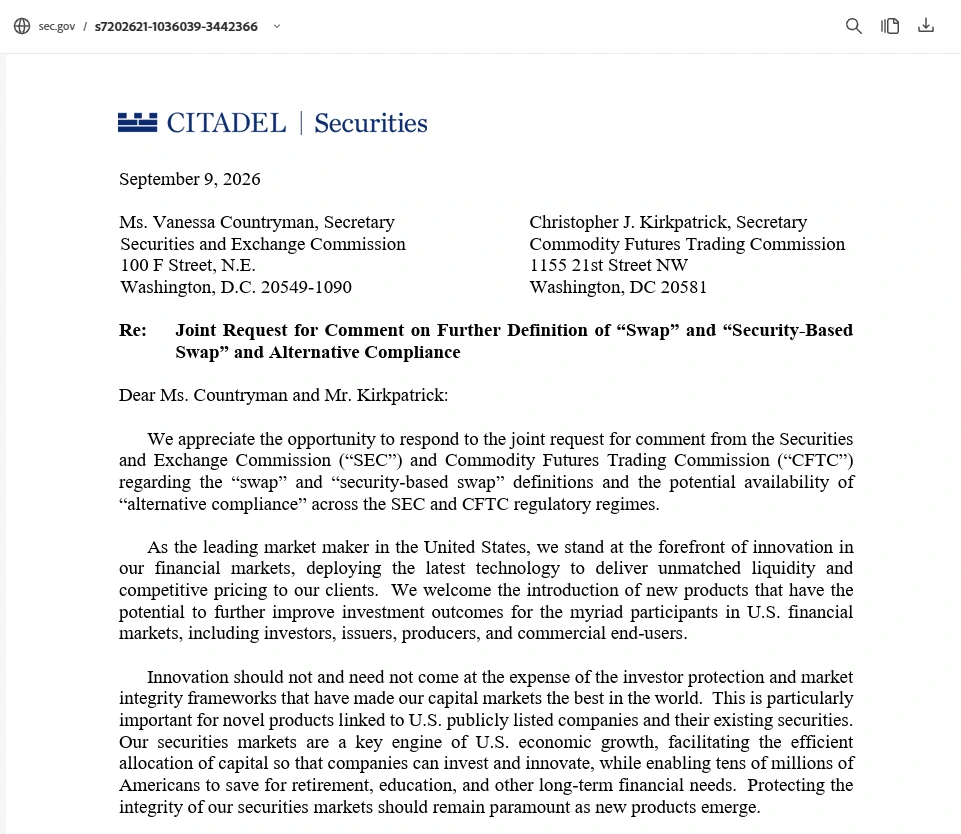
Citadel Securities is requesting that the Commodity Futures Trading Commission transfer responsibility for regulating prediction market contracts to the Securities and Exchange Commission. The company argues that bets on publicly traded companies are securities, not commodities.
The timing also coincides with prediction contract revenues being at their highest, crypto-based platforms growing, and the US administration grappling with a discrepancy that may radically change the way equity-linked risk is transacted.
Citadel Securities, a prominent figure in the trading industry, wrote in the letter that new technologies should not lead to a relaxation of the rules under which the American securities markets operate. Equity futures and security-based swaps are already within the ambit of the SEC’s regulations, and products having a connection with publicly traded U.S. firms should be under the SEC’s supervision as well.
Table of Contents
Closing SEC Loophole
The dispute is about KPI contracts, which are prediction products that end up settling the main performance indicators of public companies like revenue earnings user growth, etc. Citadel Securities claims that these are security-based swaps as per the legal definition and fall under the SEC’s supervision.

Mainly worries about the way contracts are introduced. Under CFTC regulations, designated contract markets can themselves confirm the creation of a new contract and start trading on that business day. Then again, venues regulated by the SEC must submit documents formally and then wait for public comment and finally, approval by the SEC.
Citadel Securities said that venues might take advantage of self-certification to get around SEC’s jurisdiction.
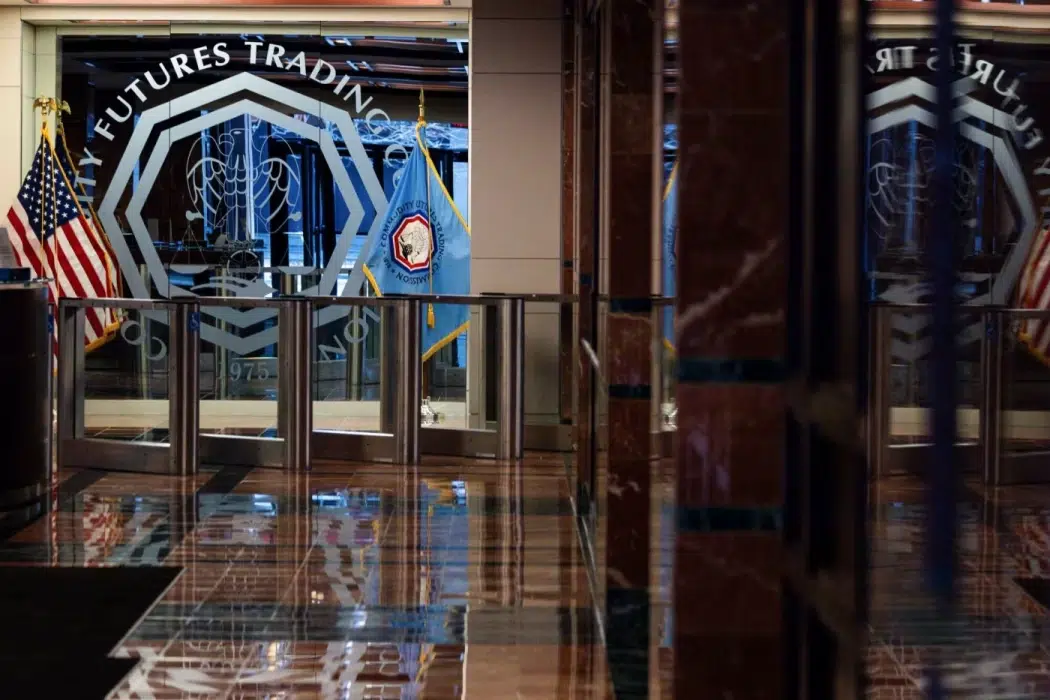
Source: WSJ
The company also pointed out equity-linked perpetual derivatives, which are instruments duplicating perpetual futures as popularized by, for instance, Binance, Bybit, and dYdX, yet they reference American equities. If traded at scale, such products might be able to get away from SEC oversight, among other consequences, even with audit trail and insider trading monitoring.
Also Read: AI Agents in Crypto: Citadel CEO on Speed, Risk, and Blockchain Impact in 2026
Why Crypto Builders Care
For the crypto community, classification is the foundation, and prediction markets have become one of the main crypto use cases. Polymarket’s transactional volume surpassed one billion dollars in the month of the US presidential election 2024, based on Dune Analytics, whereas oracle networks like Chainlink and Pyth Network provide data to resolve prediction market outcomes. Those who develop and create corporate metrics trading markets will have to engage in securities discussions on the aspects of exchange and broker functions.
Tokenized Stocks Face Tighter Scrutiny5
The idea of having equity-related contracts be under SEC supervision would make it easier to regulate tokenized stocks and synthetic equity. Some of the crypto developers are saying that this would be a way of forcing the protocols that are non-custodial into a mediated model.
Looking at it from the investors’ and institutions ‘ perspective, if the SEC has jurisdiction, then that would make the insider trading regulations strict, thereby fulfilling the congressmen’s and women’s demands about being able to trade with information that is not yet disclosed publicly. On the other hand, having CFTC jurisdiction means crypto products can be innovated and tried quite swiftly without interference, as it was one of the crypto perpetuals’ success strategies.
Also Read: Coinbase Targets US Stock Perpetuals With 2 SEC Filings
Regulatory Showdown Enters Final Phase
The next stage hinges upon inter-organizational agreements. Citadel Securities submitted a request for agencies to reaffirm SEC jurisdiction over equity-linked products, prevent the self-certification practice from circumventing that jurisdiction, and also clarify perpetual derivatives.

Source: Times Now
The Commodity Futures Trading Commission is developing a parallel set of regulations simultaneously. The next stage also coincides with Citadel Securities CEO Jim Esposito warning that AI agents automating KPI trading could amplify insider risks if equity-linked contracts stay outside SEC surveillance.
Also Read: Citadel Securities Eyes Crypto Market Entry Amid Shift in U.S Regulatory Framework
Next Steps After Kalshi Win
Following a federal court order in favor of Kalshi, the Commodity Futures Trading Commission withdrew its 2024 recommendation in February 2026 and in June 2026 introduced a three-step test of whether an economic contract is involved in gaming and whether it is contrary to the public interest, which gathered approximately 3,500 comments.

Source: Global Business and Finance Magazine
The closest term objectives include SEC-CFTC joint guidance on KPI contracts, a final CFTC public interest regulation expected in the fourth quarter of 2026, and SEC’s rule-making for security-based swaps. If the SEC gains control, likely political and sports contracts will remain under CFTC regulation while corporate ones will become SEC-regulated ATSs.If the CFTC’s jurisdiction remains, crypto-native venues could extend their product offering to equity-adjacent ones; thereby, prediction markets, perpetual futures, and tokenized equities will merge very quickly and reshape competition.
Also Read: SEC DeFi Rules: Citadel Securities Faces Backlash Over Tokenized Equity Push