• Skip to primary navigation
  • Skip to main content
  • Skip to primary sidebar
  • Skip to footer
  • About TronWeekly
  • Write for us
  • Terms and Conditions
  • Privacy Policy
  • Disclaimer
  • Contact
  • All Posts
  • Advertise

TronWeekly

Crypto World News

  • Home
  • Latest News
  • Opinion
    • Education
    • Best TRON Wallets
    • Beginner’s guide to TRON
    • Tron Tokens
    • Market Analysis
  • Industry
    • Tron Exchange
    • Project Review
  • Press Release
  • Bitcoin (BTC)
  • Ripple (XRP)
  • Advertise
  • About TronWeekly
    • The Team
    • Editorial Policy
    • Write for us
    • Privacy Policy
    • Disclaimer
    • Terms and Conditions
    • Contact
You are here: Home / Industry / CLARITY Act at “5-Yard Line,” Heads to Floor: Lummis

CLARITY Act at “5-Yard Line,” Heads to Floor: Lummis

What to know:

  • The CLARITY Act passed committee and heads to a full House vote, seen as a key test for U.S. crypto market reform.
  • The bill defines whether digital assets are securities or commodities and outlines registration and disclosure rules.
  • Clearer rules could drive institutional adoption and innovation in tokenization and stablecoins, but questions remain on conflicts.

By Ananthyka J | Edited By Messam Raza,June 8, 2026, 2:00 PM

CLARITY Act

This week, US digital asset regulation took a step forward when Senator Cynthia Lummis said, “The CLARITY Act has passed the committee stage. The floor is next. We have come too far to now turn back at the 5-yard line.” This message underscores the importance of the bill as it heads towards a full House vote. For the crypto, blockchain, and Web3 industries, the bill is a major test to see whether Congress is willing to overhaul the structure of the crypto market.

Defining Regulatory Jurisdiction

One of the main goals of the CLARITY Act is to identify regulatory jurisdiction between the SEC and CFTC. Initially, the bill offers a way of figuring out whether a digital asset is a security or a commodity. It also describes the different registration requirements for crypto exchanges, brokers, and custodians, as well as disclosure obligations for token issuers.
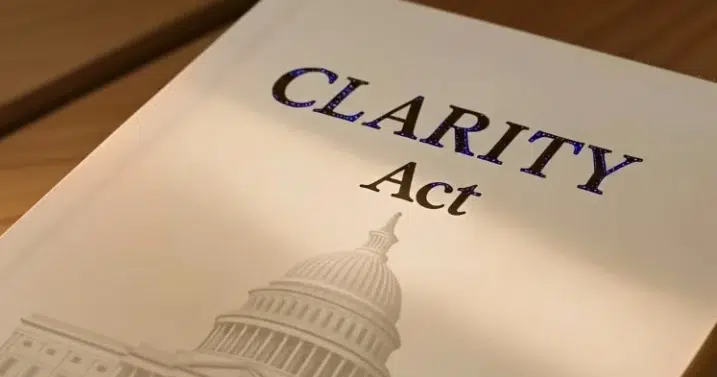
CLARITY Act

Source: Freedom For All Americans

Through these measures, the bill aims to clarify the legal environment for developers of blockchain, DeFi protocols, and digital asset intermediaries in the US.

Also Read: Galaxy Research Warns CLARITY Act Could Face Major Delays in 2026

Potential Industry Opportunities

By providing a more understandable regulatory structure under the CLARITY Act, institutional adoption could be really boosted as banks, asset managers, and payment firms might get a clearer view of the compliance boundaries. Having detailed rules might also lead to innovations in tokenization, stablecoins, and smart contracts, besides harmonizing US policy with the digital asset systems existing internationally. Startups and infrastructure providers would be given a more certain direction with product launches, audits, and investor protection measures.

The Clarity Act passed committee. The floor is next. We did not come this far to quit at the 5 yard line.

— Senator Cynthia Lummis (@SenLummis) June 7, 2026

Also Read: CLARITY Act: Bold Boost for Crypto Future 2026

Ongoing Challenges and Debate

Still, some stakeholders feel that certain provisions in the CLARITY Act might be at odds with securities laws or create difficulties for decentralized networks. Besides that, there are still some questions about the timeframes for rulemaking, the extent of enforcement, and how staking, mining, and self-custody will be treated. Industry associations keep advocating for the use of technology-neutral language so as not to unintentionally limit blockchain scalability and open-source development.

Also Read: CLARITY Act Faces Senate Delays Before Key August Crypto Regulation Deadline

Filed Under: Industry, Cryptocurrency News

About Ananthyka J

Ananthyka J is a market reporter at Tronweekly, reporting on cryptocurrency news. She covers cryptocurrency markets, blockchain technology, and digital asset regulation, focusing on Bitcoin, Ethereum, DeFi, altcoins, and crypto policy. Her reporting emphasizes clear and accurate market coverage, including crypto market movements, regulatory developments, and blockchain adoption. She holds a BA in Journalism and Mass Communication and an MA in Communication and Media Studies. She has also completed multiple media internships, follows strict editorial and fact-checking standards, and discloses potential conflicts of interest when reporting.

🔗 Connect on LinkedIn

Twitter LinkedIn

Primary Sidebar

Recent Posts

  • CLARITY Act at “5-Yard Line,” Heads to Floor: Lummis June 8, 2026
  • KOSPI Crash Wipes Out $416B From South Korean Stocks June 8, 2026
  • MicroStrategy BTC Sales Fund Debt While Bitcoin Buying Continues June 8, 2026
  • Satoshi Wallet Reactivates, Challenging $285B Lawsuit June 8, 2026
  • NVIDIA and SK Hynix Announce Multiyear AI Memory Partnership Expansion June 8, 2026

Footer

News

  • Latest News
  • Altcoin News
  • Bitcoin (BTC)
  • Blockchain
  • Tron (TRX)
  • World

Digest

  • Meet the Founder
  • Price Winning Article
  • DeFi
  • Cyber Security
  • Crypto Scam

Industry

  • Project Review
  • Technology
  • Fintech
  • Tron Exchange
  • New in Town

Tron Universe

  • Event and Tron Parties
  • New in Town
  • Tron Tokens

FOLLOW US

  • Facebook
  • Telegram
  • Twitter
  • Linkedin

Subscribe US

Editorial Policy | Privacy Policy | Disclaimer | Terms and Conditions | Masthead

Copyright © 2026 · Tron Weekly. All Rights Reserved. NOTE: Tron Weekly is an independent crypto news site that adheres to the strict journalism policy anchored on transparency, trust, and objectivity, we have no affiliation with the TRON Foundation, its founder Justin Sun or any other cryptocurrency firm.