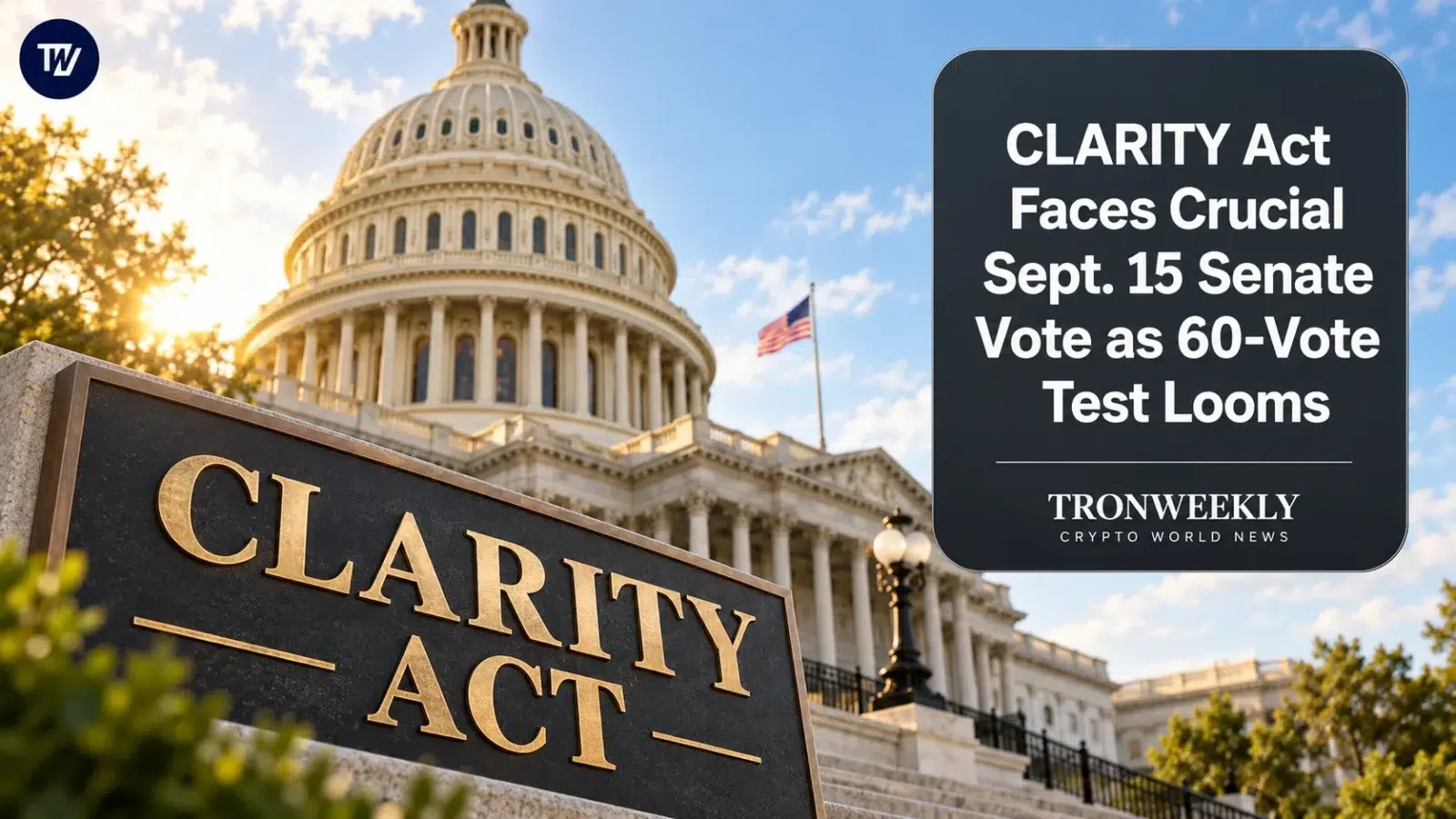
The CLARITY Act faces a Senate cloture vote on September 15. Senators will decide whether formal debate can begin. The vote will test support for a federal framework governing US crypto markets across the country.
Table of Contents
What Will the September 15 Senate Vote Decide?
This cloture vote on September 15 is supposed to be on the motion to proceed to H.R. 3633. It will not determine whether the bill passes into law. In most instances, clotures in the Senate need at least 60 votes.
Upon invoking cloture, senators may go on to debate. They may discuss any amendments and changes. Another vote on passage will be needed eventually.
Also Read: Thailand SEC Proposes Stablecoin Rules With $151K Daily Transfer Cap
The cloture motion was made by the Senate Majority Leader John Thune before the August recess, according to official Senate schedules. This cloture motion marked the next procedural step. It put the bill on an expedited calendar.
Failure to get 60 votes will prevent proceeding through this path. Republican leadership may opt for reconsideration or other procedures. There will be limited time on the Senate floor before the midterms of 2026.
The first reported outcome will reveal whether the senators wish to proceed with consideration of this bill. However, it will not determine the final content of the legislation.
Why Has the CLARITY Act Triggered Heavy Lobbying?
According to Reuters, on September 9th, crypto firms and banking organizations had stepped up their lobbying. Both industries have conflicts regarding several issues, such as stablecoin incentives, deposits from banks, anti-money laundering policies, and regulatory authority.
Independent Community Bankers of America has been trying to get answers from senators about deposits. The crypto sector has tried to get the bill passed. “Stand With Crypto” and the Blockchain Association have been using events, opinion pieces, and advocacy.
The political donations have made the negotiations much more high-stakes. According to Reuters, the crypto sector has spent more than $190 million on politics. The industry wants federal regulation on token classifications and trading platforms.
The Democratic critics have tried to demand more anti-money laundering provisions. Also, they have tried to give the authority to state regulators, Reuters noted. Ethical limitations, which concern elected officials and their families, are another controversial issue.
Forbes said that the newest negotiating draft included 114 amendments or requests made by Democrats. The presence of these amendments does not mean the Democrats’ approval of the whole package. Senators can ask for changes while not giving consent for cloture or passage.
Who Is Pushing Senators to Advance the Measure?
According to Patrick Witt, the executive director of the White House Digital Asset Advisory Council, bipartisan support is necessary. Failure to pass the bill will mean closing down the existing window for legislation. This is a political prediction and not a procedural rule.
The US Treasury Secretary, Scott Bessent, has been advocating for the bill to be passed. In April, according to Reuters, he expressed fears that unclear rules had already started driving the digital-asset development to Singapore and Abu Dhabi. This way, he was framing the discussion from the perspective of competitiveness.

President Donald Trump favors the CLARITY Act. However, support from Witt and Bessent does not change the fact that 60 Senate votes are still necessary.
The House of Representatives passed its version by 294-134 votes in July 2025. The Senate Banking Committee moved forward its version by 15-9 in May 2026. Both Republican Senator Ruben Gallego and Democratic Senator Angela Alsobrooks were in favor of the bill.
However, neither of the two committed to voting in favor of the floor bill. Both said that negotiations were still open.
Where Does Senate Support Stand Before September 15?
According to Politico, not a single Democrat was ready to commit to the September 15 motion in the latest evaluation of the situation. It is assumed that the proponents require at least six votes among Democrats. However, it depends on attendance and possible Republican support.
Earlier forecasts were not as optimistic. According to the report by Reuters in August, at least eight Democrats would be required if every voting Republican supported the legislation. Attendance and changes in the position would affect this number.
The 60-vote threshold gives power to the minority if the majority lacks it. This is the reason for such an important role of bipartisan support. It is also the reason why the negotiations were held close to the vote.
The vote of the committee shows that at least some Democrats were ready to negotiate. Gallego and Alsobrooks voted for moving the bill to the next step. However, none of them was ready to support the future version of the bill on the floor.
The CLARITY Act thus goes to the vote lacking any confirmation of bipartisan vote margin. Negotiations become especially relevant due to the same 60-vote threshold for procedure.
How Would the CLARITY Act Change Crypto Oversight?
In addition to defining circumstances in which crypto-assets fall under securities regulation, the bill aims to provide criteria for classification as a digital commodity. In this regard, the proposed framework will assign certain regulatory responsibilities to both the CFTC and the SEC.
The CFTC will have jurisdiction over certain spot-market activities. On the other hand, the SEC will continue to regulate the securities and investment contracts. The bill hence aims to establish clearer lines between the two regulatory bodies.
Certain exchanges, brokers, and dealers active in the digital-asset markets will be subjected to registration obligations. The bill further contains provisions on disclosure, custody, and customer protection. However, senators are still working out the exact scope and treatment of decentralized finance.
If the Senate passes a revised version of the bill, then the House of Representatives will have to approve such language or negotiate differences. For the legislation to move to the president, the Congress needs to approve identical versions.
What Comes Next if the CLARITY Act Cloture Vote Fails?
Failure of a closure vote will mean that the SEC and CFTC will continue to function under current laws. According to Witt, the agencies have options to go ahead with rulemaking in case of inaction by Congress. Administrative regulations cannot rewrite authority established by Congress.
Any future regulation by either the SEC or CFTC would go through its own process of notice and comments. Such regulations may come under legal scrutiny on matters of authority, process, and costs associated with compliance. Regulation will always be distinct from comprehensive market structure legislation.
The vote on September 15 will reveal whether the Senate is prepared to start the formal debate. This vote will not decide whether the CLARITY Act finally becomes a law. Debate, amendment, approval by the House, and presidential action would still be required.
Also Read: Senate Republicans Revise CLARITY Act Ahead of Key September 15 Vote