The Crypto Exchange market faced a significant slowdown in trading activity due to centralized platforms having their worst performances since October 2023.
According to CryptoQuant indicates that total spot trading volume in the Crypto Exchange sector fell down to $679 billion, indicating poor retail trading activities in digital assets.
According to the analysis conducted, the recent fall is the result of a 46% year-on-year decrease and a 67% decrease compared to October 2025 when the peak was registered.
It appears that decreased speculation had an effect on derivatives trading, too, with perpetual futures volume in the ecosystem falling by 53% from the recent highs.

Also Read | Ethereum Transfer of $121 Million From Joseph Lubin-Linked Wallet Sparks Market Speculation
Retail Activity Slows as Liquidity Gains Importance
As retail activities slowed down, market liquidity turned out to be an advantage for the leading exchanges. Major platforms like Binance and OKX managed to preserve considerable order-book depth, which usually varied from 500,000 up to 850,000 BTC. The fact that there is high liquidity makes these exchanges attractive places for large institutional and professional trading.

The importance of this factor becomes especially relevant considering how retail activities decline. Exchanges that offer higher liquidity will be able to build a positive feedback cycle where increased liquidity will make the exchange more appealing, attracting more traders. On the other hand, those with thin books will struggle to attract professionals.
In addition, the changing market environment leads to exchanges offering new types of assets to trade. Instead of limiting themselves to only cryptocurrencies, platforms aim to offer other assets that will attract traders. Thus, traders get the opportunity to trade according to different macroeconomic themes within their favorite platform.
Crypto Exchanges Expand Into Traditional Asset Markets
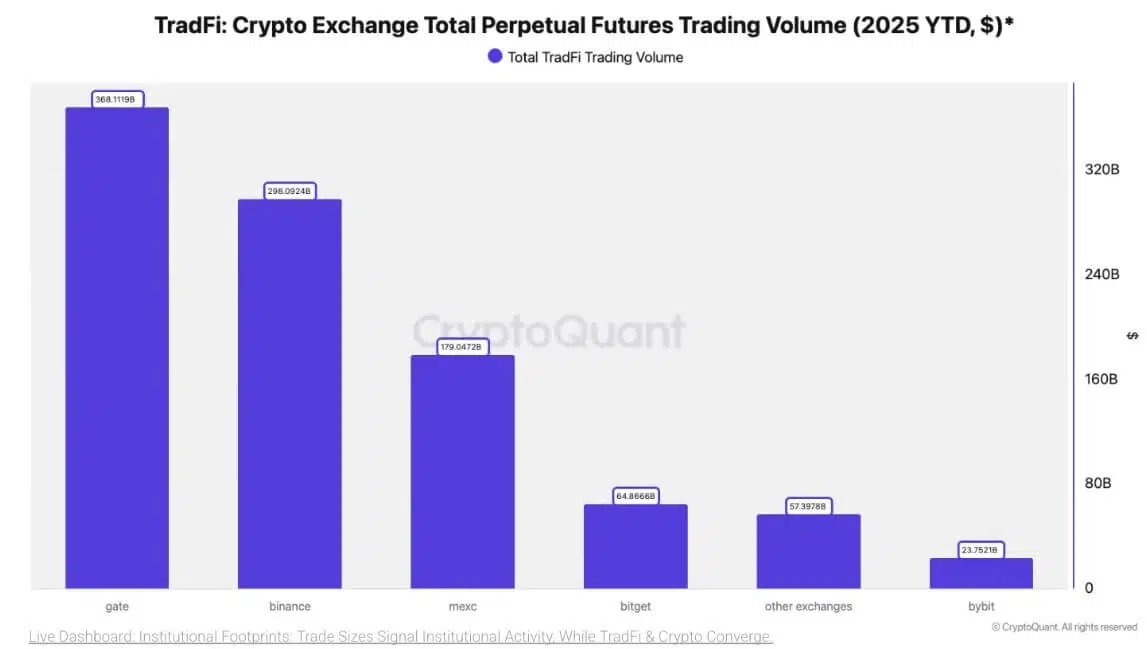
According to data shared by CryptoQuant, there was a high increase in the demand for perpetual futures of tradfi assets offered by crypto exchanges. Specifically, monthly trading volume of these contracts reached $450 billion in March 2026. Most of these volumes belong to gold and silver perpetuals, accounting for 90% of the peak monthly volume.
The list of tradfi perpetual contracts includes assets like gold, silver, crude oil, stocks, and stock indices. These contracts are popular because of being perpetual and accessible around the clock. Moreover, they do not expire, allowing traders to have better exposure to tradfi markets. Gate took the largest share, reaching almost $290 billion worth of trades. Binance ranked second with its $109 billion.
This article contains market analysis and price predictions. These are not guarantees. Crypto markets are volatile. Always DYOR. Not financial advice.
Also Read | Crypto Exchanges Could Channel $2 Trillion Into Global Stocks By 2031