Mounting doubts over the Dogecoin price narrative have resurfaced after the flagship meme-coin slipped beneath key short-term resistance, reigniting debate about its ability to reclaim former highs.
In response, several market strategists now highlight Remittix (RTX) as a more promising vehicle, forecasting that it could eclipse DOGE’s upside many times over before 2025.
This article dissects the bearish technical signals weighing on Dogecoin, breaks down fresh on-chain and macro data, and explains why rotational capital sees a pathway to 20-fold gains in RTX for investors.

Doge price stalls amid fading catalysts
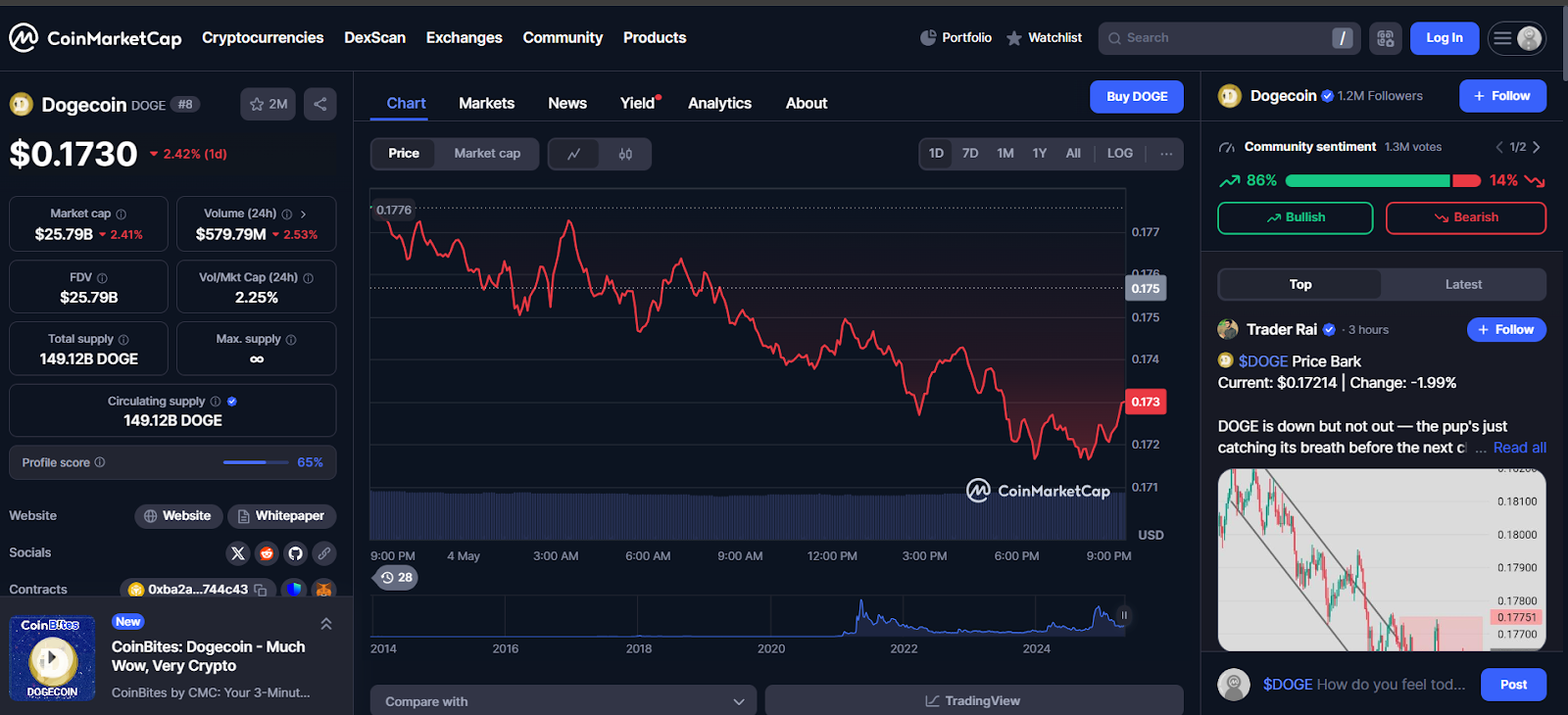
On CoinMarketCap, Doge trades at $0.172 with a market cap of $25.7 billion and a 24-hour volume under $600 million. The token has trailed Bitcoin by ten percentage points since March as enthusiasm around an eventual X/Twitter integration cools.
Macro pressure compounds the problem. It is evident that when global liquidity tightens, Doge tends to underperform because, unlike BTC, it lacks a capped supply, and unlike ETH, it does not collect meaningful on-chain fees.
Analysts warn that if sentiment fails to flip soon, Doge could revisit its previous lows, where the last accumulation spike occurred. Conversely, should that support trigger a reflex bid, the Doge price might claw back.
The path to the celebrated “Doge to $1” meme therefore appears steeper than ever. To justify a dollar, fully-diluted value would exceed $140 billion, assuming current issuance—comparable to PayPal and larger than Coinbase.
Without a burn mechanism or a major new revenue stream, many strategists now call that target “aspirational at best.”
Remittix: Utility-first token chasing a 20× payoff
While meme tokens fret over momentum, Remittix has been busy solving a trillion-dollar pain point: turning crypto into spendable cash in minutes. The project routes BTC, ETH, Doge, and 40-plus other assets through smart-contract pools that settle in RTX, then credit local-currency bank accounts almost instantly.
Consider Lena, a Berlin-based designer who invoices U.S. clients in USDC. With Remittix’s checkout widget, her customer pays the bill in stablecoins; behind the scenes, RTX handles the swap and wires euros to Lena’s Deutsche Bank account in roughly ten minutes for a flat fee close to 1%.
Numbers already hint at traction: Remittix has secured $14.74 million in early funding, and RTX changes hands at just $0.0757, implying a fully diluted valuation under $190 million—a fraction of rivals such as Ripple or Stellar.
Tokenomics add a scarcity kicker: every transaction burns a micro-slice of supply, linking network volume directly to appreciation potential. If Remittix merely captures 0.05% of global remittances, its demand could surge enough to support a 20× surge.
Weighing risk-reward into 2025
For traders eyeing the next explosive move, the calculus is shifting. Doge retains unmatched brand power, a massive community, and the ever-present possibility of an Elon Musk tweet that jolts price action. Yet absent fresh token-economy upgrades, upside appears capped by sheer market-cap gravity and declining whale engagement.
Remittix, by contrast, offers a tangible revenue model already in production. Its crypto-to-fiat bridge removes what many see as the final hurdle to mainstream adoption, while its deflationary design rewards every dollar of real-world volume.
Crucially, RTX’s micro-cap status means even modest traction can translate into outsized percentage gains—something Doge simply can’t replicate at its current scale.
Investors, therefore, face a classic portfolio dilemma: stick with the proven meme brand whose best days may be behind it, or allocate a slice to a nimble utility token addressing a vast, underserved market.
With the risk-on cycle still fragile, diversifying beyond headline favourites looks prudent. Should Remittix execute even half its roadmap, it could easily outpace Doge—and perhaps many larger caps—on the road to 2025.