- Solana quietly patched a zero-day bug that could’ve let attackers forge confidential tokens.
- The flaw involved a cryptographic issue in zero-knowledge proof validation.
- Critics pointed to Solana’s reliance on a single client as a decentralization risk.
The Solana Foundation has disclosed and patched a zero-day vulnerability that could have allowed attackers to mint confidential tokens and withdraw them from unsuspecting users’ accounts. The flaw, which was silently resolved before any known exploit occurred, has reignited debates around Solana’s network decentralization.
According to a May 3 post-mortem from the Solana Foundation, the vulnerability was first identified on April 16 and affected Solana’s privacy-focused “Token-22 confidential tokens.” These tokens rely on zero-knowledge proofs (ZKPs) to ensure the privacy of transfers, a feature designed to enable advanced and confidential token functionalities within the Solana ecosystem.
The security gap originated in the Token-2022 and ZK ElGamal Proof programs, where a cryptographic flaw in the Fiat-Shamir Transformation process allowed attackers to potentially craft forged zero-knowledge proofs. It occurred because certain algebraic components were not properly hashed, undermining the integrity of the proof verification mechanism.
Put simply, the flaw could have let malicious actors simulate valid balances and mint confidential tokens, an alarming loophole that, had it been exploited, might have shaken user trust and triggered significant financial losses.
Despite the critical nature of the vulnerability, no funds were lost, and the Solana Foundation reported that a supermajority of validators had already adopted the patched version within two days of the fix. The coordinated response involved several key contributors, including Anza, Firedancer, Jito, Asymmetric Research, Neodyme, and OtterSec.
Yet, it’s the very nature of that coordination that has come under scrutiny.
Solana Patch Sparks Centralization Fears
The rapid behind-the-scenes patching process has raised eyebrows among decentralization purists. Critics questioned the Foundation’s ability to swiftly reach out to validators and whether this level of influence undermines SOL’s claims of being a decentralized network.
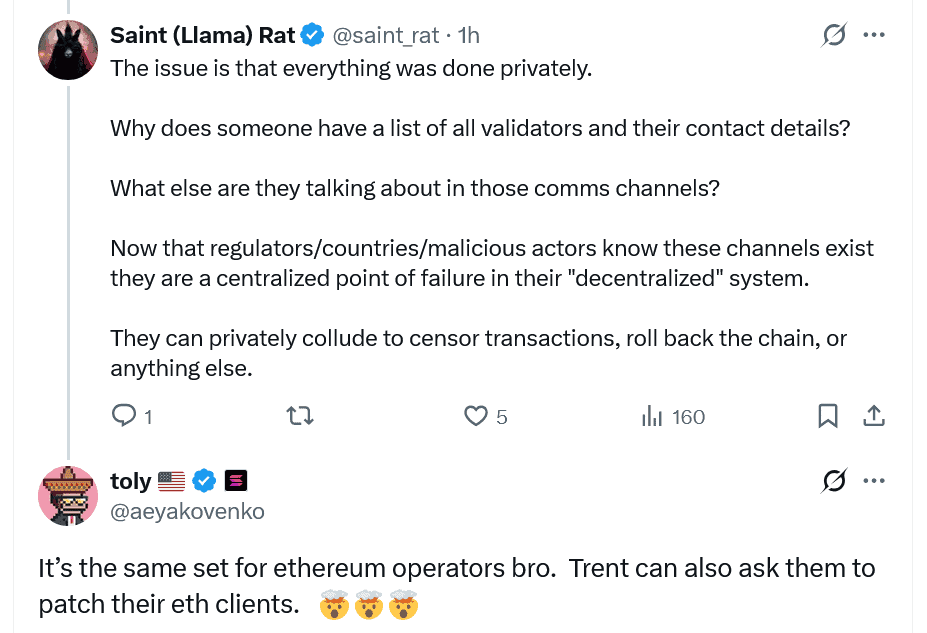
A contributor from Curve Finance sparked the debate by asking, “Why does someone have a list of all validators and their contact details? What else are they talking about in those comms channels?” The concern: such close coordination could enable censorship or even orchestrated rollbacks, hallmarks of centralized control.
Solana Labs CEO Anatoly Yakovenko responded by pointing out that Ethereum validators, many operated by large staking providers like Lido, Binance, Coinbase, and Kraken, could coordinate similarly in a security emergency. “If geth [Ethereum’s client] needs to push a patch, I’ll be happy to coordinate for them,” Yakovenko stated. But not everyone agrees with the comparison.
Solana One Client Risk Exposed
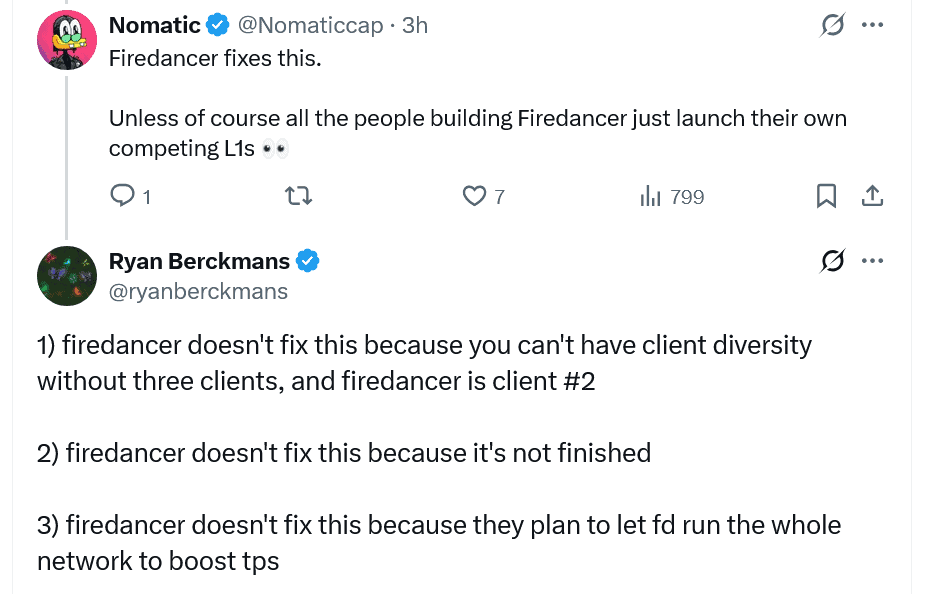
Ethereum community member Ryan Berckmans rebutted that Ethereum’s client diversity shields it from the kind of single-point-of-failure risks SOL faces. He emphasized that Geth, Ethereum’s dominant client, holds no more than 41% market share, while SOL currently operates with just one production-ready client, Agave.
“This means zero-day bugs in the single Solana client are de facto protocol bugs,” Berckmans argued. “Change the single client program; change the protocol itself.”
Solana’s roadmap offers a partial answer. The highly anticipated Firedancer client, developed in collaboration with Jump Crypto, is expected to launch in the coming months, promising enhanced performance and redundancy.
Still, as Berckmans noted, true decentralization at the client level may require at least three independent clients, a goal Solana has yet to achieve.
While the vulnerability was patched before any real damage occurred, the incident underscores a growing tension in the blockchain world: the trade-off between security responsiveness and decentralization. Solana’s ability to act quickly in the face of a zero-day flaw is commendable, but it has also spotlighted its centralized levers of control.
As Solana continues to evolve with Firedancer on the horizon and more zero-knowledge capabilities in development, the community will be watching closely. Will the network strike a sustainable balance between performance, privacy, and decentralization?
Related | Best Crypto to Buy Now as BTC Price Predictions Hit $1 Million
