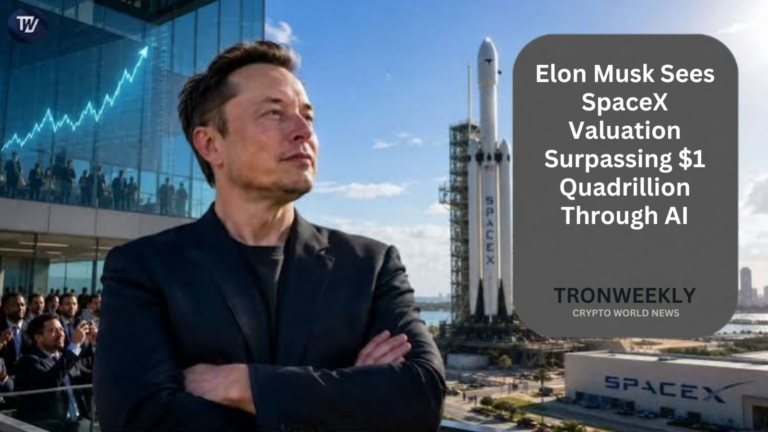
Elon Musk has outlined an extraordinary future for SpaceX, saying the company could become worth far more than the global economy. The SpaceX valuation vision relies on expanding industries beyond Earth, including solar-powered artificial intelligence computing in orbit, although Musk stressed that this outcome remains uncertain.
Table of Contents
In an October 9 post on X, Musk said he could see a path for SpaceX to become worth “orders of magnitude more than the current Earth economy.” He clarified the following day that identifying a possible path did not mean he was highly confident the company would achieve that outcome.
Also Read | ENA Price Outlook Gains Attention as Onchain Activity Signals Breakout
SpaceX Valuation Faces Extraordinary Growth Expectations
Musk’s goals become more understandable when they are put in relation to the global economy. According to the International Monetary Fund, the world economy will amount to approximately $126 trillion in 2026. On the other hand, according to the provided article, the market value of SpaceX was at about $2.2 trillion as of Thursday.
A valuation ten times more than the global economy’s annual output should be at least $12 quadrillion. The jump in SpaceX valuation from $2.2 trillion to $12 quadrillion would need a growth of 5,500 times, with everything else being constant.
However, company valuation and gross domestic product measure different things. Valuation shows the worth of a company from the investors’ perspective, while GDP is an indicator of economic output per year.
Orbital AI Computing Supports Musk’s Vision
Musk’s argument builds on his broader belief that industries operating beyond Earth could eventually create more economic value than those on the planet. In January, he stated that space-based industries will have access to much more solar power than industries on Earth have.
Deployment of space-based, solar-powered computing infrastructure, as demand for artificial intelligence grows, can become one element of this business model. SpaceX can deploy computing equipment using its launch systems and can use solar energy. However, the success of such a project depends on launch costs, equipment efficiency, cooling systems, maintenance, and customer demand.
Starship is central to this plan because transporting large amounts of equipment into space would be necessary to establish substantial infrastructure. At the same time, deployment of AI computing in orbit is a difficult task from both technological and commercial perspectives.
Revenue Growth Still Falls Short of Ambition
SpaceX’s financial results are impressive but also indicate the gap between the company’s current status and Musk’s vision of the future. The firm earned $7.8 billion in revenue during the second quarter, which was 92% higher compared to the same period in the previous year. Moreover, the net loss of SpaceX decreased from $1 billion to $541 million.
According to Musk, in August, the company projected $1 trillion in revenues for 2030, with a possible chance of reaching that milestone already in 2029. Even if the revenue grew by 100 times to $100 trillion, it still would be less than 1% of the valuation of $12 quadrillion.
Thus, future revenues, profit, and capital are important factors for evaluation of the SpaceX valuation due to the reason that such enormous values could be achieved only if the company managed to establish businesses that generate enormous cash flows. However, the current financial results of SpaceX do not prove that the growth is possible.
SpaceX Valuation Raises Debt And AI Concerns
Market experts have questioned the economic assumptions behind Musk’s vision. Russ Mould, investment director at AJ Bell, explained that the idea seems to require the creation of new industries and colonies beyond Earth since the company may access resources that are not available on Earth.
Mould added that investors who use the discounted cash flow model should discount the cash flows at an exceptionally high rate due to uncertainties in the business. Ipek Ozkardeskaya, a senior analyst at Swissquote Bank, similarly questioned the costs required to achieve Musk’s ambitions.
Neil Wilson, UK investor strategist, called the space venture a long-term bet on the future of humanity while adding that investors need to look at the economics of the venture along with risks related to debt and AI. These considerations show how there is a difference between what is technologically possible and the financial valuation of the idea.
For now, SpaceX’s path depends on its ability to expand launch operations, orbital computing, and realize profits from the plans. This would mean that the investors need to see something tangible regarding profitability, costs, and technology.
Also Read | Ledger Wallet Implant Found in Device Linked to Crypto Losses