
Ethereum developer Diyahir Campos took action after being targeted by the Euler Finance hack in March. The recently published ERC-7265 proposal introduces a decentralized finance (DeFi) “circuit breaker” designed to prevent the theft of billions of dollars’ worth of crypto from DeFi protocols in 2022.
On July 3, an Ethereum request for comment (ERC) was released on GitHub, with Campos as the lead developer proposing a standard for a DeFi “circuit breaker.” This standard aims to establish guidelines for a smart contract capable of detecting and halting suspiciously large token outflows from DeFi protocols.
Last year witnessed a surge in crypto hacks, with over $3.1 billion stolen from DeFi protocols, and cross-chain bridges accounting for 65% of the incidents.
Campos highlighted that implementing circuit breakers could have prevented billions in losses. By utilizing circuit breakers, approximately 70% of stolen funds could have been saved, with minimal impact on users. Campos himself experienced losses as a depositor in the $195 million Euler Finance attack, which had a domino effect on 11 other protocols.
Reflecting on this experience, Campos questioned the practice of allowing 100% of the total value locked (TVL) to be withdrawn within short timeframes, suggesting a more controlled approach. Normally, a DeFi protocol sees about 20% of the total value locked entering or leaving a project in a day. Campos stressed that once the percentage surpasses 30% or 40%, it becomes crucial to differentiate between legitimate daily usage and exploitative actions.
The proposed standard has generated controversy, as skeptics like DeFi researcher Chris Blec expressed concerns about potential misuse. However, Campos clarified that the circuit breaker would be optional, not universally applicable, and wouldn’t ensure complete safety. He stressed the importance of a balanced circuit breaker that safeguards users while minimizing false positives and disruptions.
However, it’s important to note that a circuit breaker would be ineffective in cases of internal rug pulls, as the controlling team of the protocol could simply deactivate it.
Here’s How Ethereum Has Been Fairing In Terms Of Staking
After the implementation of the Shanghai hardfork, Ethereum (ETH) staking deposits have experienced a significant increase, as reported by crypto analysis firm Glassnode. The firm observed that stakers have grown more confident due to the newfound flexibility to unstake their tokens. On June 2, deposit activity reached a peak with over 13,595 new deposits, totaling more than 408,000 ETH ($799,643.28). Notably, the number of Ethereum staking deposits has surpassed exchange deposits, which remain stagnant at approximately 30,000 ETH.
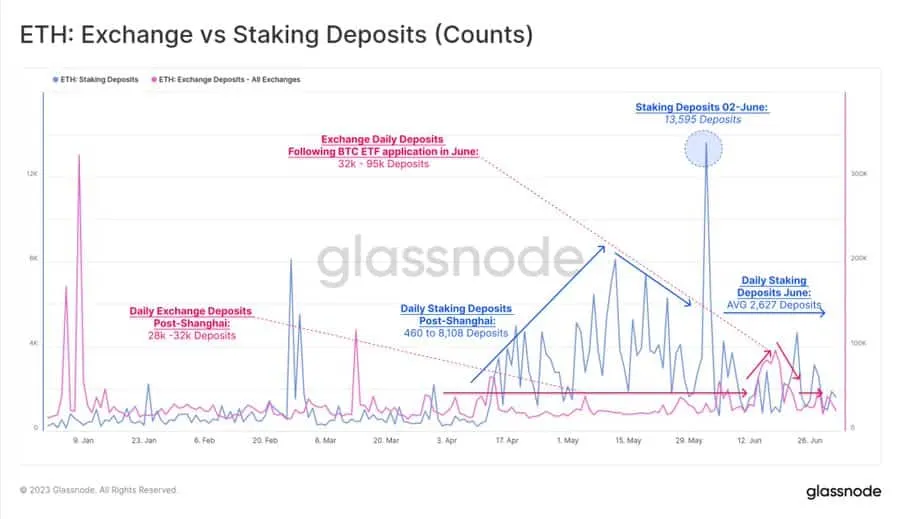
Before the Shanghai update, concerns arose about a potential market sell-off as users were expected to unstake their tokens. However, contrary to these worries, stakers have become more assured in utilizing their tokens. Despite the surge in staking deposits, Ethereum’s price has only seen a modest increase of about 3.4% in the second quarter of 2023, while Bitcoin experienced an 8.6% rise.
Glassnode also highlighted the dominance of Lido’s stETH in the liquid staking derivative market, with stETH emerging as a favored collateral asset.
