• Skip to primary navigation
  • Skip to main content
  • Skip to primary sidebar
  • Skip to footer
  • About TronWeekly
  • Write for us
  • Terms and Conditions
  • Privacy Policy
  • Disclaimer
  • Contact
  • All Posts
  • Advertise

TronWeekly

Crypto World News

  • Home
  • Latest News
  • Opinion
    • Education
    • Best TRON Wallets
    • Beginner’s guide to TRON
    • Tron Tokens
    • Market Analysis
  • Industry
    • Tron Exchange
    • Project Review
  • Press Release
  • Bitcoin (BTC)
  • Ripple (XRP)
  • Advertise
  • About TronWeekly
    • The Team
    • Editorial Policy
    • Write for us
    • Privacy Policy
    • Disclaimer
    • Terms and Conditions
    • Contact
You are here: Home / Cryptocurrency News / Ethereum Leads 47% Boom As Aggregators Unlock Smarter Trading Routes: Report

Ethereum Leads 47% Boom As Aggregators Unlock Smarter Trading Routes: Report

What to know:

  • Liquidity is now spread across chains and pools, making manual trading inefficient as aggregators handle routing, pricing, and execution.
  • Aggregators have evolved into advanced systems that split orders, reduce slippage, and protect users from risks like MEV attacks.
  • Institutional entry is shifting focus toward compliance, with aggregators expected to add regulatory tools alongside trade optimization.

By Mishal Ali | Edited By Messam Raza,April 8, 2026, 10:00 AM

Ethereum Leads 47% Boom As Aggregators Unlock Smarter Trading Routes: Report

The new report titled A Deep Dive into the Future of Onchain Liquidity Routing outlines how decentralized trading has become more complex as liquidity spreads across chains and platforms. 
Source: The Block

It explains that users can no longer rely on a single exchange to get the best trade. Instead, aggregators now act as the main gateway, scanning multiple sources to deliver better execution.

This research explores the evolution of aggregators from simple to complex entities capable of handling tasks such as routing, order execution, and security. In view of the many liquidity pools running on various networks, the process of trading has become technical.

Aggregators can assist with route discovery and the fragmentation of trades in an attempt to reduce price slippage. They offer protection against MEV exploits.

Also Read: Ethereum 1000x Bold Plan: Vitalik Maps Out 3-Stage Scaling Push

Liquidity Fragmentation Hits New Highs On Ethereum

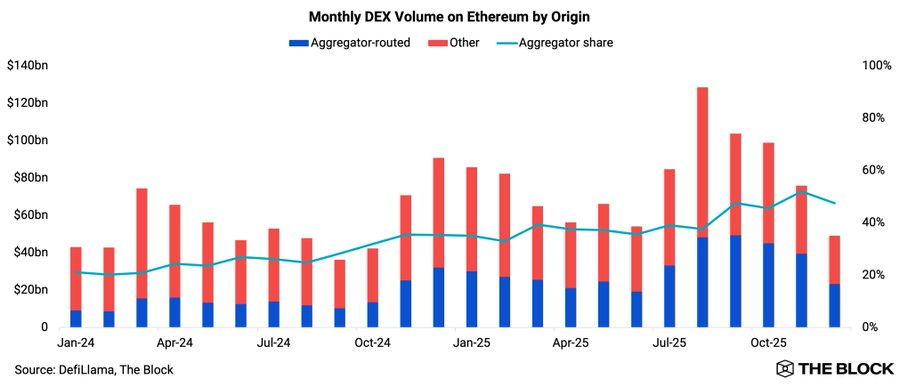
As illustrated in the report, the phenomenon of liquidity fragmentation has increased significantly. In large networks such as Ethereum, the use of aggregators has increased from 21% at the start of 2024 to 47% towards the end of 2025.
Source: The Block

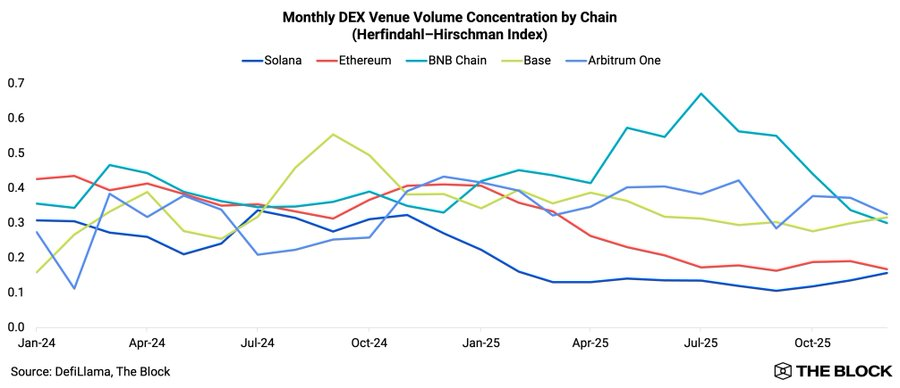
Blockchain ecosystems can vary in terms of how they are structured. While some ecosystems, such as BNB Chain, still have liquidity that is centralized, other ecosystems, such as Solana, are shifting towards having more decentralized liquidity.

In addition, the research provides an overview of how the routing engines operate. They analyze many potential trade routes and place the order in multiple places.

Although this decreases slippage, it complicates matters. On the other hand, the protective layers make sure that the ultimate price aligns with expectations.

One of the most significant developments outlined in the article is the move towards intention-based execution. Rather than selecting one particular route, the user states the desired result, and independent solvers compete to fulfill the goal.

Institutional Demand Shifts Focus To Compliance

As per the report, large institutions would be the driving force behind the next wave of innovation in DeFi. This being the case, the objective cannot be the optimization of prices alone but rather the optimization of compliance.

Aggregators are required to offer mechanisms for risk management, reporting, and compliance. In jurisdictions such as the European Union, regulations such as MiCA are dictating the architecture of platforms.

This requires aggregators to engage in the filtering of tokens and transaction monitoring, among others, in terms of compliance at the user interface level.

Also Read: Ethereum Targets Next Growth Phase With Powerful Scaling and ZK-EVM Roadmap

Filed Under: Cryptocurrency News, Altcoin News

About Mishal Ali

Mishal Ali is a Policy and Regulations Reporter at Tron Weekly with over four years of experience covering the global crypto and blockchain space. Her reporting focuses on crypto regulations and policy, alongside Bitcoin, Ethereum, altcoins, DeFi, NFTs, Web3, Layer 2 solutions, and AI-driven crypto use cases. She also tracks Ripple-related developments, enforcement actions, licensing updates, and crypto scams and fraud trends, helping readers understand regulatory and compliance risks.

🔗 Connect on LinkedIn

Twitter LinkedIn

Primary Sidebar

Recent Posts

  • XRP Price Consolidation Near End As $56 Target Enters Focus May 25, 2026
  • Litecoin Price Eyes $70 Break as Analyst Flags Major Expansion Setup May 25, 2026
  • Ethereum Price Analysis: Can ETH Break $2,150 and Rally Toward $2,250? May 25, 2026
  • Worldcoin Price Prediction: Can WLD Reach $0.41 After Trendline Breakout? May 25, 2026
  • XRP Price Alert: Futures Open Interest Falls Sharply As $1.55 High Triggers Massive Sell-Off Cycle May 24, 2026

Footer

News

  • Latest News
  • Altcoin News
  • Bitcoin (BTC)
  • Blockchain
  • Tron (TRX)
  • World

Digest

  • Meet the Founder
  • Price Winning Article
  • DeFi
  • Cyber Security
  • Crypto Scam

Industry

  • Project Review
  • Technology
  • Fintech
  • Tron Exchange
  • New in Town

Tron Universe

  • Event and Tron Parties
  • New in Town
  • Tron Tokens

FOLLOW US

  • Facebook
  • Telegram
  • Twitter
  • Linkedin

Editorial Policy | Privacy Policy | Disclaimer | Terms and Conditions | Masthead

Copyright © 2026 · Tron Weekly. All Rights Reserved. NOTE: Tron Weekly is an independent crypto news site that adheres to the strict journalism policy anchored on transparency, trust, and objectivity, we have no affiliation with the TRON Foundation, its founder Justin Sun or any other cryptocurrency firm.