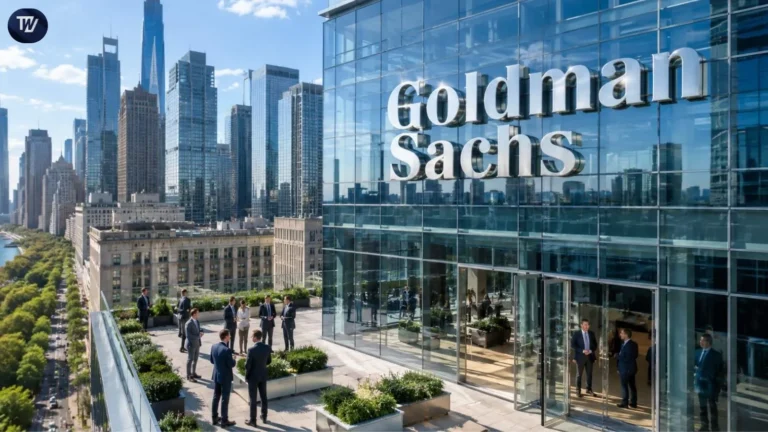
Goldman Sachs is bringing one of Wall Street’s most widely used cash management funds to the AVAX blockchain. The Goldman Sachs Financial Square Treasury Instruments Fund (FTIXX), now tradable via a network for settling transactions between institutions called Lynq, is built on a permissioned Avalanche L1.
The fund offers participating institutions an alternative to participating in this fund, which has more than $100 billion in assets under management, without having to tokenize the fund itself. The link to the fund’s distribution identified by tZERO in a blog post on 28 September 2026 now brings qualified parties to tZERO Securities, an SEC-registered broker-dealer.
Table of Contents
Treasury Fund Meets AVAX Settlement
FTIXX invests solely in US Treasury obligations and is focused on capital preservation, with daily liquidity. Total assets were about $105.27 billion as of August 31 2026 based on Goldman disclosures. This amount represents total fund assets, not capital held on-chain. Lynq is managed by Arf subsidiary Tassat, which moved its core operations to a dedicated permissioned Avalanche L1 on April 29 2026 to support real-time post-trade settlement for institutional clients.
Source: Binance
Over 30 firms use Lynq, including B2C2, Wintermute, Galaxy, FalconX, and Fireblocks. tZERO co-developed Lynq and brings the regulated access layer. Compared to BlackRock’s BUIDL, no new security token is issued; clients acquire the existing institutional share class, with the blockchain serving as the settlement and distribution infrastructure.
Source: Bombay Chamber
Also Read: AVAX One Cuts $14.9M Debt to $970K, Buys 333,500 Shares
Why It Matters for Crypto Market Structure
The solution is a long-standing pain point for institutions that could boost use of digital assets without bringing institutional money into the public market. Trading firms often sit with large amounts of uninvested cash and digital assets open on their books that have gone essentially unchallenged and unfixed, until now.
With Lynq, firms can sweep cash into the FTIXX product to accrue yields and redeem on-demand without leaving the same settlement environment used for executing digital assets. This can optimize capital efficiency without forcing firms to self-custody or interact with a public blockchain a challenge cited by Lynq CEO Jerald David. It’s also distinct from tokenization.
Goldman Sachs stays in the familiar world of traditional fund structures while building on a blockchain that handles the operational side, not changing the regulation of the product. For compliance, the existing approach is familiar. For operations, cash, and crypto can both move on the same rails. And for AVAX, it’s an architectural choice.
Lynq is permissioned and not powering the public AVAX markets directly, but a flag-bearing Goldman Sachs product opting for Avalanche tech marks a vote of confidence from enterprise. At the same time, it’s following a bigger trend where banks choose private L1s to settle transactions, separate from the public DeFi space.
Also Read: AVAX Price: 2026 Nod From O’Leary Backs Enterprise Use
Future Impact Beyond Tokenized Treasuries
FTIXX is the inaugural external fund on Lynq and only the second investment product overall, making it a test case for embedding traditional Treasury funds in crypto-native settlement. If adoption grows, other settlement networks, custodians, and exchanges may add similar yield-bearing Treasury access, blurring the lines between money market infrastructure and digital asset operations.
Stablecoins currently dominate treasury management, largely backed by Treasuries, but direct FTIXX access offers regulated yield without intermediation. Limitations remain: access is restricted to qualified US clients who are dual-onboarded to Lynq and tZERO, limiting immediate scale. Private infrastructure also raises questions about composability with public DeFi and transparency compared to fully on-chain funds.
For AVAX developers and investors, the question is whether private validation leads to more enterprise L1 deployments. For the industry, tokenization does not require minting a token to be meaningful; sometimes the most consequential step is using blockchain to distribute what already exists more efficiently.
Also Read: Avalanche Expands Real-World Adoption as AVAX Price Setup Gains Attention