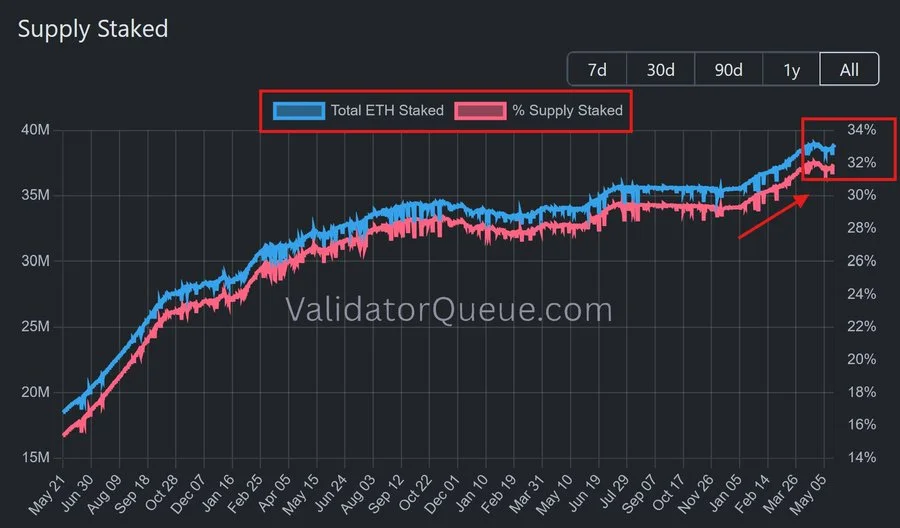
Ethereum’s staking ratio has climbed to nearly 31% of the total ETH supply despite the cryptocurrency declining 26% year-to-date. The growing percentage of staked ETH highlights continued confidence among long-term holders and validators, even as market prices remain under pressure. Recent blockchain data also suggests that staking participation continues to increase steadily across the Ethereum network.
Ethereum Staking Reaches New High Levels
The number of people participating in staking on the Ethereum blockchain has been increasing over the course of 2026, as more individuals have been locking their ETH in validators. As per data from blockchain monitoring websites, the percentage of ETH that is currently staked is about 31%. This marks one of the highest staking ratios recorded since Ethereum transitioned to proof-of-stake.
The increase in staking comes despite ETH experiencing a significant price decline this year. Ethereum has fallen roughly 26% on a year-to-date basis as broader crypto market volatility affected major digital assets. Even with weaker prices, investors appear willing to hold and stake ETH for long-term rewards.
The practice of staking ensures that ETH owners can earn money from holding their tokens passively while securing the ETH network. The validators are involved by locking up their ETH and validating transactions within the blockchain. Increased participation in staking shows positive expectations about future growth.
Also Read: Ethereum Foundation Faces Growing Wave of Leadership Resignations
ETH Price Weakness Contrasts With Network Activity
Ethereum’s market performance in 2026 has remained weaker compared to previous bullish cycles. The cryptocurrency faced selling pressure amid broader macroeconomic concerns and declining speculative activity in crypto markets. Reduced investor appetite for risk assets also contributed to ETH’s decline.
The decline in prices does not affect the performance of Ethereum in some other fields. The decentralized finance protocols, staking solutions, and layer two scalability networks still actively operate on the ETH network. Moreover, developers still try to increase the scalability and efficiency of ETH.
It is believed that the increased staking ratio can lower the supply of tokens in the market. As more tokens become locked in staking smart contracts, there will be less coins left for the trading process.
Validator Participation Continues Expanding
The Ethereum proof-of-stake mechanism uses validators to guarantee security and validate transactions. The number of active validators has been increasing consistently since the introduction of the system due to the increased number of people joining the staking system.
Staking platforms and liquid staking mechanisms have also played a part in the increase in staked ether. Staking is made easier through such platforms since the stakers do not need to run their own validator nodes. Thus, small investors can also earn staking rewards.
Validator queue data showed sustained interest in joining ETH’s staking system over recent months. Even during periods of price declines, staking demand remained elevated. Analysts believe this demonstrates confidence in ETH’s role as a leading smart contract blockchain.
Long-Term Outlook for Ethereum Remains Mixed
While staking growth remains strong, ETH still faces challenges in the broader market environment. Competition from alternative blockchains and concerns over transaction fees continue to affect investor sentiment. Market uncertainty has also limited aggressive buying activity in recent months.
Meanwhile, Ethereum still reigns supreme in some significant industries in the crypto space. This blockchain continues to be the biggest platform for decentralized finance and tokenization. Future improvements and developments in the network can further solidify its standing.
The future trajectory of ETH’s price, according to analysts, can depend on both macroeconomic factors and adoption trends. Further increases in staking would make the supply better in case of eventual recovery of demand. Meanwhile, volatility will remain one of the most important aspects for traders.
Also Read: Bitmine Expands Ethereum Treasury to 5.28M ETH With 71,672 ETH Buy