Institutional interest in U.S.-listed Hyperliquid ETF products is emerging as banks, asset managers, and trading firms disclose positions in the funds. UBS, Bank of Montreal, and Jane Street were among the first reported institutional investors in the funds. This shows the increase in exposure to the HYPE tokens via investment vehicles and institutions.
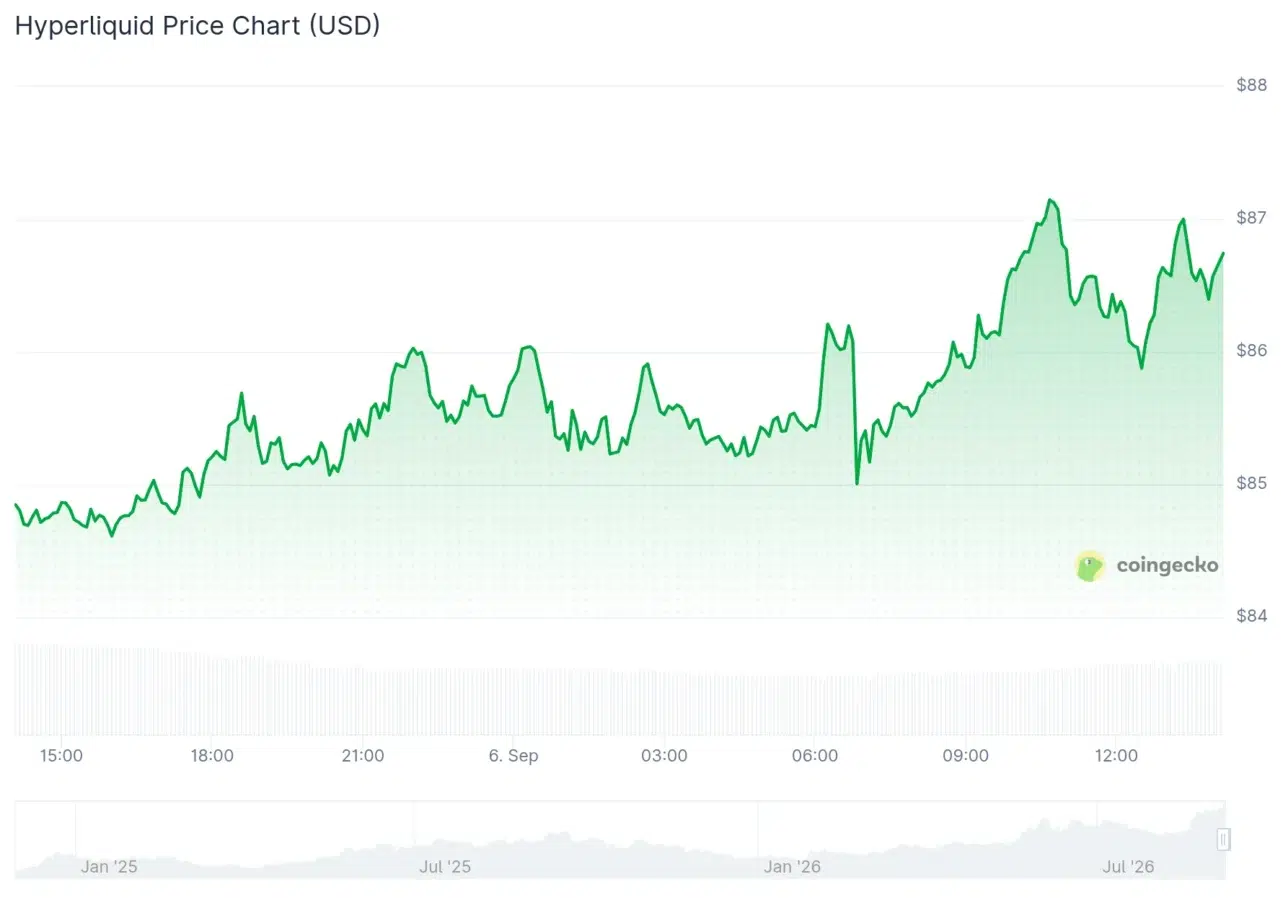
HYPE was trading at $86.61 on September 6, per CoinGecko data. The token reached its peak of nearly $88 on the day when the disclosures were made. However, the disclosed positions only reflect the holding status up to June 30, so no new positions, transactions, and holdings since then are reflected in the disclosures.
Table of Contents
Also Read | DASH Price Eyes $500 Rally as Activity Surges and Financial Integration Expands
Institutional Holders Expand Hyperliquid ETF Exposure
Thirty institutions reported a total of $74.9 million in three Hyperliquid ETFs, as per a recent post by James Seyffart, a Bloomberg Intelligence ETF analyst. Wealth High Governance Asset Management was the largest institutional investor of the three ETFs in terms of holdings, with 632,614 shares of 21Shares’ THYP worth $23.95 million. OLP Capital Management held the second-largest share at $10.5 million.
Third position in holdings of Hyperliquid ETFs is held by UBS with $7.5 million, followed by Bank of Montreal with $6.7 million and Jane Street holding $4.4 million. Thus, the five largest holders account for a total of about $53 million, which is about 70.8% of all reported positions. Some other notable institutions include Discovery Capital, Brevan Howard, Balyasny and Boothbay.
ETF Growth Expands Institutional Access
The disclosure of the ETF positions came after the launches of 21Shares’ THYP on May 12, Bitwise’s BHYP on May 15 and Grayscale’s HYPG on June 3. All three ETFs have gained $356.58 million in net inflows until September 4, while net assets stood at $480.86 million, according to SoSoValue data.
The development matters because ETF structures give investors HYPE exposure through conventional brokerage accounts rather than directly using Hyperliquid. The platform operates its own blockchain and specializes in perpetual futures. U.S. users remain restricted on the existing venue, while Payward is reportedly working with the CFTC on regulated Hyperliquid-linked perpetuals.
The 13F data remains an incomplete snapshot because reporting rules limit coverage, banks can hold securities for clients, and trading firms may hedge positions. Attention will now turn to later filings, Hyperliquid ETF flows and regulatory developments. Hyperliquid’s September 6 token unlock and ongoing HYPE buybacks could also influence market dynamics.
Also Read | HYPE Price Eyes $105 as Whale Accumulation and ETF Exposure Fuel Momentum
This article contains market analysis and price predictions. These are not guarantees. Crypto markets are volatile. Always DYOR. Not financial advice.