
In July, Bitcoin saw a noticeable shift in market behavior, with larger investors accumulating more BTC while smaller traders sold off during the dip. According to Santiment, there has been a net increase of 261 wallets holding at least 10 BTC, which may indicate long-term confidence despite recent market turbulence.
Bitcoin has experienced its deepest correction since late 2022, falling below the 200-day moving average (DMA) and leaving many short-term holders with unrealized losses. Glassnode’s report highlights that the 2023-24 Bitcoin cycle has unique characteristics compared to previous ones.
After an 18-month steady price rise post-FTX collapse, Bitcoin saw three months of sideways trading following a $73k ETF peak. The market’s deepest correction between May and July resulted in a 26% drawdown from the all-time high (ATH), although this downturn has been less severe than in past cycles, suggesting a robust underlying market structure.
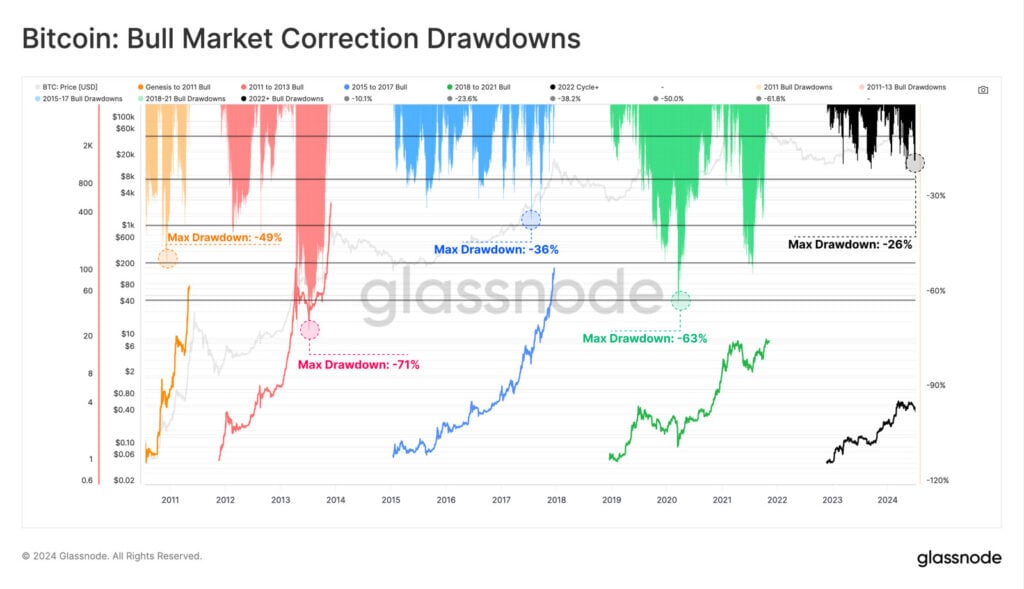
Historically, Bitcoin’s current cycle mirrors previous cycles, such as 2018-21 and 2015-17, providing a valuable framework for analysts. Yet, when indexed to the Bitcoin halving date, the current cycle underperforms despite reaching a new cyclical ATH before the April halving, a first in Bitcoin’s history.
Analyzing the number of daily drawdowns exceeding 1 standard deviation in an uptrend shows the current cycle has recorded only six such events, suggesting either a shorter, less volatile cycle or potential for further growth. The volume of supply held by short-term holders has surged since January 2024, driven by the spot ETFs launch, but has plateaued recently, indicating a balance between supply and demand that has now shifted towards a supply overhang.
Recent $53k Drop Puts Over 2.8M Bitcoin in Loss
Significant sell-offs, like the recent drop to $53k, have pushed the volume of coins held at a loss to over 2.8 million BTC, a level seen only once before in the past year. The current correction has already seen 20 days where over 2 million short-term holder coins were underwater, compared to 70 days during the severe Q2-Q3 2021 stress period.

The ratio of realized profit to loss has been reduced to a range from 0.50 to 0.75, which is normal for bull market corrections, but there are rapid shifts in this measure that show investor’s instability underneath it. This week only, short-term holders suffered losses of around $595 million, the biggest since the low point of the 2022 cycle; however, these losses are typical when compared with previous bull market corrections though they are severe.

Related Reading | Solana on Fire: Major TWAP Alert Signals Bullish Surge