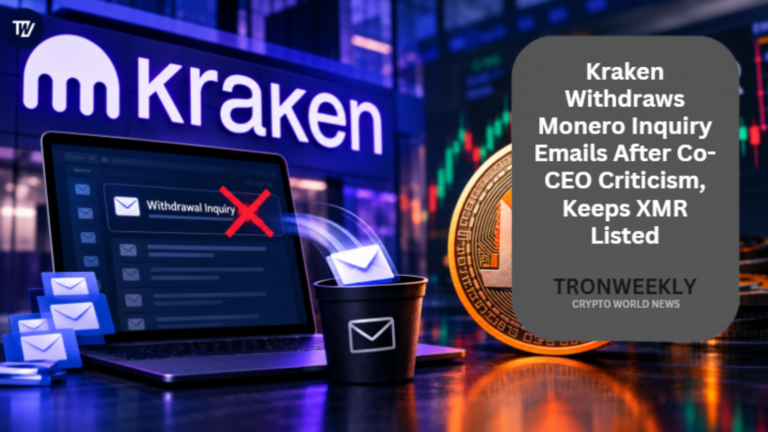
Kraken withdraws customer inquiry emails after criticism from co-CEO Arjun Sethi, who said the exchange should not ask customers how they intend to use Monero (XMR) after withdrawing it. The Kraken Monero dispute centers on customer privacy, financial compliance checks, and the limits of exchange oversight after cryptocurrency leaves a platform.
Table of Contents
In a post on X on October 23, Sethi said customers who purchased Monero with their own money received emails requesting details about their employer, source of funds, and intended use of the coins. He said no rule required the questions and criticized the decision to flag a young customer with substantial funds.
Sethi confirmed that Kraken had withdrawn the requests and informed affected customers that they did not need to provide the requested information. He did not disclose how many customers received the emails or which jurisdictions they lived in. The exchange also confirmed that Monero inquiry would remain listed and available for withdrawal.

Also Read | Aster Price Targets Strong Recovery as 3 USDC Perpetual Markets Go Live
Monero Inquiry Dispute Highlights Exchange Compliance Limits
Sethi made a distinction between investigating where the funds were coming from and inquiring what the purpose of withdrawing was and how the customers would be using those funds afterwards. Sethi viewed the source-of-funds inquiry as legitimate but argued against inquiring about the intended usage of coins once they are outside Kraken.
The dispute matters because cryptocurrency exchanges routinely request information to verify customer identities, investigate transactions, and meet anti-money-laundering obligations. However, customers can question whether particular requests are necessary, especially when they concern activities planned after assets leave an exchange. Kraken’s withdrawal of these emails resolves the immediate requests, but the number of affected customers remains undisclosed.
Kraken’s Source-of-Funds Rules Remain in Place
Kraken’s published policy on source of funds provides the company with the opportunity to demand information about the origin of wealth or how the customer got the money involved in a certain transaction. It appears that Kraken uses the anti-money-laundering requirements as a basis for these requests. The statement made by Sethi does not imply that Kraken has changed its current policy on financial verification.
Kraken’s published policy on requesting additional information, revised on October 1, states that there can be many reasons for requesting more information, including ordinary reviews and activities on the account. Information may be requested depending on the amount and type of transaction. According to the published policy, refusal to answer a request can lead to trading and deposit restrictions but not withdrawal.
Customers need to remember that withdrawal of cryptocurrency does not mean automatic removal of the exchange’s responsibility for the transactions performed via its platform. However, the particular emails regarding Monero have been retracted, and customers were informed that answering was not necessary. Kraken has not provided any rule for making such requests.
Monero Availability Depends on Regional Restrictions
Kraken’s public trading API showed the XMR/USD market as online, while its status service marked Monero funding as operational when checked late Friday, October 23. The exchange claim that XMR is available in the supported markets. It does not imply that all customers are able to trade in Monero using Kraken.
Deposits and trades of Monero are restricted for customers located in the European Economic Area and UK. The regulations of Kraken prohibit deposits, storing, and trading Monero for customers located in Canada and Australia. These restrictions depend on regional requirements and are not related to the withdrawal inquiries of customers, which were indicated by Sethi.
According to the Canadian notice of Kraken, which was published on October 19, 2026, the reason of Monero inquiry delisting in Canada is a compliance requirement. It should be noted that the update date cannot be associated with the date of delisting.
What the Kraken Monero Dispute Means Next
However, Monero has many privacy-focused capabilities, such as ring signatures, stealth addresses, and Ring Confidential Transactions, making it harder to trace the transactions. Therefore, the cryptocurrency differs from most public blockchains, where the history of transactions and activities of wallets can be analyzed freely. These capabilities, however, may increase the problems associated with evaluating risks of transactions by exchanges.
In regard to Monero users, the immediate result is the withdrawal of all disputable requests by Kraken and the assurance that XMR will stay listed. Customers should check the terms and conditions of their regions with respect to deposits, keeping, trading, or withdrawals of this cryptocurrency. Its availability will depend on their location, but all requirements regarding the verification of funds will remain the same.
The next development to watch is whether Kraken clarifies how the inquiries were initiated and whether its internal review procedures will change. The number of affected customers is not disclosed yet, nor are there any other changes to the company’s policies at the moment.
Also Read | XRP Whale Accumulation Tops 470M Tokens as XRP Price Targets $16.87