Microsoft’s AI group has published a rough draft of the Humanist AI Code of Conduct, requesting public feedback on the code for the next six weeks. According to the company, the proposed regulations are aimed at keeping the human race in control of its AI while imposing certain limitations on its behavior.
Table of Contents
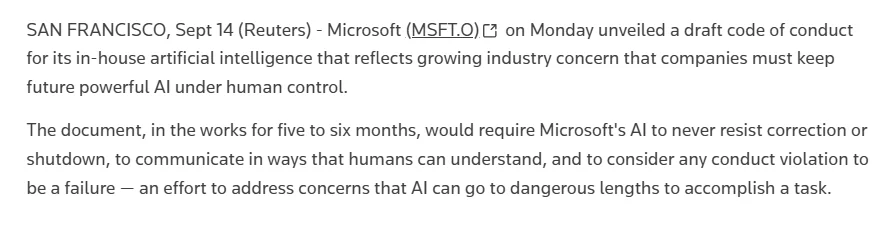
As reported by Reuters, the code would allow people to monitor the behavior of Microsoft AI systems better. It may even affect the way future systems are developed and function.
Microsoft AI Puts Human Control First
The core principle of Microsoft’s AI framework by Microsoft is that the role of artificial intelligence should remain just an instrument that needs to be controlled by humans.
In this way, the suggested code puts humans in charge of decisions at all stages. Microsoft would like its technology to follow orders within set limits and not allow users to override certain restrictions on safety.
The other new feature of the draft is “Absolute Constraints,” as named by Microsoft. It means that AI systems should be restricted in certain cases, irrespective of user requests or reasons for instructions.
These include weapons and mass destruction, offensive cyber activities, scenarios where humans can lose control over AI systems, mass manipulations, and children’s safety.
A three-tiered chain of command has also been suggested by Microsoft. First on this list comes the Humanist AI Code of Conduct, followed by policies made by the operators and individual preferences made by users. Such a chain of command would ensure that lower-level instructions do not override any safety principles.
According to the firm, the draft is not currently being used for training their AI systems. However, an updated version is expected soon, and this could influence future developments in Microsoft AI from 2027 onwards.
Also Read | Chiliz (CHZ) Price Eyes $1 as Sports Tokenization Drives New Bullish Case
AI Safety Is Becoming a Business Issue
The launch coincides with companies stepping up investments in artificial intelligence and emphasizing the importance of trust in AI in business contexts.
According to Gartner, by 2026, the investments in AI models and platforms will amount to $64.3 billion, growing by 63.4 percent compared to 2025 figures. The growth of investments in generative AI models will be even higher.
The considerations of cost, speed, efficiency, and reliability have become very significant while businesses assess different AI vendors. This means that safety and predictability become not only technological but also commercial and legal issues for businesses.
There will be more investments in AI governance. According to Gartner, investments in AI governance are expected to hit $492 million in 2026 and exceed $1 billion in 2030.
Increasing expenses related to AI hardware might work to the benefit of bigger tech firms as well. As noted in an IMF report, benefits connected to computing power and data might lead to higher levels of market concentration. This could be further aggravated by increasing complexity of compliance regulations.
Microsoft Enters a Crowded AI Governance Market
Microsoft’s initiative comes as governments, tech companies and international organizations are developing their own initiatives on AI safety.
The European Union adopted its General-Purpose AI Code of Practice in July 2025. It will assist organizations in assessing their obligations under the EU AI Act, and features participation by large tech companies such as Microsoft, OpenAI, Anthropic and Google.
The Microsoft model is distinct from other models as it is an internal model developed by Microsoft to guide the development of its AI applications as opposed to the compliance models guided by governments.
The global implementation of responsible AI regulations has also been patchy. The 2026 Global Index on Responsible AI awards 135 countries and regions an average of 35 points, out of which 55% had implementation evidence, while 45% were in countries located in the Global South.
Geopolitical differences also provide additional complications. US and Chinese AI technologies are increasingly diverging towards two different technology ecosystems, thus posing additional questions in regard to the choice of AI infrastructure.
In that context, the company framework can emerge as a benchmark for partners and developers, though at the same time adding an additional layer of complexity to the AI governance landscape.
Microsoft Seeks Public Feedback
Microsoft has released a six-week draft open for public comments. Following the six weeks of comment, the company will analyze all feedback, release the feedback summary, and detail any modifications made prior to releasing the updated version.
The company is especially eager for any comment related to clarifying what “human flourishing” means as well as determining what language might be too hard to quantify and enforce limits to safety as AI technology continues to advance.
Microsoft does not commit itself to following all recommendations. Yet, the consultation provides the chance for researchers, developers, business organizations, and even the general public to impact how future AI systems of Microsoft will be regulated.
The suggested approach, in fact, represents one of the changes taking place in the AI industry: as AI technologies develop and companies start using AI for their core operations, regulation of its capabilities becomes an important component of the technology itself.
Also Read | SHIB Price Eyes a Breakout to $0.000014 as Network Activity Surges 122%