OKXICE stock tokenization has hit a snag after nine American firms refused to have their stocks traded using OKXICE’s tokenized stock trading solution.
Table of Contents
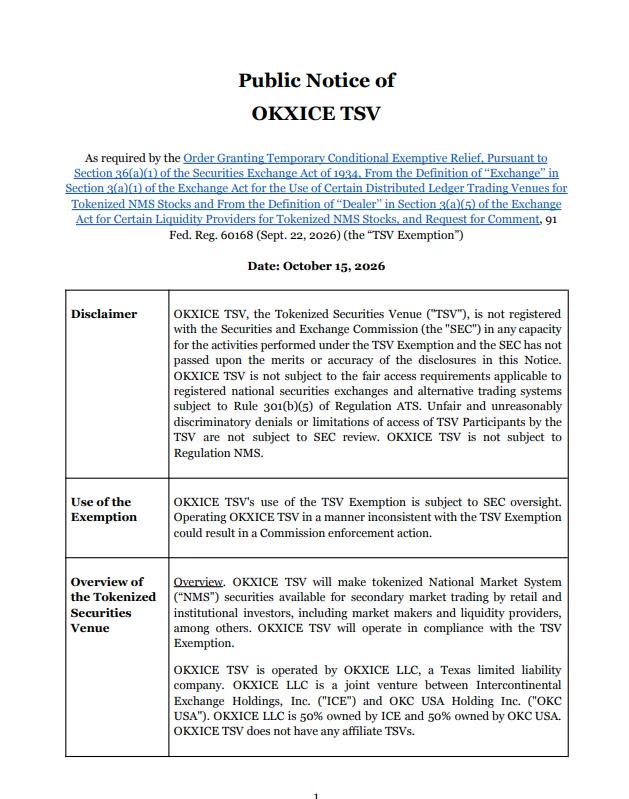
As per the OKXICE announcement released on October 15, the nine firms are Cerebras, AppLovin, Applied Digital, Rocket Lab, CoreWeave, Verizon, Applied Optoelectronics, Broadcom, and UnitedHealth. Their stocks cannot be tokenized via OKXICE TSV. This indicates that there are many obstacles in the path of blockchain-based stock markets.
This development introduces a new factor to the growing debate on tokenized securities. Despite blockchain technology facilitating transactions of stock-related products outside normal market trading hours, companies will still be against having tokenized securities of their own stocks being offered on third-party platforms.
Also Read | Sui Integrates Alibaba Cloud Into Agent Payments as SUI Price Watch $1.40
OKXICE Stock Tokenization Targets 24/7 Equity Trading
OKXICE stock tokenization falls into the framework of initiatives undertaken by OKXICE to integrate exposure to U.S. stocks in blockchain-enabled financial systems. OKXICE is to launch trading continuously using a permissioned AMM running on the Uniswap v4 protocol and implemented on XLayer.
OKXICE LLC is co-owned by Intercontinental Exchange (ICE) – the parent of the New York Stock Exchange – and OKC USA, with each company owning an equal share of 50%.
This proposed platform seeks to merge stocks and blockchain technology such that one can gain access to tokenized equity instruments even outside stock exchange hours. Nevertheless, the objections raised mean that there are going to be limitations to the types of companies the platform can accommodate.
In the case of OKXICE stock tokenization, it becomes clear that nine companies will be left out of the platform. It also brings out the impact that issuer objections may have on the variety of financial instruments.
SEC Framework Allows Companies to Object
The OKXICE stock tokenization project takes place at a time when the U.S. authorities are dealing with the issue of regulating the operation of tokenized securities. Specifically, on September 17, 2026, the US Securities and Exchange Commission published a temporary, conditional exemption concerning some tokenized securities markets.
According to the description provided in the announcement, such platforms must inform firms prior to launching tokenized securities using the firm’s shares. Firms may object to the issuance of such tokens.
This process is significant since the tokenization of stocks on a blockchain will not necessarily eliminate all the legal obligations that come with conventional stocks. It is crucial for the platforms to have regard to the regulations as well as the reactions from the issuers when designing trading services.
These objections related to OKXICE stock tokenization are an example of how this process can influence a platform’s listings even though the service has the capability to offer continuous trading of stocks.
Why OKXICE Stock Tokenization Matters for the Market
OKXICE stock tokenization is just one of many initiatives aiming to create bridges between existing financial market systems and blockchain technologies. Tokenized stocks may serve as investment tools, allowing access to company shares in a digital form, depending on their structure and properties.
Nevertheless, it should be noted that tokenized stocks may not be equal to holding the respective shares. They may differ in terms of ownership, transferability, and even protection.
The companies’ concerns bring to light a key issue in OKXICE stock tokenization: constructing a blockchain-based exchange system is but one aspect of integrating traditional stocks into the digital world. The platforms need to take into account companies’ concerns, regulations, and the nature of the instruments they want to list on their systems.
This does not mean that the development of tokenized stocks in general will be stunted. On the contrary, this brings out an important point: some companies might want more influence on the way their stocks are tokenized.
Regarding the OKXICE stock tokenization project, the subsequent step would be to determine a range of appropriate assets, taking into account the relevant regulatory environment. The response of issuers to the platform may affect the planned listing by the platform, serving as a more extensive illustration of the problem with blockchain stock markets.
As further financial platforms consider offering tokenized securities, the question of the balance between access to digital markets and issuer management will probably continue to be a significant one. The OKXICE case demonstrates that the development of tokenized stocks will depend both on technology and on regulation.
Also Read | Stablecoin Remittances Show 84% Cost Savings Over Traditional Transfers