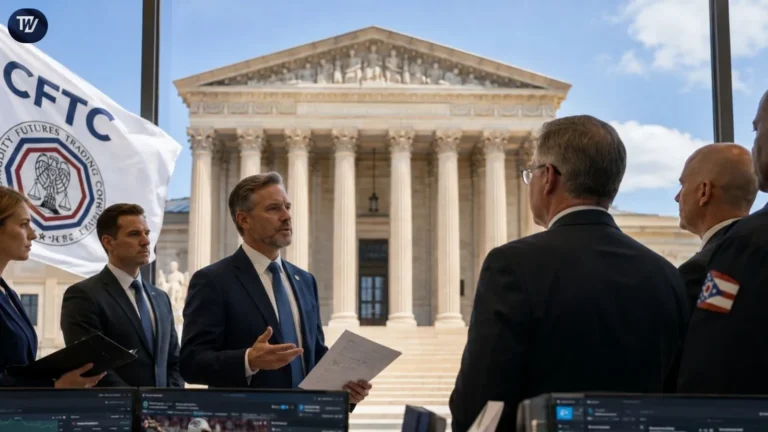
The Commodity Futures Trading Commission has joined Kalshi’s Ohio court fight, widening a legal clash over prediction markets. The agency asked a federal appeals court to stop states from treating federally regulated event contracts as illegal gambling under state law.
Ohio initiated action against Kalshi’s sports-related event contracts and filed an amicus brief in the CFTC case. State regulators had ordered the company to cease offering those products, claiming they were similar to illegal gambling.
Also Read: Crypto Prediction Markets’ Growth Accelerates As Regulators and Institutions Enter the Sector
CFTC Rejects State Gambling Claims Over Prediction Markets
Federal officials rejected that position. They said the contracts qualify as derivatives under federal law and are still subject to CFTC oversight. In its letter, the agency also accused Ohio regulators of overstepping by going after products that were federally supervised.
CFTC Chairman Michael Selig criticized the earlier Ohio ruling that went against Kalshi. He said the judge took “an improperly narrow view” of the agency’s power over prediction markets. His comments showed the regulator’s concern about state cases against event contracts.
Selig also addressed the dispute in a video posted on X. He said the CFTC would fight what he called an “onslaught of state-led litigation” against prediction market platforms. He argued that federally regulated derivative products should not be handled as state gambling operations.
The case may impact other companies in the industry. Other platforms, like Polymarket and Crypto.com, are also a part of the wider discussion on prediction markets. Sports and political event contracts have come under criticism from several states that claim those products involve betting.

CFTC Expands Legal Push Against State Regulators
The CFTC has already acted against regulators in Wisconsin, New York, Arizona, Connecticut, and Illinois. It has also backed Crypto.com in a lawsuit against the Nevada regulators earlier this year. The moves represent a broader federal effort to regain control over prediction markets.
Selig said the agency has been monitoring event-based contracts for more than 20 years. He claimed prediction markets can assist users in managing financial risks and also aid in price discovery.
But critics are still worried about insider trading, manipulation, and speculation in sports and political results.
The Sixth Circuit is now reviewing the Kalshi dispute. According to legal experts quoted in the report, it is a case that could ultimately be brought to the United States Supreme Court.
The decision could have implications for how comparable contracts are drafted, examined, and challenged nationwide in the courts. A ruling could be a key point of demarcation between federal derivatives regulation and state sports betting authority.
Also Read: Coinbase Loans Surpass $2.3 Billion After Solana Integration Launch