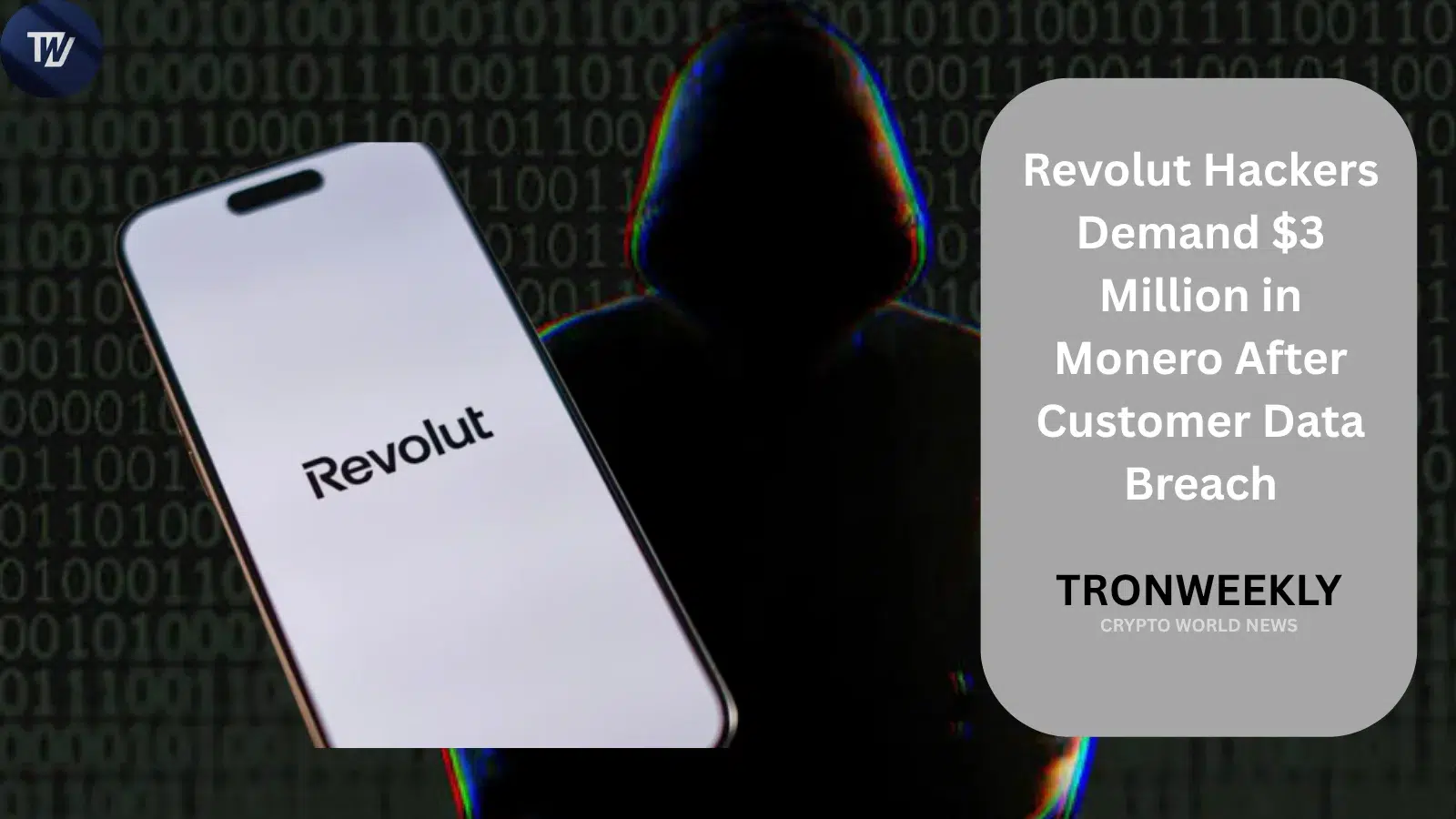
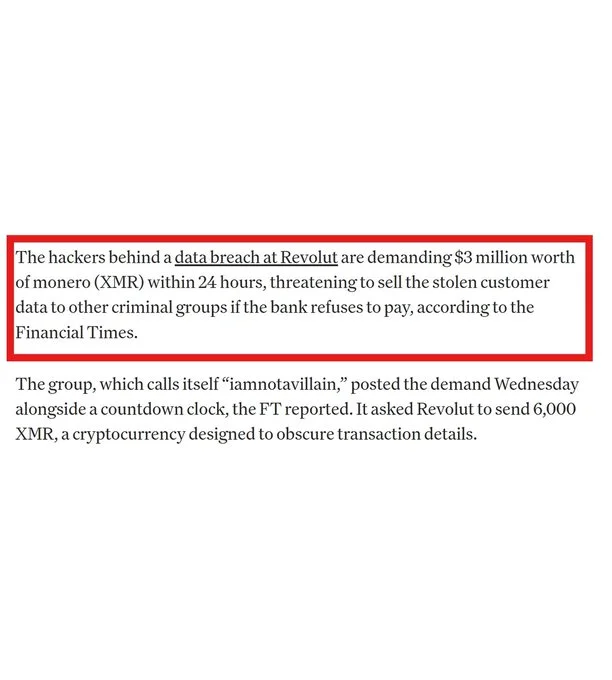
Revolut Hackers want $3 million in ransom by threatening to leak information related to customers from Revolut. The hackers, who operate under the alias Iamnotavillain, have demanded that Revolut pay a $3 million ransom in the form of Monero (XMR) within 24 hours; otherwise, the hackers will sell the stolen information to other criminals.
Table of Contents
The case was reported by the Financial Times, and there have been fears about customer data safety, cryptocurrency crimes, and the increased risk faced by financial technology firms. But in a statement made to Reuters, Revolut says it did not get any ransom request from the hackers directly.
Also Read | Binance System Upgrade Sept 22, 2026 – Safe Powerful Live
Revolut Hackers Target Customer Information
It is claimed that the assault impacted the bank accounts of at least 680 customers of Revolut. The assailants are believed to have gained the information through impersonation of Italian law enforcement and sending requests via an Italian government email account.
It is claimed that the information stolen by the criminals comprised the following data: IDs, passports, self-taken photos for verifying identities, addresses, and other transactional information.
The technique mentioned above demonstrates how hackers may attack organizations using social engineering and masquerading tactics rather than just employing technical exploits.
The Revolut hackers are said to claim that analysis of the blockchain made it possible for them to find out which clients have substantial cryptocurrency balances.
According to Revolut, there was no threat to its core systems or customer funds. The company was reported to have banned the email address that sent the message.
Why Revolut Hackers Demand Monero
The attackers demanded 6,000 XMR, which makes Monero one of the crucial aspects of the case. Monero is a digital currency that is known for its privacy features; transactions made in Monero cannot be traced as easily as transactions made on clear blockchains like Bitcoin.
This makes it popular among users who seek privacy, even from the police.
This is happening amid the mounting concerns about the capability of the authorities to trace Monero transactions under particular conditions.
According to the Norwegian police, in 2025, the investigators managed to develop an ability to trace Monero transactions in particular cases. This effort was related to the international probe into the case of abuse of children that ended up with 28 arrests in seven different countries.
Nonetheless, it has not been disclosed by any authority that the cryptography behind Monero has been compromised. It is noteworthy that when it is mentioned “certain transactions,” it does not imply that all the Monero transactions can be traced.
Monero Tracking Raises New Questions
Monero incorporates various privacy tools like ring signatures, stealth addresses, and anonymous transaction amounts. The design of these tools is intended to be such that transactions cannot be linked to particular users.
This case from Norway does not necessarily imply that Monero’s privacy features have been broken.
Research related to privacy coins can also include data beyond the blockchain. Seized gadgets, cryptocurrency accounts, operational errors, and good old-fashioned detective work might all assist the investigators in finding out who the suspect is.
This is relevant when it comes to the issue of Revolut hackers and the usage of XMR by them. While the criminals themselves find Monero useful for making private transactions, it doesn’t mean that it is untraceable for the investigators.
What Happens Next for Revolut and XMR
It is still under investigation as to what exactly led the hackers to acquire the data and whether there are other users who have been victimized by the hacking incident.
The 24-hour ransom deadline is also adding pressure on the company as Reuters reports that, according to Revolut, it has not been contacted by the alleged hackers directly.
At the same time, the adoption of Monero will help maintain the focus on this privacy-centric cryptocurrency. The case of Norway shows that authorities may discover Monero users within a specific investigation, but there is no evidence that Monero’s underlying cryptography was ever fully compromised.
From the perspective of Revolut’s users and the crypto community at large, this example proves that ensuring the safety of personal data is one of the key aspects of the protection of digital assets, and the breach of such data may cause danger even without the theft of crypto money.
Also Read | Circle’s Arc Mainnet Goes Live With 100+ Institutional Partners