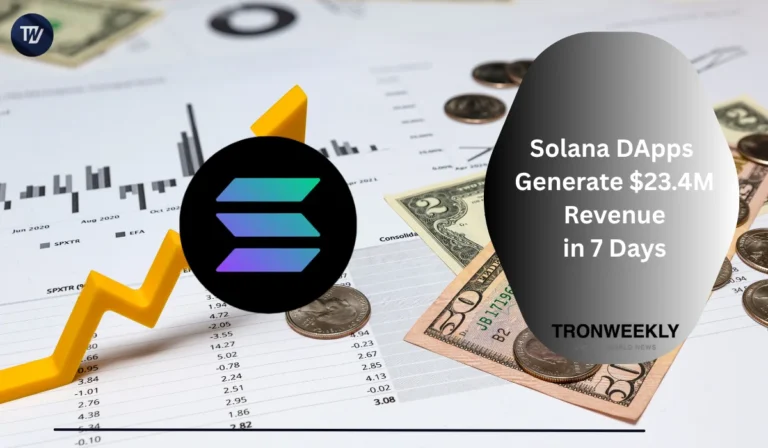
Solana’s application layer generated $23.42 million in revenue between August 10 and August 16, according to data shared by SolanaFloor. The weekly figure reached a 26-week high, with Pump.fun accounting for almost half of the total, highlighting both the strength and concentration of economic activity across the network.
Solana DApps Reach $23.4M Weekly Revenue High
Solana’s tracked applications generated $23.42 million during the seven days, according to data shown by SolanaFloor. The figure represents the highest weekly level in 26 weeks and indicates that users are continuing to generate meaningful fees across applications built on the network.
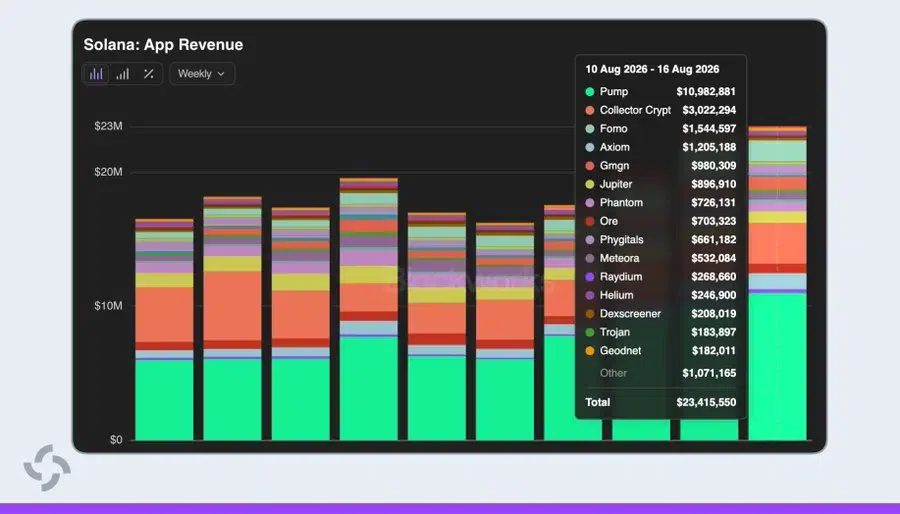
Pump.fun led the period with $10.98 million, followed by Collector Crypt at $3.02 million and Fomo at $1.54 million. Other major contributors included Axiom, GMGN, Jupiter, and Phantom, showing that revenue extends beyond a single application category.
Also Read: Solana Price Prediction: Is SOL Preparing for a Breakout Toward $276?
Pump.fun Generates $11M as Solana Revenue Concentrates
Pump.fun generated roughly 47% of the weekly total, making it the largest contributor by a substantial margin. That concentration matters because application revenue is an important indicator of ecosystem activity, but a large dependence on one application can also increase exposure to shifts in trading behavior.
Blockworks’ Solana token holder report similarly identifies application revenue as an important measure of product-market fit. It reported that SOL applications generated $292 million in revenue during Q1 2026, although the tracked dataset is not exhaustive.
SOL App Revenue Shows Demand Beyond Network Fees
The latest figure also reinforces the distinction between SOL network activity and application-level earnings. Applications capture revenue from users through trading, marketplaces, and other services, while the underlying blockchain provides the infrastructure required to execute those transactions.
Fundstrat reported that SOL applications generated approximately $4.2 billion in fees during 2025, while noting that revenue remained concentrated in memecoins and decentralized exchanges. The firm also identified emerging categories such as real-world assets as evidence of a potentially broader application economy.
SOL’s $23M Week Tests Ecosystem Revenue Durability
For SOL investors, the key question is whether elevated application revenue can remain durable. Strong app earnings can indicate sustained user demand and create a deeper economic base for the network, but they do not automatically translate into equivalent value accrual for SOL.
The composition of revenue will therefore remain important. SOL recently recorded 171.9 million non-vote transactions in a single day, showing that broader network usage is also expanding. If application activity continues across trading, DeFi, payments, and tokenized assets, the network’s revenue profile could become less dependent on speculative activity.
Also Read: Solana Price Targets $85 as Buyers Defend Key $73–$75 Support Zone
This article contains market analysis and price predictions. These are not guarantees. Crypto markets are volatile. Always DYOR. Not financial advice.