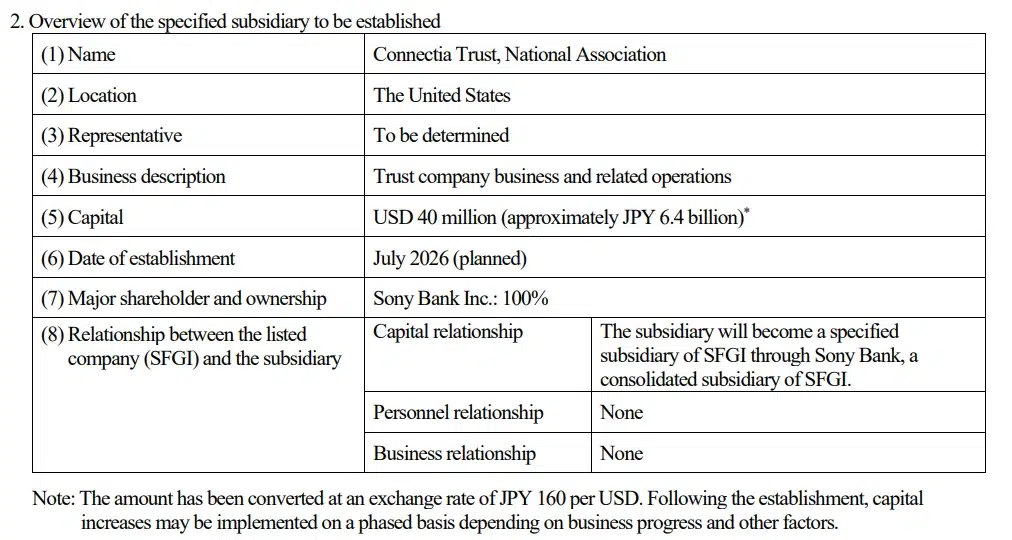
Sony Bank moved closer to a U.S. stablecoin launch after receiving conditional approval to create a national trust bank subsidiary. The unit will be called Connectia Trust. It will issue and manage a dollar-denominated stablecoin after final regulatory clearance.
According to a statement, the Japanese lender said the subsidiary will be formed in July as a wholly owned unit. It will begin with $40 million in capital. Sony Bank said the structure is meant to support Sony Financial Group’s wider digital asset plans.
Connectia Trust is expected to start operations in 2027, according to the company statement. The new entity has not yet named a representative. Its planned work remains tied to final approval from the Office of the Comptroller of the Currency.
Also Read: Kraken Extends MiCA Licence Lead With $400M Spot Liquidity
How Sony Bank Plans to Use Its Dollar Stablecoin
According to Sony Bank, no activities will be started until receiving the necessary permissions. This concerns the issuance of a stablecoin as well as trust operations. Moreover, the subsidiary has to obtain a final OCC approval before proceeding further.
It should be noted that the approval has been granted against the backdrop of plans announced at the very beginning of Sony applying for a U.S. national trust bank charter through Connectia Trust.
As previously reported, the proposed stablecoin would be pegged 1:1 to the US dollar. According to the initial reports, the stablecoin would have allowed American customers to use their stablecoins for purchasing video games, anime, subscriptions, and digital content.
Sony Bank has also explored stablecoin links in Japan. In March, Sony Bank signed an agreement with JPYC Inc. to explore stablecoin-related cooperation. The agreement was concluded concerning researching the possibility to create a yen-pegged stablecoin linked directly to the bank’s deposit rails.
What Is Delaying the CLARITY Act in Congress
The digital asset companies are seeking to receive more federal supervision in the US. BitGo has received full OCC approval to convert from a state-chartered entity into a federally chartered national trust bank.
U.S. crypto legislation is still uncertain despite pressure from the industry. The CLARITY Act did not make progress in Congress, forcing Galaxy Digital to reduce its probability of passage in 2026 to 50%. The legislation is expected to be discussed at a House hearing on July 17.
According to Galaxy’s head of research, Alex Thorn, the lack of floor time could prevent the bill’s passage. The Senate is expected to go on recess on Aug. 8 to spend four weeks out of session.
The bill was approved by the Senate Banking Committee in May but encountered opposition. Democrats and part of the banking industry raised issues about yield-bearing stablecoin products.
Why Banks Oppose Crypto Yield-Bearing Products
According to the critics, crypto companies should not offer products of that kind without bank-level compliance.
In early June, more than 200 crypto companies and related associations called on the Senate to approve the bill. The letter was released by Stand With Crypto, a crypto lobbying group.
JPMorgan CEO Jamie Dimon said in May that banks will oppose the proposed CLARITY Act. He also said that companies developing plans to release yield-bearing products should obtain a banking charter.