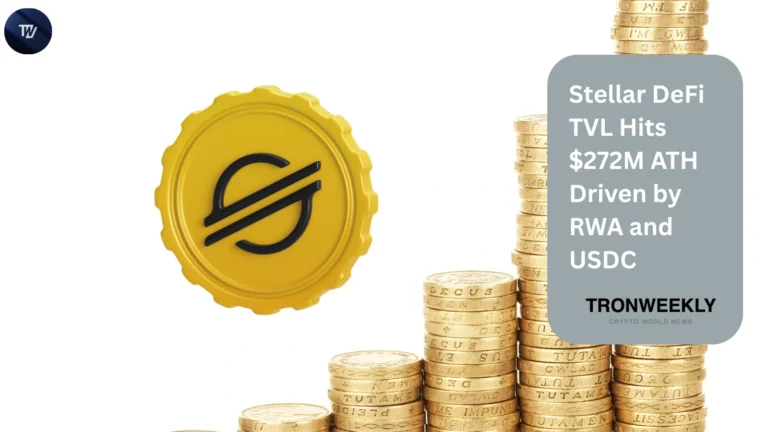
Stellar DeFi infrastructure has entered a new phase as the industry pushes higher on TVL and sees healthy tokens flow into the ecosystem. With its TVL topping $272 million which the data aggregator DeFiLlama states is one of its highest levels to date, up from $265million one week earlierit’s clear that the rise comes in response to more sustained inflows, rather than a catch-up behaviour of one-off wave.
Additional evidence of ecosystem growth in Stellar DeFi is given by an onchain volume of about $3.4 million in the 24 hours, alongside active addresses approaching 95,000 and some $934.5 million in market capitalization for stablecoins secured on the blockchain, making the network more attractive to the institutional pairings and perhaps a way away from the proposed democratization of tokenized finance.
Table of Contents
DeFi Momentum Accelerates
Further indication that Stellar has moved far beyond the scope of a payments-focused blockchain, the Stellar DeFi ecosystem now features 94,972 active addresses and approximately $3.4 million in 24-hour DEX volume. This record streak for AMMs, lending markets and yield protocols in Stellar DeFi is built on Soroban, Stellar’s smart contracts platform live on mainnet since 2024, with growing Stellar DeFi liquidity and rising Stellar DeFi developer activity closing the gap with EVM chains.
Source: Stellar
Stellar has lagged EVM chains in DeFi, but Soroban’s low-fee design and native compliance modules are closing the distance. By stablecoin cap is near $934.5 million and active addresses near 100K, a flywheel is taking hold: tokenized dollars generate DeFi activity, attracting more liquidity and developers.
For holders and liquidity providers of XLM, this TVL record shows utility beyond simple transfers: capital remains onchain and capital is put to work, not just passing through it. For exchanges and market makers, rising DEX volume signals prospects of deeper onchain markets alongside centralized liquidity.
Also Read: Stellar Price Surges Above $0.20 After BVNK Partnership and Bullish Sentiment
Stablecoins, RWAs, and Institutional Positioning
Stellar’s momentum in Stellar DeFi runs well past DeFi. It is reported the Stellar network internally has an estimated $2.82 billion worth of operational real-world assets powering Stellar DeFi, in the form of tokenized U.S. treasuries, money market funds, and institutional credit tracked by the Stellar Development Foundation and other RWA trackers.
It places Stellar among the leading chains for Stellar DeFi and the issuance of RWA, behind Ethereum, Polygon, and XRP Ledger. Stablecoins are critical to this Stellar DeFi thesis.

Stellar’s deep liquidity and commitment from Circles supporting the USDC with system-wide fiat on- and off- ramps, rapid settlement, and protocol-level compliance makes the anchor system robust. In a recent communiqu, the Stellar Foundation highlighted tokenized treasuries as increasingly preferring the network due to its enterprise-grade infrastructure.
This confluence of payment activity and registry of yield- producing instruments brings differentiation. For an ecosystem that is not predicated upon apes and yield swapping, Stellar maintains a public blockchain economy supported by regulated instruments.
For users across the spectrum of regulators, institutions, and developers looking into tokenization, the network represents a way where open source blockchain and compliance converge. Today, competition for a place in this narrative extends to other payments focused chains as well as Ethereum’s Layer-2s and Avalanche subnets targeted at institutional tokenization.
Also Read: Zebec Integrates MoneyGram and Stellar to Expand Stablecoin Payments
Market Impact and Outlook
What it means and what to expect next are complex. For developers, rising active addresses and Soroban tooling will increase the scope for new use cases. For investors, $272m TVL alongside $934.5m stablecoin cap reflect improved capital efficiency while TVL remains modest compared to large Layer-1s. For institutions, the expanding RWA footprint strengthens its case as settlement layer for tokenized cash and treasuries. Challenges remain.
Source: LinkedIn
Security audits of Soroban contracts, liquidity fragmentation, and changing guidance on tokenized securities will reveal whether growth is sustainable. Stellar must persuade MoneyGram and Franklin Templeton to embed further into DeFi if active addresses climb above 100,000 and stablecoin cap rises above $1bn, key benchmarks for recurring institutional allocations.
Mass RWA inflows and developer grants will be important catalysts for this. Until then, Stellar is on its way to developing into a full-stack ecosystem where stablecoins, real-world assets, and DeFi build on each other.
Also Read: Stellar RWA Hits $4B Milestone as Demand Surges in 2026