Uniswap is gaining a larger role in the emerging tokenized-stock market, with its v3 and v4 versions accounting for about 60.1% of the $20.9 billion in DEX trading volume recorded over the past 30 days.
Table of Contents
The activity highlights growing use of Uniswap’s infrastructure beyond conventional crypto trading and comes as UNI continues to recover from earlier September levels. With the token now trading near key technical resistance, rising protocol activity provides an important backdrop for assessing UNI’s next price move.
Uniswap Captures 60% of Tokenized-Stock DEX Volume
Uniswap’s growing presence in tokenized-stock markets shows how the decentralized exchange is being used beyond conventional crypto asset trading.
Token Terminal reported that tokenized stocks generated approximately $20.9 billion in DEX trading volume over the past 30 days. Uniswap v4 accounted for 40.7% of that activity, while v3 represented another 19.4%. Combined, the two versions captured about 60.1% of total tokenized-stock DEX volume, equivalent to roughly $12.6 billion.
That level of activity places Uniswap at the center of an expanding segment of on-chain markets. Tokenized equities allow representations of traditional stocks to trade through blockchain-based infrastructure, creating another use case for automated market makers and decentralized liquidity.
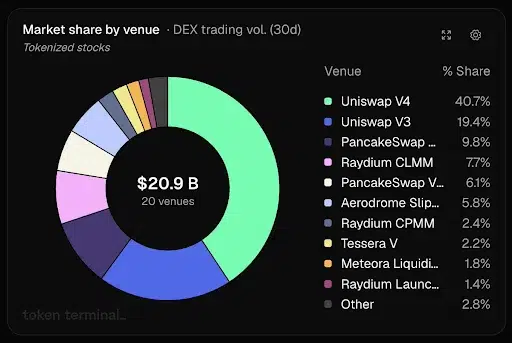
Source: Token Terminal
The development is relevant to UNI because trading activity is an important measure of Uniswap’s position within decentralized finance. It does not, however, mean that tokenized-stock volume directly translates into UNI token demand. The connection is instead through the broader activity and relevance of the Uniswap protocol.
Who does it affect?
The development matters to UNI holders and traders because the token’s market performance is occurring alongside increased activity across the Uniswap ecosystem.
UNI closed at $9.63 on September 25 after trading between $9.05 and $9.92 during the session. The token had closed at $9.15 on September 24 after reaching a September 23 high of about $10.90.
The recent move follows a much stronger advance earlier in the month. UNI closed at $6.13 on September 13 and reached $8.86 by September 18. By September 22, it had climbed to a daily close of $10.22 before experiencing a pullback.
That sequence shows that UNI has already undergone a substantial repricing. As a result, maintaining the reclaimed resistance zone becomes important for the technical structure.
For traders, the combination of a strong price recovery and elevated Uniswap activity creates two separate metrics to monitor: whether UNI can hold its breakout area and whether protocol activity remains elevated.
Also Read: UNI Price Eyes $30 as Long-Term Downtrend Breaks Amid Rising Activity
What does the UNI price structure show?
Analyst Alpha Crypto Signal says UNI has reclaimed a key horizontal resistance zone and is holding above it following the breakout. The analyst also describes the broader structure as turning bullish and expects another potential upward leg.
Current price data provides some context for that view. UNI reached a September high of approximately $10.92 on September 23 before pulling back toward $9.15 the following day. It then recovered to close at $9.63 on September 25.
The $9 area therefore becomes an important reference for the current structure. UNI has traded above that level during the latest recovery, while the September 23 high around $10.90 represents the most recent major upside test.
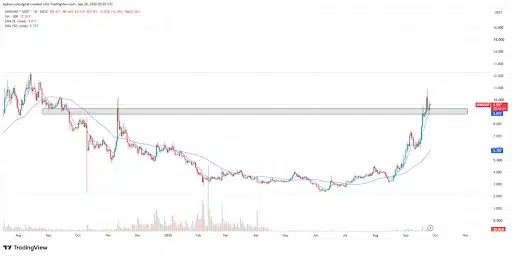
Source: Analyst Alpha Crypto Signal X post
A move through that September high would mark a fresh expansion of the current range. Conversely, a sustained move back below the reclaimed horizontal zone would weaken the breakout structure identified by Alpha Crypto Signal.
The price also remains well above the levels seen at the start of the month. UNI closed at $5.95 on September 10 and $6.36 on September 15 before accelerating higher.
What happens next?
UNI price is now approaching the recent 10.90–10.92 area after reclaiming the resistance zone identified by Alpha Crypto Signal. Holding above the breakout area would keep the analyst’s bullish structure intact, while a move through the recent high would establish a new short-term price range.
At the same time, Uniswap’s dominance in tokenized-stock DEX activity provides a broader fundamental backdrop. With v3 and v4 accounting for about 60.1% of the reported $20.9 billion in 30-day tokenized-stock DEX volume, the protocol is capturing a substantial share of trading in an emerging on-chain asset category.
The next phase for UNI will therefore depend on two developments: whether the token can sustain its reclaimed technical level and whether Uniswap’s elevated trading activity continues. A sustained breakout would strengthen the current technical structure, while a loss of the breakout zone could send UNI back into consolidation.
Also Read: UNI Price Eyes a Strong Move to $20 as Whale Accumulation Strengthens Outlook
This article contains market analysis and price predictions. These are not guarantees. Crypto markets are volatile. Always DYOR. Not financial advice.