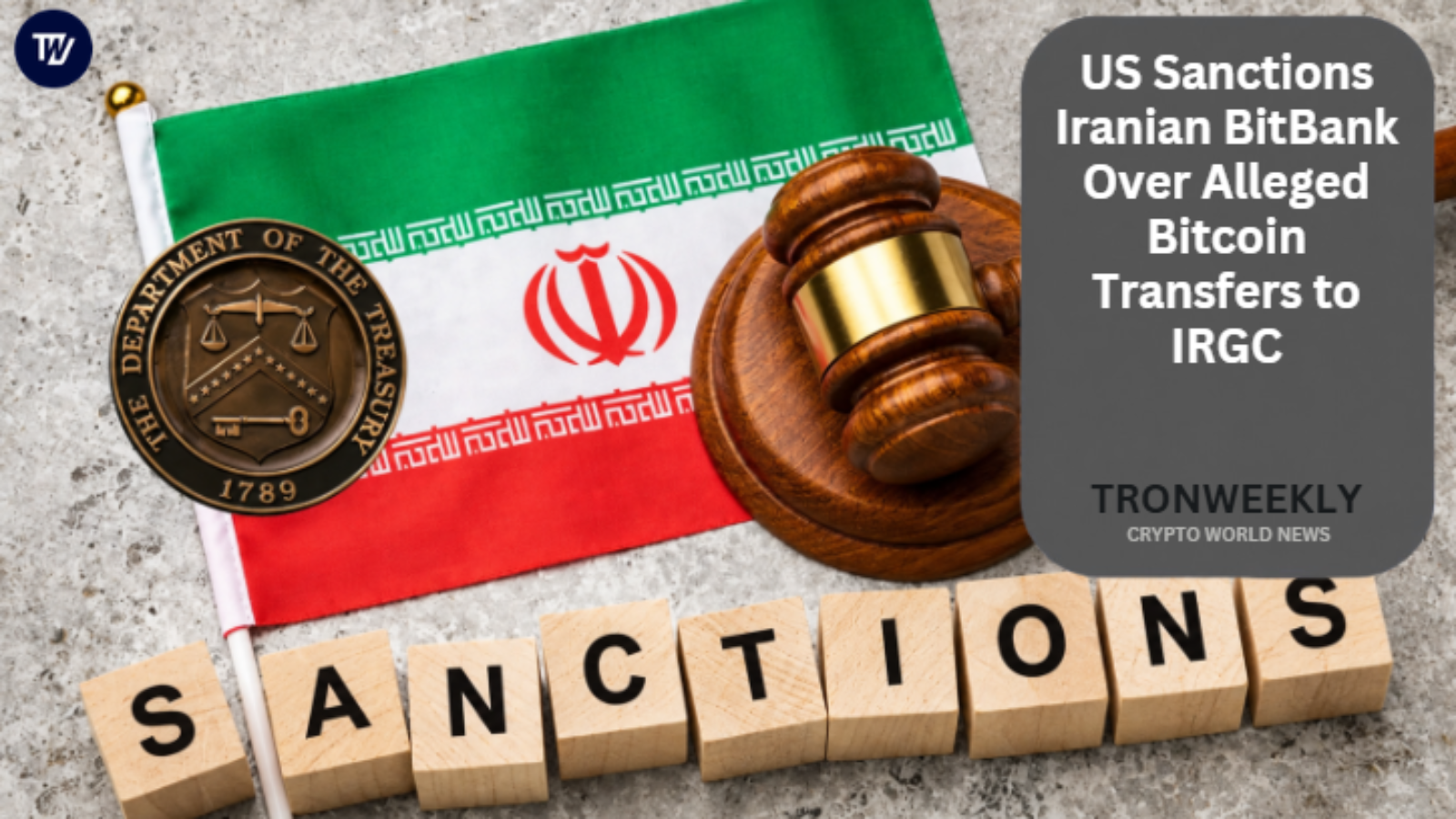
The United States has imposed US sanctions on Iranian crypto exchange BitBank, alleging that the platform processed Bitcoin payments connected to a maritime scheme around the Strait of Hormuz. The Treasury Department said BitBank helped move cryptocurrency payments linked to Iran’s Islamic Revolutionary Guard Corps (IRGC).
The Office of Foreign Assets Control (OFAC) also designated BitBank’s developer, Pishtaz Simorgh Electronic Trade Company, and three associates of Iranian financier Babak Zanjani. Treasury described the entities as important parts of Iran’s digital-asset infrastructure used for alleged US sanctions evasion.
According to Treasury, the Hormuz Safe Marine Services Authority began using BitBank in June to transfer payments it received to the Iranian regime. The agency also alleged that Zanjani used BitBank between June and July to move hundreds of millions of dollars in Bitcoin to the IRGC.
Table of Contents
Also Read | AVAX Price Eyes Recovery as Triangle Breakout Meets Institutional Momentum
BitBank Linked to Hormuz Safe Scheme
Treasury’s action builds on its earlier designation of Hormuz Safe. US authorities have alleged that the organization operates an IRGC-backed maritime insurance scheme involving vessels traveling through the Strait of Hormuz.
According to the allegation, the program required the vessel to purchase maritime insurance for its navigation, which included protection from any possible seizure by Iran. Treasury said payments connected to this activity were transferred through BitBank, linking the crypto exchange to the wider financial structure.
The Strait of Hormuz is a major transit point for international ships. Financial services related to navigation in the strait are especially important, and thus this Treasury designation does not only relate to the crypto exchange but rather focuses on the infrastructure related to maritime operations and Iranian financial systems.
As the Secretary of the Treasury Scott Bessent stated, the recent designation proves that OFAC’s jurisdiction covers cryptocurrency-based financing.
US Sanctions Target Crypto Infrastructure
The US sanctions specifically identify BitBank, Pishtaz Simorgh Electronic Trade Company and three Zanjani associates. The Treasury identified the individuals as Hossein Ali Zaker Hossein, Mohammad Mahdi Zaker Hossein and Seyed Adel Heidari.
Zanjani himself had been sanctioned earlier by OFAC based on his involvement with a set of corporations that assisted in moving Iranian funds and evading sanctions. In the new sanctioning of Zanjani, BitBank is seen to be part of a larger network under investigation by the US authorities.
There are some compliance implications from the designation by the US. Transactions involving the property of the designated entities would not normally be conducted by US persons unless authorized by OFAC.
Iran Faces Wider Crypto Restrictions
Joining other initiatives against cryptocurrency exchanges from Iran, the Bitbank was sanctioned by the US government in early September. As reported by Reuters on June 3, the Treasury had sanctioned four more Iranian crypto exchanges, including Nobitex, Wallex, Bitpin, and Ramzinex, for their involvement in helping Iran evade sanctions.
OFAC added two more Iranian crypto exchanges, Shelbit and Aban Tether, to its US sanctions list in August. All these actions are indicative of an elaborate strategy aimed at cutting off any channels of finance through which Washington thinks Iran gets access to international marketplaces.
Another important development that occurred in July saw the freezing of $130 million worth of Tether’s USDT in wallets belonging to Iran.
Bitcoin Market Faces Separate Pressure
The US sanctions arrive while Bitcoin is attempting to recover from a recent decline. According to a recent post by crypto analyst That Martini Guy, BTC declined to near $75,000 over 24 hours before bouncing back to $76,900.
According to the analyst, the $76,000-$77,000 range is critical in the short-term. He also highlighted $79,500 as a level Bitcoin would need to reclaim for its short-term structure to improve, while a loss of $75,000 could expose the market to another decline.
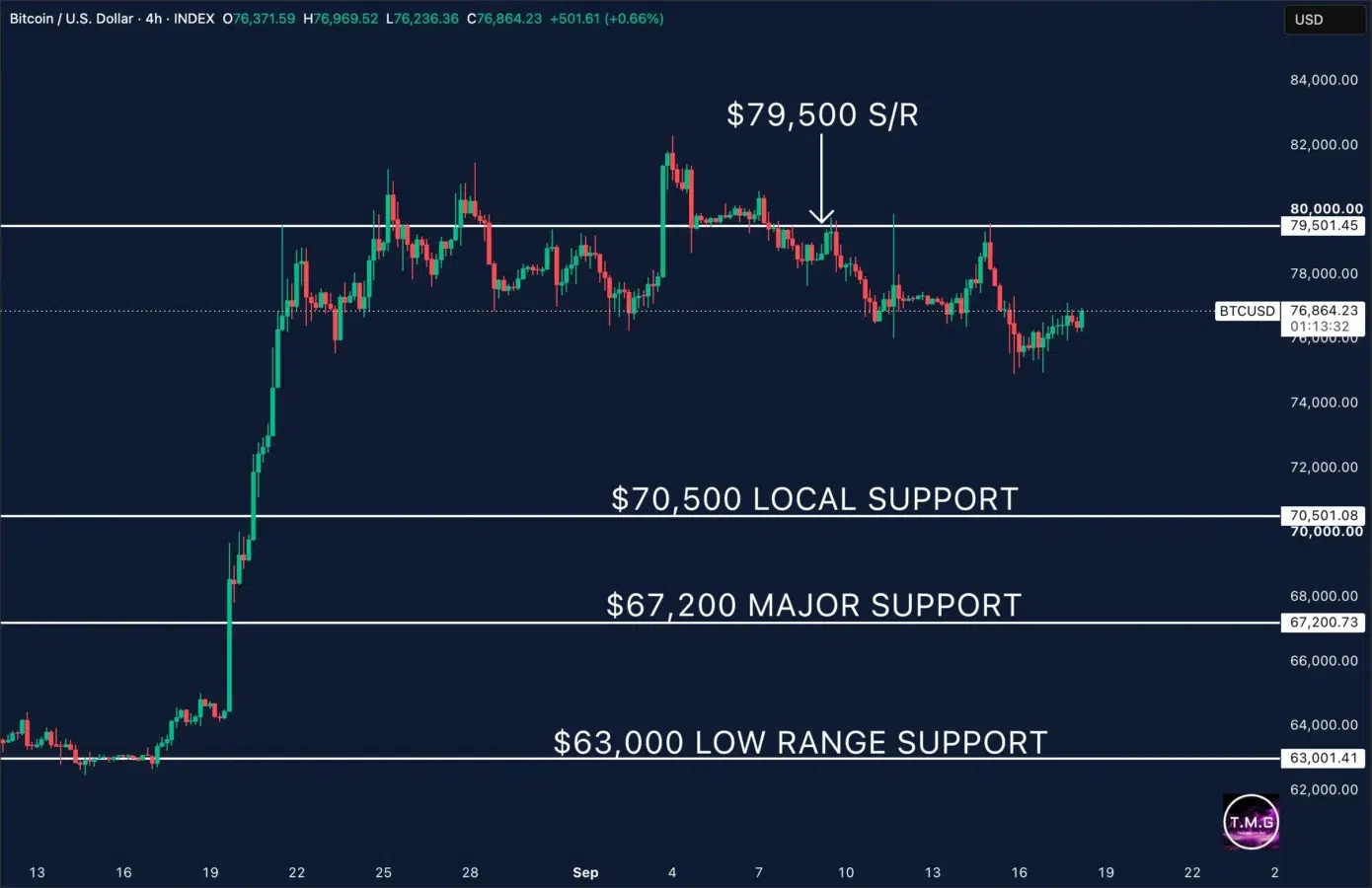
This technical view is separate from the Treasury’s BitBank action and does not establish a direct connection between the sanctions and Bitcoin’s price movement. It provides broader market context as US authorities continue increasing scrutiny of cryptocurrency infrastructure.
Iran has also taken steps to respond to tighter financial restrictions. Earlier this month, reports said Iran’s central bank eased some foreign-currency controls to encourage businesses to repatriate overseas earnings, including through cryptocurrency.
Also Read | H100 CEO Boosts Stake as Bitcoin Treasury Holds 3,506 BTC